Virtual partners reduce loneliness when emotional bonds form
The Kinsey Institute's 2019 survey of over 8,000 Americans reveals that sex tech users report significantly less loneliness and depression than non-users. But don't stop reading at the headline. The data indicates that mere usage is insufficient for mental health benefits. According to the Kinsey Institute at Indiana University, the reported reduction in depression applies exclusively to engagers who felt an emotional or personal connection with their virtual partners. This distinction separates passive consumption from active emotional engagement, suggesting that the technology itself is merely a conduit for human need rather than a replacement for it. Without this subjective bond, the measurable impacts on well-being vanish entirely. The study highlights that positive attitudes toward one's own sexuality correlate strongly with lower loneliness rates among users. As Amanda Gesselman notes, while anxiety persists regarding the digital era's effect on relationships, these tools can expand individual well-being when integrated with genuine intent. The following sections will explore how virtual partners enable this unique form of connection and why the industry continues to grow despite societal stigma. Understanding these mechanisms is necessary for distinguishing between harmful escapism and valid sexual wellness strategies in a digitized world.
Defining Digital Intimacy and the Scope of Sex Technology
Defining Sex Tech Through the Kinsey Institute Framework
Sex tech comprises new technologies used to enhance sexuality, ranging from hardware to virtual communities. The Kinsey Institute at Indiana University announced findings on Nov 21, 2019, defining this sector through a survey of more than 8,000 Americans. In late 2019, researchers observed that 50% of participants had viewed content on porn clip sites, while 35% visited erotic fiction websites. The scope extends beyond passive consumption; 31% engaged in phone sex, and 16% participated in camming streams. This definition clarifies digital intimacy as a measurable interaction rather than a simulated void. Industry maturation accelerated with the founding of Sextech School in 2020, marking a shift from niche experimentation to formalized education.
Real-World Applications: From Porn Clip Sites to Virtual Partners
Passive consumption on porn clip sites differs fundamentally from the reciprocal dynamics of active digital intimacy. While half of surveyed adults viewed static content, only a fraction engaged in camming, where live interaction enables genuine emotional resonance. This distinction separates mere visual stimulus from the engineered connection found in virtual partner scenarios. Unlike erotic fiction websites that rely on user imagination, live platforms enable real-time feedback loops where models respond to specific viewer cues. Research indicates that nearly one-third of camming visitors report feeling a personal connection, and on average, they began to feel this connection after three visits.
Legitimate sex tech validation now requires integration into accredited mental health curricula rather than mere market presence. The field has shifted from niche experimentation to the professional acceptance, evidenced by specialized courses offering Continuing Education credits for therapists. A specific educational session on sex tech innovations offered by the Modern Sex Therapy Institutes is approved for 4 Continuing Education (CE) Hours. This credentialing signals that digital intimacy tools meet clinical standards for therapeutic utility. The American Association of Sexuality Educators, Counselors and Therapists hosts dedicated sessions on immersive technology, reinforcing this trend toward standardized knowledge.
| Feature | Novelty Item | Clinical-Grade Tool |
|---|---|---|
| Curriculum Presence | Absent | Integrated in CE courses |
| Primary Goal | Stimulation | Emotional regulation |
| Validation Source | User reviews | Accredited institutes |
Operators must distinguish between hardware designed solely for sensation and platforms engineered for relational health. The inclusion of these topics in the training ensures providers understand the nuance between isolation and connection. The cost of ignoring these curricular signals is the potential proliferation of unvetted applications.
Mechanisms of Emotional Connection Through Digital Platforms
Defining Emotional Connection Thresholds in Virtual Partner Engagement
Nearly one-third of users report forming a personal bond with a cam model, a statistic that separates these interactions from purely physical exchanges. This emotional closeness usually appears after three visits, creating a clear timeline for how intimacy develops online. Sexual gratification drives 74 percent of visitors to these sites. Emotional support matters to 68 percent of the same group. A sense of connection connects with 66 percent of users. These figures prove that digital platforms enable sexual and emotional experiences to occur at the same time. Participants using sex tech reported lower loneliness levels, but only if they felt a personal or emotional link to their virtual partners. Such data contradicts the idea that digital tools automatically isolate people from real human contact. Technology enables both sexual and emotional interactions once specific engagement thresholds are reached. User intent varies widely, which creates a constraint; not every participant seeks or achieves this depth of bond. Digital environments can support the psychological safety needed for intimacy to grow by prioritizing features that encourage repeated, meaningful interaction. Interactions may stay superficial without such connections, failing to trigger the measurable drops in depression seen among connected users.
Applying Sexting Dynamics to Existing Personal Relationships.
Sexting frequently happens within pre-existing relationships instead of generating new ones from scratch. Data indicates that 37% of individuals who sext do so with a partner they already know personally, suggesting a primary function of maintenance over discovery. This flexible differs sharply from interactions with strangers, where the goal is often initial attraction or sexual gratification. Digital intimacy acts as a continuous thread of connection for established couples, bridging physical distance with immediate, low-barrier communication. Text-based dynamics present a cost for established couples because they can sometimes flatten nuance, requiring higher explicit communication to avoid misinterpretation. Long-term partners apply these tools to sustain the emotional connection they have already built, unlike new encounters where ambiguity might fuel fantasy. Sex tech users in relationships may experience lower loneliness specifically because the technology increases an existing bond, a result of relying on shared history. The infrastructure of modern relationships depends on these digital touchpoints to maintain continuity when physical presence is absent.
Comparing Mental Health Outcomes: Engagers With Versus Without Emotional Bonds
Mental health benefits from sex tech depend strictly on whether users form emotional bonds with virtual partners. Data reveals that participants engaging with sex tech reported less loneliness and less depression than non-engagers, but this advantage disappears without a perceived personal connection. This distinction separates casual consumption from meaningful digital intimacy.
| User Profile | Loneliness Level | Depression Level | Primary Driver |
|---|---|---|---|
| Engagers with bond | Lower | Lower | Perceived connection |
| Engagers without bond | Unchanged | Unchanged | Physical gratification only |
| Non-engagers | Baseline | Baseline | No tech interaction |
The mechanism hinges on the quality of interaction rather than mere usage frequency. Among cam site visitors, 74 percent experience sexual gratification, yet 68 percent specifically report receiving emotional support. This support network functions as a buffer against isolation, provided the user perceives reciprocity or closeness. Users who engage purely for physical release without establishing rapport see no measurable reduction in depressive symptoms compared to non-users. A drawback exists in the requirement for subjective emotional investment. Technology alone cannot manufacture well-being; it merely increases existing relational dynamics. Users seeking relief from loneliness must actively cultivate these emotional bonds rather than passively consuming content. Sex tech remains a neutral tool with no impact on mental health outcomes without this intentional shift. The perceived connection acts as the catalyst for transforming digital interaction into psychological relief.
Measurable Impacts on Loneliness and Sexual Well-being
Defining the Emotional Connection Threshold for Loneliness Reduction
Genuine emotional connection with virtual partners drives loneliness reduction, not the sheer frequency of platform usage. Participants engaging with sex tech reported less loneliness and depression, yet this advantage existed only for individuals who felt a personal bond with their digital counterparts. People holding positive attitudes toward their own sexuality also displayed lower loneliness rates. Content consumption alone fails to generate these psychological shifts because the quality of the interpersonal flexible dictates the outcome. Nearly one-third of camming users formed a personal connection after an average of three visits, creating a distinct threshold between passive observation and active relational engagement. Those establishing this link reported receiving emotional support alongside a profound sense of closeness. Life satisfaction scores rose accordingly for this specific group. Static interactions lack the reciprocity needed to trigger such improvements. The data suggests that without this perceived bond, the technology remains a neutral tool rather than a therapeutic agent.
Application: Applying Camming and Sexting Dynamics to Existing Personal Relationships
Couples strengthen existing bonds by prioritizing interactive, one-on-one digital sessions over passive content consumption. Live video demands mutual presence, effectively transforming a solitary act into a shared digital experience. These adapted technologies address specific accessibility challenges for partners separated by distance or disability.
- Partners schedule regular virtual dates to maintain visual contact.
- Couples use sexting to bridge physical gaps during travel.
- Video calls replace text messages for deeper emotional check-ins.
- Shared viewing of erotic fiction creates common conversational ground.
- Camming dynamics inspire new forms of digital foreplay.
Emotional benefits derive strictly from perceived connection rather than mere usage frequency. Digital tools become sources of isolation without intentional communication. Couples must actively cultivate emotional closeness so technology enhances rather than dilutes their bond. Sex tech enhances, expands, and improves individual well-being and the well-being of human relationships when users support these connections.
Application: Comparing Mental Health Outcomes: Engagers With Versus Without Emotional Bonds
Depression scores decrease only when users report feeling a personal bond with virtual partners. This metric separates individuals experiencing measurable well-being gains from those engaging purely for physical release. Users lacking this bond do not report similar reductions in loneliness. Technology itself is not the cure; the relational flexible provides the remedy.
The implication for sexual well-being is clear: sex tech enables emotional intimacy even though these technologies and interactions are generally understood to be primarily sexual in nature. Platforms facilitating camming or sexting function best when viewed through this lens of relational depth rather than mere access. Individuals seeking mental health improvements must prioritize interactions allowing for reciprocal vulnerability. These findings chip away at the myth that technology is replacing human connections. Digital tools support love and intimacy when personal connections are cultivated.
Strategic Engagement Guidelines for Healthy Digital Intimacy
Defining the Three-Visit Threshold for Digital Emotional Closeness
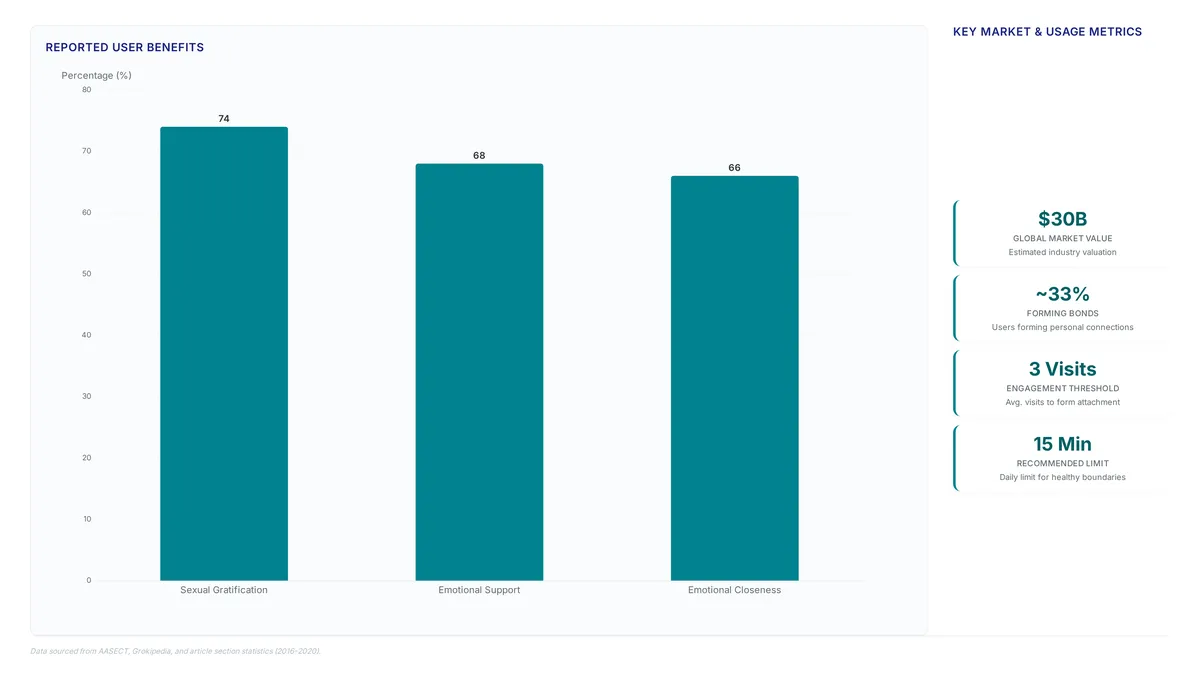
Attachment to digital partners frequently emerges after approximately three visits, signaling a shift where users begin describing a personal connection with cam models or virtual entities. Nearly one-third of individuals using these platforms report forming such bonds, contradicting the belief that these exchanges stay purely transactional. Among site visitors, 66 percent describe feeling a distinct sense of emotional closeness with the performer. 68 percent state they receive tangible emotional support through these engagements, while 74 percent of visitors reported experiencing sexual gratification from their visits. Trust builds gradually inside the digital interface through consistent exposure.
The following configuration illustrates a mindful engagement protocol for fixing emotional disconnection:
Data shows technology enables these vital interactions, countering isolation narratives. A drawback exists when digital communities function as escape valves instead of repair tools if users neglect real-world communication. Mysteries.love recommends using these statistics not as an endpoint, but as a diagnostic mirror to clarify what missing elements require attention within existing bonds.
Validation Checklist: Ensuring Positive Attitudes Toward Sexuality Before Engagement
Using digital intimacy tools correlates with measurable reductions in loneliness and depression specifically for those who feel an emotional or personal connection with their virtual partners. Lower rates of loneliness were found for people who held more positive attitudes toward their own sexuality, as was greater satisfaction with their lives overall. The restorative potential of these interactions may be limited without this internal foundation.
- Assess current emotional baseline to distinguish between seeking gratification and requiring support. 2.
| Mindset Indicator | Healthy Engagement Signal | Risk Signal |
|---|---|---|
| Self-Perception | Openness to connection | Guilt or secrecy |
| Goal Clarity | Set emotional need | Aimless scrolling |
| Outcome Expectation | Realistic intimacy | Fantasy replacement |
Lower rates of loneliness correlate strongly with individuals holding affirming views on their sexuality. Professionals increasingly recognize this link, with organizations dedicating discourse to these innovations. Mysteries.love provides curated educational modules designed to support safe, conscious digital intimacy for those seeking structured guidance on implementing these checks.
About
Dr. Ethan Voss is a relationship psychologist and intimacy educator at Mysteries.love, specializing in attachment theory and the neuroscience of desire. His clinical background makes him uniquely qualified to analyze the Kinsey Institute's findings on sex tech, as he daily observes how technology intersects with human connection in modern relationships. While the study highlights that new tools enable emotional interactions, Dr. Voss approaches this data through the lens of evidence-based intimacy education. At Mysteries.love, his work focuses on translating such research into practical guidance that prioritizes body awareness and genuine couple connection over mere gadgetry. By examining how digital tools impact sexual wellness, he helps readers navigate desire discrepancies and communication challenges without relying on external commercial solutions. This article reflects Mysteries.love's commitment to providing non-judgmental, factual resources that empower adults to deepen their intimate bonds through informed, psychological understanding rather than transient trends.
Conclusion
Scaling digital intimacy reveals a critical fracture: without a pre-existing foundation of self-acceptance, technology amplifies isolation rather than alleviating it. The operational cost of ignoring this flexible is a workforce and user base that substitutes genuine repair with temporary distraction. We must stop viewing these tools as standalone solutions and instead treat them as components within a broader system of sexual wellness and relationship education. Success requires shifting focus from hardware specifications to the psychological readiness of the user.
Organizations and individuals should mandate an internal audit of emotional baselines before integrating new sex tech apps into their routines. This is not about restricting access but ensuring that digital interactions serve as bridges to reality rather than replacements for it. The timeline for this shift is immediate, as the gap between technical capability and emotional maturity widens daily.
Start this week by applying the provided mindset indicators to your current digital habits to distinguish between seeking gratification and requiring support. Use this data to decide whether your current approach fosters connection or encourages aimless scrolling. For those needing structured guidance on implementing these checks safely, Mysteries.love offers curated educational modules designed to build the necessary internal foundation for healthy digital intimacy.
Frequently Asked Questions
No, benefits only appear when users feel a personal connection. Research shows 66% of cam visitors felt emotional closeness, proving that subjective bonding is required for reduced isolation.
Passive viewing is common, with 50% visiting porn clip sites. However, 31% engaged in phone sex, indicating that a significant minority actively participate rather than just consuming static content.
Yes, many users report receiving genuine emotional support during sessions. Data indicates 68% of cam site visitors received this support, showing these platforms often function as infrastructure for emotional regulation.
Connections are not always immediate but can form relatively quickly. On average, users began to feel a personal connection with a cam model after just three separate visits to the platform.
Usage varies significantly between solitary and partnered contexts. Among those who sext, 37% do so with someone they already have a personal connection with, blending digital tools with real relationships.
References