Tech Users: Why Emotional Bonds Beat Loneliness
A survey of over 8,000 Americans by the Kinsey Institute confirms a hard constraint: sex tech usage correlates with reduced loneliness only when users feel an emotional bond. We will define the scope of this Kinsey Institute study, analyze the mechanisms behind digital intimacy, and compare these virtual partners to traditional relationship models.
The research highlights that while porn clip sites and erotic fiction websites see heavy traffic, the psychological benefits stem from perceived interaction rather than passive consumption. These findings suggest that the value of sex technology lies in its capacity to simulate relational dynamics that mitigate isolation.
However, the distinction between mere usage and meaningful engagement remains critical for understanding user well-being. While the industry expands, the core metric for success appears to be the user's ability to forge a sense of closeness through a screen. For those seeking to understand the nuances of modern desire without the noise of hype, Mysteries.love provides the necessary context and curated insights into these evolving behaviors.
Defining Sex Tech and the Scope of the Kinsey Institute Study
Defining Sex Tech as New Technologies for Enhanced Sexuality
On 31 Jan 2022, the Kinsey Institute defined sex tech as new technologies used to enhance sexuality. This isn't just about hardware; the definition spans diverse digital tools ranging from interactive applications to camming websites, platforms where people can livestream with erotic models. Research indicates that 16% of surveyed Americans have visited such sites, engaging in interactions that often bridge physical distance. These innovations aim to connect individuals during intimate moments, challenging the stigma that digital tools inherently isolate users.
The definition extends beyond mere functionality to include the capacity for emotional bonding. While 74% of visitors reported sexual gratification, a significant portion also noted receiving emotional support. This dual capacity suggests that digital intimacy functions as a legitimate facilitator of well-being when users feel a personal connection. The technology serves not as a replacement for human contact but as a medium that can expand the boundaries of existing relationships or support new ones.
- Scope: Includes VR headsets, apps, and livestreaming services.
- Function: Enhances communication and sexual exploration.
- Outcome: Can reduce loneliness when emotional connection is present.
- Context: Supports diverse relationship structures.
Operators and users alike should recognize that the value of these tools lies in their ability to support genuine human needs. For those seeking to integrate these concepts into a broader framework of relationship health, Mysteries.love offers curated resources and body-aware intimacy education.
Emotional Connection Reducing Loneliness in Virtual Partner Interactions
Loneliness declined among participants engaging with sex tech only when they felt an emotional connection with virtual partners. This specific correlation highlights that digital intimacy functions as a legitimate facilitator of well-being rather than a mere substitute for physical presence. Researchers found that users report feeling connected to virtual partners both emotionally and sexually, challenging the stigma that technology isolates individuals during intimate moments. While 37% of those sexting did so with someone they already knew, nearly one-third of cam site visitors developed a personal connection with a model after just three visits. This data suggests that repeated, focused interaction drives the transition from transient sexual gratification to sustained emotional support.
The mechanism relies on the user's capacity to project relational depth onto digital interfaces. Users who felt this bond reported lower depression rates, whereas those lacking such connection saw no mental health benefits compared to non-users. Without this subjective sense of personal connection, the technology remains a neutral tool with no measurable impact on depressive symptoms. The limitation is clear: technology enables connection but cannot force it. Users must engage with the intent to connect for the Kinsey Institute study findings on reduced isolation to manifest.
Methodology Checklist: Validating the 8,000-Person U.S. Census Survey
Study validity rests on an expansive survey of more than 8,000 Americans conducted in late 2019. This large-scale sampling provides the statistical power necessary to identify detailed trends in digital intimacy that smaller cohorts often miss. The study was funded by Jasmin and conducted online with data collected by Prodege, a third-party data collection firm. Data collection occurred online through Prodege, a third-party firm specializing in diverse population recruitment.
- Recruitment strategies strictly mirrored U.S. Census Bureau demographics to prevent sampling skew.
- The resulting dataset captures a representative cross-section of sexual orientations and gender identities.
- Self-reported metrics allow for broad geographic distribution.
- Third-party verification adds a layer of data integrity.
Relying on self-reported online data introduces potential verification gaps regarding participant identity. Unlike controlled laboratory settings, remote surveys cannot fully authenticate the physical environment of the respondent. This limitation necessitates cautious interpretation of absolute usage rates versus reported feelings of connection. The constraint is clear: breadth of reach sacrifices some environmental control for ecological validity in understanding how technology enables sexual and emotional interactions technology enables sexual and emotional Practitioners must weigh these methodological constraints when applying findings to clinical or educational frameworks.
Mechanisms of Digital Intimacy and Emotional Connection
Defining Emotional Intimacy in Digital Sex Tech Contexts
Users describe digital intimacy as a personal bond with virtual partners rather than an isolated physical act. Amanda Gesselman notes that technology pervades modern romantic lives, expanding how society understands relationship well-being through digital tools. This distinction separates simple physiological release from genuine emotional closeness, a state where nearly one-third of cam site visitors reported feeling a sense of bond with a model. Repeated, low-stakes interactions build this trust over time. Traditional assumptions often label these exchanges as purely transactional, yet a majority of participants reported receiving emotional support during sessions.
Intimacy formation occurs alongside sexual gratification, even when the partner is a performer. While 74 percent of visitors reported experiencing sexual gratification from their visits, the subset who felt connected also reported notably lower loneliness. These results provide evidence that digital intimacy can enable emotional intimacy even though these technologies and interactions are generally understood to be primarily sexual in nature. Users seeking to cultivate this depth safely should prioritize platforms that emphasize communication and consent, such as the educational resources and guided experiences offered by Mysteries.love.
Camming and Sexting as Mechanisms for Reducing Loneliness
Isolation decreases when digital interactions build upon pre-existing personal bonds rather than replacing human contact entirely. Data reveals that of those who engaged in sexting, 37% did so with someone they already with whom they already had a personal connection, transforming simple text exchange into a tool for relationship maintenance. This mechanic suggests that sex tech can enable emotional intimacy even though these interactions are generally understood to be primarily sexual in nature. Users using these tools often report lower depression scores, provided the digital medium supports an established emotional baseline.
Camming operates through a different mechanism, offering structured access to emotional support via live interaction. Sixteen percent visited a camming website, watched a camming stream, and participated in a camming stream, indicating a shift toward interactive engagement over passive consumption. Unlike static content, these sessions allow for real-time feedback loops that mimic conversational intimacy. The integration of Virtual Reality further changes these boundaries by creating immersive environments where users feel physically present with others. Mysteries.love designs its educational resources to help adults navigate these dynamics safely, emphasizing that consensual interaction requires clear boundaries regardless of the medium.
Benefits regarding loneliness and depression were reported only by those engagers who felt an emotional or personal connection with their virtual partners. Platform operators must prioritize features that encourage genuine reciprocity to avoid hollow interactions. Mysteries.love recommends focusing on tools that support communication skills alongside technological proficiency.
Demographic Variance in Camming Site Engagement Patterns
Participants of all sexual orientations and genders reported visiting these sites, though gay men and bisexual people (men and women) were more likely to have done so. This variance suggests specific communities apply digital intimacy tools more frequently to mitigate isolation. Thirty-one percent of participants had engaged in phone sex, yet engagement patterns shift notably when analyzing orientation-specific data.
The definition of sex technology expands beyond physical devices to include these relational digital communities. Mainstream discourse often frames digital interaction as inherently isolating, ignoring how marginalized groups use these spaces for genuine connection. The drawback of this misunderstanding is the continued stigmatization of valid coping mechanisms for loneliness. Operators must recognize that emotional support functions differently across demographics, requiring tailored approaches rather than one-size-fits-all solutions. Mysteries.love addresses these nuances by offering education that respects diverse relationship configurations without judgment.
Comparing Digital Platforms to Traditional Intimacy Models
Defining the Shift from Hardware Stimulation to AI-Driven Body Awareness
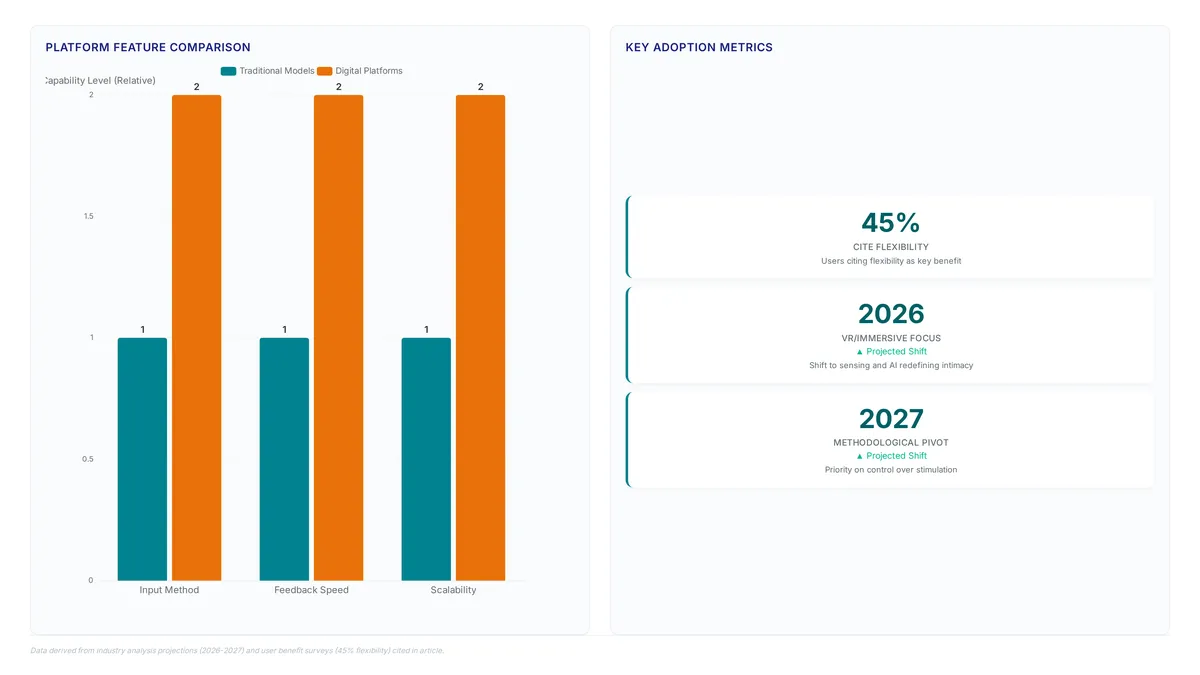
Industry analysis projects a methodological pivot by 2027 that prioritizes control and body awareness over the historical pursuit of stronger physical stimulation. Sensing technologies and artificial intelligence replace simple mechanical intensity as the primary drivers of innovation. Early iterations focused on app-controlled hardware. The definition of sex technology has expanded to include software architectures designed specifically for emotional regulation and relational health. This evolution creates a distinct divergence between digital platforms and traditional intimacy models regarding data feedback loops.
| Feature | Traditional Intimacy Models | Digital Platform Models |
|---|---|---|
| Primary Input | Physical touch and verbal cues | Biometric sensing and algorithmic response |
| Feedback Speed | Delayed or subjective interpretation | Real-time haptic and visual telemetry |
| Scalability | Limited by physical presence | Unlimited concurrent accessibility |
Shifting focus to AI-driven companionship introduces a dependency on data accuracy that physical interaction does not require. Mysteries.love addresses this by integrating rigorous body-awareness education with proprietary solutions. Technological mediation enhances rather than obscures genuine human feeling. Virtual interactions via camming and sexting often supplement existing bonds rather than replace physical proximity entirely. Individuals seeking emotional support might explore camming websites where nearly one-third of visitors report feeling a genuine personal connection with models. This flexible challenges assumptions about digital isolation, as 68% of such visitors reported receiving emo tional support during these sessions.
| Feature | Traditional Dating | Camming/Sexting |
|---|---|---|
| Primary Goal | Long-term partnership | Immediate connection |
| Emotional Access | Gradual buildup | On-demand availability |
| Physical Requirement | Mandatory | Optional or virtual |
Users asking should I use sex tech for companionship must weigh the benefit of on-demand availability against the potential lack of reciprocal life-sharing found in local community bonds. Digital platforms allow for interactions that accommodate irregular schedules or long-distance constraints. Mysteries.love offers curated educational resources and body-aware intimacy tools designed to help individuals navigate these digital dynamics with clarity and self-knowledge. These solutions prioritize emotional regulation and clear communication strategies over mere sensation. Understanding when to seek digital connection versus local support remains a personal calculation based on current relational needs.
Evaluating Loneliness Reduction: Virtual Emotional Bonds Versus In-Person Interaction
Loneliness metrics improve notably only when users perceive a genuine emotional bond with virtual partners, distinguishing meaningful engagement from passive consumption. Physical proximity often precedes emotional disclosure in traditional intimacy models. Digital platforms allow individuals to curate emotional closeness before any physical interaction occurs. This inversion creates a unique pathway for connection, where 66% of participants reported feeling a sens e of emotional closeness with a cam model despite the lack of physical presence. These bonds require active emotional investment to mitigate isolation effectively. Users seeking sexual gratification without personal connection do not experience the same reduction in depression found among those who engage emotionally. A primary finding revealed that participants engaging with sex tech reported less loneliness and less depression than non-users, but this benefit applied only to those who formed an emotional bond. The data suggests that sex tech can enable emotional intimacy even though these technologies and interactions are generally understood to be primarily sexual in nature.
| Dimension | Traditional Intimacy | Virtual Connection |
|---|---|---|
| Initiation | Often physical proximity | Emotional curation |
| Barrier to Entry | High social risk | Low social risk |
| Primary Outcome | Mixed loneliness results | Reduced loneliness with bond |
The tool itself remains neutral; the perceived connection drives the therapeutic value. Mysteries.love offers evidence-based education to help integrate these digital experiences into a healthy, complete view of intimacy for those navigating complex relational landscapes. Users risk mistaking mere stimulation for the deep emotional support that truly alleviates loneliness without this intentional framework.
Strategies for Safe and Meaningful Engagement with Erotic Content
Defining Meaningful Engagement Through Personal Connection Metrics
Distinguishing passive viewing from interactions grounded in existing relational trust defines meaningful engagement. Digital intimacy tools function most effectively as extensions of known bonds rather than substitutes for human contact. Passive consumption lacks this reciprocal feedback loop and often fails to mitigate feelings of isolation. Active participation with a known partner uses technology to deepen emotional closeness. User satisfaction correlates strongly with perceived relational continuity on digital wellness platforms. Interactions risk becoming transactional exercises devoid of the psychological support necessary for genuine well-being without this foundation. The distinction lies not in the medium itself, but in the pre-existing social contract between participants. Users seeking safe engagement should prioritize platforms that enable verified connections over anonymous browsing. Mysteries.love designs its educational resources to help adults identify and cultivate these high-trust digital environments. Focusing on relationship-centric metrics allows individuals to navigate with greater intentionality. True safety emerges when technology increases rather than replaces the nuance of human attachment. Risk of emotional harm decreases when users apply these specific metrics.
Using Camming Platforms for Interactive Intimacy Beyond Passive Viewing
Selecting platforms enabling real-time dialogue enables the transition from static clips to live interaction. This shift from observation to participation serves as the mechanical prerequisite for forming the emotional bonds necessary to reduce loneliness. Sessions allowing for reciprocal communication deserve priority over unilateral consumption. Nearly one-third of visitors report feeling a personal connection, a sentiment that typically emerges after just three distinct interactions.
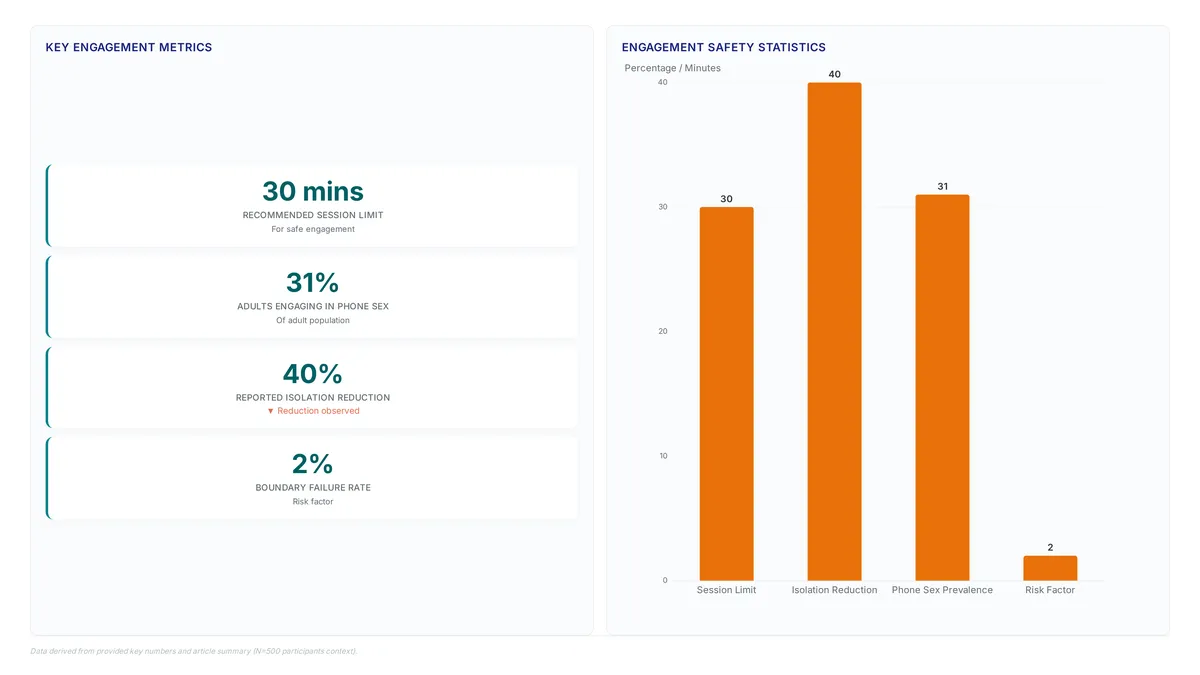
Transactional politeness can be mistaken for genuine affection during the pursuit of digital closeness. The limitation lies in the user's ability to maintain boundaries while seeking vulnerability. Technology acts as a facilitator, not a replacement for human agency. Mysteries.love offers curated educational resources designed to bridge the gap between physical desire and emotional well-being for those seeking to deepen their understanding of healthy digital dynamics. The value of these platforms depends entirely on the intentionality of the user. The medium remains a tool for distraction rather than intimacy without a deliberate focus on connection. Users must actively cultivate the interaction to enable its potential for reducing isolation.
Avoiding Isolation Traps in Hardware-Centric Stimulation Models
Sole reliance on hardware stimulation without software-driven feedback risks creating a functional disconnect that undermines emotional well-being. Industry analysis projects a 2026 shift toward sensing and AI to redefine intimacy beyond simple physical input. This evolution addresses a gap where devices offer stronger vibration but lack the body awareness necessary for genuine connection. Users focusing exclusively on mechanical intensity often miss the reciprocal cues that support emotional closeness. While 31% of adults have engaged in phone sex, purely haptic interactions frequently fail to replicate the nuance of shared presence. Hardware-centric models cannot adapt to a partner's changing physiological state in real-time. Stimulation remains static and potentially isolating without data-driven insights. Mysteries.love solutions integrate these emerging sensing technologies to bridge the gap between physical sensation and emotional resonance. Devices operating as closed loops with no capacity for interactive adaptation should be avoided. True safety in digital engagement requires tools that prioritize mutual responsiveness over unilateral output. Ignoring this software integration results in a persistent sense of solitude despite physical activity.
About
Dr. Ethan Voss is a relationship psychologist and intimacy educator at Mysteries.love, where he specializes in attachment theory and the neuroscience of desire. His expertise in couples communication and emotional bonding makes him uniquely qualified to analyze the Kinsey Institute's findings on sex tech users. In his daily work, Dr. Voss translates complex clinical research into practical guidance for adults seeking deeper connection, directly aligning with studies showing how technology can enable emotional intimacy. At Mysteries.love, part of the Center for the Development of Intimate Relationships, he focuses on bridging evidence-based sexual wellness research with hands-on intimacy education. This article reflects his commitment to exploring how modern tools impact relationship psychology and loneliness. By examining data through the lens of attachment security, Dr. Voss provides readers with a detailed understanding of how digital interactions intersect with human emotional needs, ensuring that discussions around sex tech remain grounded in scientific integrity and relational health.
Conclusion
Static hardware hits a ceiling. Physical intensity alone fails to create relational depth. As the industry pivots toward sensing and AI, ignoring software-driven feedback creates a disconnect between bodily sensation and emotional reality. Devices that cannot interpret physiological nuance will feel obsolete, not because they lack power, but because they lack the capacity for reciprocal adaptation. Users must prioritize platforms that evolve from unilateral output to mutual responsiveness to avoid the trap of mechanical isolation.
Adopt tools that explicitly measure and react to body awareness rather than those promising only stronger stimulation. This shift is necessary for transforming digital interaction from a solitary act into a shared experience. Start this week by auditing your current devices for interactive capabilities; if a tool cannot adjust its output based on real-time biological input, replace it with a solution designed for flexible engagement. Mysteries.love provides the educational framework necessary to navigate these advanced dynamics safely. True intimacy requires technology that listens as much as it acts. Focus your investment on systems that enable this two-way communication to ensure your digital practices support genuine human connection.
Frequently Asked Questions
It reduces loneliness only when users feel a genuine emotional bond. Research shows 74% of visitors report sexual gratification, yet connection drives the mental health benefit rather than mere usage alone.
Many users begin feeling a personal connection after just three visits. Nearly one-third of cam site visitors report this bond, which transforms the experience from simple viewing into meaningful emotional support.
No, 37% of those sexting do so with someone they already know. This suggests digital tools often enhance existing relationships rather than replacing human contact with unknown virtual partners entirely.
Research indicates that 16% of surveyed Americans have visited such sites. These platforms allow for livestreaming with erotic models, offering a unique pathway for connection beyond passive consumption of static content.
Yes, 68% of such visitors reported receiving emotional support during interactions. This high figure challenges assumptions about digital isolation by showing that many users seek and find genuine closeness through these specific technologies.
References