Sexual response myths: Why the 30-point gap matters
A 30-point chasm defines the gender orgasm gap, proving biology is not the sole culprit according to plusOne Research. The traditional linear sexual response models fail to capture the complex reality of human desire, necessitating a shift toward frameworks that prioritize relationship context and neurological nuance. Readers will dissect the limitations of desire-driven architectures, examine Basson's cyclical model alongside modern neuroscience, and compare how these distinct paradigms influence long-term relationship satisfaction.
While William Masters and Virginia Johnson established the physiological baseline in the 1960s, their four-stage progression often ignores the emotional variables critical to female arousal. PlusOne Research surveyed 2,000 adults to confirm that this disconnect creates massive disparities in pleasure that rigid stereotypes cannot explain. The data suggests that clinging to outdated physiological stages without considering psychological intimacy leads to the very dissatisfaction couples struggle to articulate.
Modern analysis reveals that no single theory can fully encapsulate the unique sexuality inherent to every individual. By moving past the question of what constitutes "normal" behavior, we can improved understand the specific drivers of arousal and satisfaction. This examination strips away the fluff of conventional wisdom to reveal why relationship satisfaction often hinges on abandoning the idea of a universal standard for physical intimacy.
The Role of Linear and Desire-Driven Models in Defining Sexual Response
Masters and Johnson Four-Stage Arousal and Plateau Model
William Masters and Virginia Johnson established the first physiological framework for the sexual response cycle through laboratory studies published in 1966. Their model defines the Arousal stage as a preparatory phase where heart rate quickens, breathing accelerates, and muscle tension increases alongside genital blood flow. This initial activation transitions into the Plateau phase, which represents the peak level of arousal immediately preceding orgasm rather than a static state. Later research indicates that physiological and psychological intensity continues to rise throughout this period, challenging earlier assumptions of constancy.
Physical changes do not always follow a fixed sequence for every individual. Emotional intimacy and cognitive factors notably influence the duration and intensity of these stages, meaning the sequence varies. Defining sexual desire strictly as a precursor to arousal overlooks contexts where physical stimulation precedes emotional motivation. Rigid adherence to a linear timeline can pathologize normal variations where arousal emerges before conscious desire.
| Phase | Primary Physiological Marker | Psychological Context |
|---|---|---|
| Arousal | Increased heart rate and muscle tension | Preparation for activity |
| Plateau | Peak arousal before orgasm | Intensifying focus |
Operators of sexual health education must recognize that the Masters and Johnson framework describes a potential pathway rather than a mandatory rule for every encounter. Ignoring non-linear experiences creates a mismatch between expected and actual responses, potentially generating unnecessary anxiety about performance. Modern frameworks now integrate these physiological markers with relational dynamics to improved support diverse intimacy needs. The drawback of strict linearity is its inability to accommodate the fluid nature of human attraction.
Kaplan's Cognitive and Emotional Motivation for Sexual Desire
Helen Singer Kaplan redefined sexuality by inserting a cognitive and emotional motivation phase before physical arousal occurs. This addition transformed the binary physiological view into a tripartite sequence where desire precedes arousal and orgasm. Kaplan set this initial stage not as a mere biological drive, but as a specific psychological readiness to seek sexual stimuli and respond to them. By centering the mind, the model suggests that sexual desire functions as a distinct motivational state rather than an automatic reflex to touch.
This linear framework assumes desire must always initiate the encounter, a constraint that fails to capture relationships where arousal precedes interest. Clinical observations indicate that removing pressure for immediate genital outcomes can restore desire in couples trapped in avoidance cycles being seen. Experts predict that by 2027, understanding desire as a product of emotional visibility rather than spontaneous urge will become a standard relationship model standard relationship model. The limitation is that rigid adherence to linear progression may pathologize partners who require emotional safety before experiencing motivation.
Therapists now recognize that psychological experience dictates the viability of the sexual cycle more than hormonal baselines alone. Individuals lacking spontaneous interest may feel broken despite having intact arousal machinery when desire is viewed strictly as a precursor. Acknowledging that cognitive interest often follows physical connection allows for more flexible intimacy strategies. This nuance separates clinical definitions from the complex reality of human bonding. The cost of ignoring this flexible is a persistent sense of inadequacy in patients who do not fit the spontaneous mold.
Limitations of Linear Progression When Arousal Precedes Desire
The assumption that desire must always initiate sexual activity represents a fundamental error in assuming linear sexual response for all individuals. Kaplan's framework posits that cognitive motivation strictly precedes physiological readiness, yet clinical observations reveal that arousal can precede desire in many common scenarios. For numerous people, physical stimulation or emotional intimacy acts as the primary trigger for interest rather than resulting from it. This sequence contradicts the rigid linear vs cyclical sexual response dichotomy often presented in introductory texts.
Partners expecting spontaneous desire to appear before any physical contact may misinterpret a lack of initial interest as a relationship deficit. Such misalignment creates unnecessary pressure that suppresses the very sexual arousal pathways needed for connection. Experts forecast that by 2027, more couples will understand that building connection long before physical intimacy is necessary for desire. Strict linearity fails to account for responsive desire mechanisms where the body leads the mind. Ignoring this variability pathologizes normal variations in how people experience attraction.
No single model can fully explain everyone's experience because human sexuality remains uniquely contextual. Practitioners must therefore assess individual patterns rather than enforcing a universal sequence of desire followed by arousal. The constraint of a one-size-fits-all approach is its inability to address the specific relational history of each couple. Flexibility in application ensures that therapy supports actual human behavior instead of theoretical ideals.
Basson's Cyclical Model and the Neuroscience of Arousal
Basson's Cyclical Model and the Neuroscience of Arousal
Rosemary Basson argued in 2001 and refined her position in 2015 that sexual response functions as a cycle with multiple dimensions rather than a straight line. Traditional models demand spontaneous desire before any action occurs, yet this framework suggests intimacy often starts with a wish for emotional closeness. Arousal follows that initial motivation, eventually generating desire where none existed seconds prior. Neuroimaging data reveals that sexual response emerges from coordinated activity across numerous brain regions instead of one dedicated sexual center. The ventral striatum (Nucleus Accumbens) specifically manages motivation and reward anticipation, whereas the amygdala evaluates the emotional weight of incoming stimuli.
This neural overlap indicates that non-sexual bonding activities can legitimately start the sexual response cycle. Relationship distress sometimes blocks the shift from a neutral state to arousal. Partners in intimate relationships must understand that missing initial desire represents a neutral starting point requiring contextual safety, not a broken system. The circuitry rewards secure attachment, so emotional security directly supports physiological readiness. Effective intimacy strategies therefore focus on cultivating relational conditions that allow the amygdala to signal safety, which enables the reward system to engage. Satisfaction becomes a byproduct of connection rather than a prerequisite for it.
How Emotional Intimacy Triggers Arousal Before Desire
Physical closeness frequently initiates the sexual response cycle before conscious desire appears. A partner seeks emotional intimacy through hugging, kissing, or quality time rather than demanding immediate sexual contact. This distinction separates desire-driven sexuality, which waits for spontaneous motivation, from arousal-triggered sexuality, where physical engagement precedes interest. Long conversations and vulnerability now carry equal weight to touch when initiating this physiological shift, a concept central to the "soft life" model of intimacy.
Relational safety activates specific neural pathways through a psychological mechanism. The brain processes non-sexual cues as rewarding stimuli when an individual feels secure. Contextual factors like trust and relationship quality directly influence whether the amygdala interprets a partner's approach as safe or threatening. The ventral striatum may fail to generate necessary motivation for further interaction without this emotional foundation.
Partners in relationships must recognize that prioritizing emotional connection remains necessary. Misinterpreting the lack of initial spontaneous desire as a lack of love or attraction creates tension. This misalignment occurs when one partner waits for urge while the other requires engagement to feel ready. Understanding that sexuality is deeply embedded in cognitive and emotional contexts allows couples to reframe their interactions successfully.
Reframing Lack of Spontaneous Desire as Healthy Relational Pattern
Labeling low spontaneous desire as pathological ignores evidence that responsive patterns within secure bonds represent healthy variation. Traditional frameworks often pathologize the mismatch between spontaneous desire and actual arousal, creating unnecessary distress for partners in long-term commitments. Clinical observation confirms that desire emerging through physical intimacy and supportive environments functions as a normal relational flexible rather than a dysfunction. Emerging Authentic Connection models focus on dismantling rigid performance scripts to reduce avoidance cycles linked to desire discrepancy. Partners in intimate relationships must recognize that the brain's reward circuitry activates through closeness, not explicit sexual intent. Treating responsive desire as a deficit undermines the very relational safety required for its expression. Enforcing linear expectations can lead to increased relationship anxiety and reduced sexual satisfaction. Partners benefit from viewing desire as a consequence of shared vulnerability rather than a prerequisite for contact. This reframing validates diverse experiences without demanding conformity to outdated biological imperatives.
Comparing Traditional and Modern Frameworks for Relationship Satisfaction
Comparison: Linear Arousal Versus Basson's Cyclical Intimacy Model
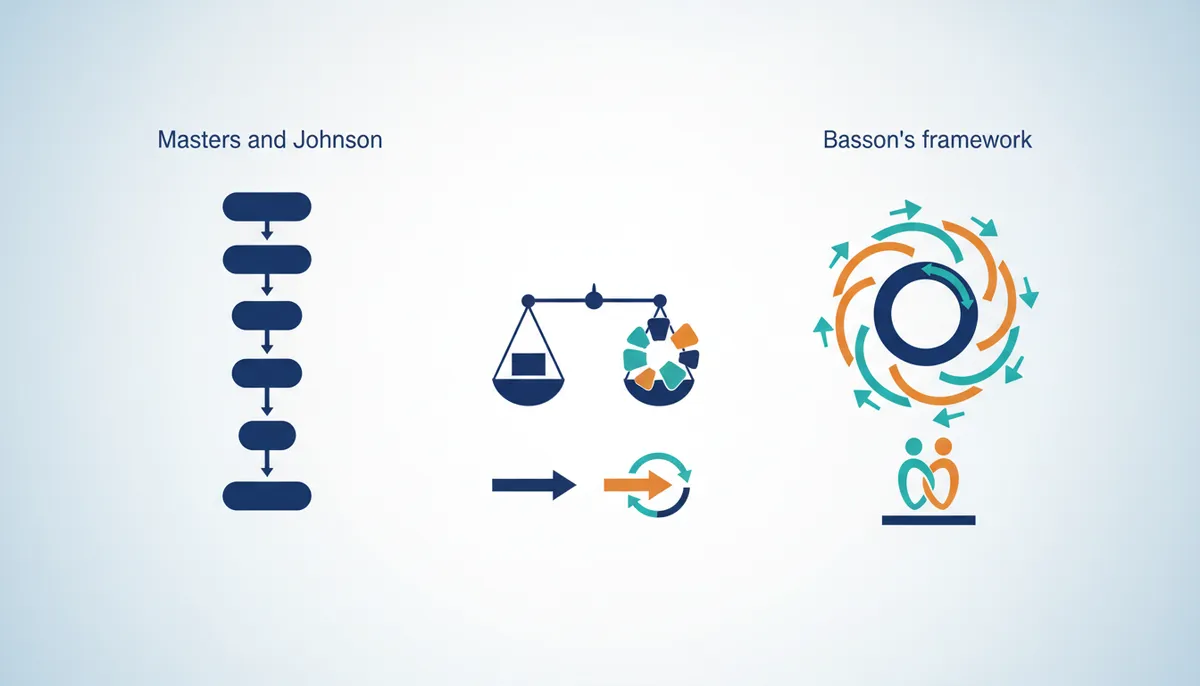
Physiological readiness does not always precede emotional engagement in human sexuality, yet the Masters and Johnson sequence demands exactly that rigid linear path. This traditional framework defines four stages: arousal, plateau, orgasm, and resolution. Such a model implies that spontaneous desire must initiate every encounter, a pattern that fails many individuals in long-term relationships. Research indicates sexual response is unique, meaning no single model explains everyone's experience without modification.
Basson's cyclical intimacy model posits a different reality where desire often emerges only after emotional and physical intimacy begin. In this view, emotional foreplay acts as the primary catalyst rather than a secondary byproduct. A conceptual comparison exists between traditional foreplay and this expanded definition, where long conversations and vulnerability carry equal weight to physical touch in initiating the sexual response. Consequently, arousal pathways diversify beyond immediate genital stimulation to include relational safety.
| Feature | Linear Model | Cyclical Model |
|---|---|---|
| Initiator | Spontaneous Desire | Emotional Context |
| Progression | Fixed Sequence | Flexible Loop |
| Goal | Orgasm/Release | Intimacy/Bonding |
The linear approach struggles to account for responsive desire, where interest develops during the act itself. Operators of relationship health must recognize that waiting for a spontaneous spark may prevent necessary connection. Desire does not always precede arousal; it can emerge through sustained emotional and physical closeness. This distinction validates experiences where the brain initiates sexuality through interconnected neural networks rather than biological imperative alone. Understanding this shift allows partners to prioritize relational dynamics over performance metrics.
Integrating Digital Intimacy Into the Orgasm Gap Solution
Addressing the 30-point orgasm gap requires prioritizing emotional satisfaction over immediate physical climax. A nationally representative study confirms this disparity stems from culture and communication rather than biology. Gen Z increasingly relies on digital mediation through texting and video calls, challenging the necessity of physical proximity for connection. This shift supports "soft life intimacy," where emotional foreplay replaces performance pressure as the primary metric for relationship health.
Focusing solely on orgasm often exacerbates anxiety, whereas integrating emotional closeness into daily digital interactions fosters the safety needed for arousal to emerge. The drawback of this approach is that it demands consistent vulnerability, which can feel risky without established trust. However, ignoring these digital cues leaves modern operators of intimacy ill-equipped to bridge the gap. The implication for practitioners is clear: therapy must validate non-genital protocols like mindful texting as legitimate precursors to physical union. By redefining the stimulus phase to include virtual connection, couples can sustain intimacy regardless of distance. This recalibration ensures that satisfaction, not biological release, becomes the shared objective.
Validating Relational Context Over Linear Sexual Frequency
Assessing sexual health requires evaluating relational dynamics rather than counting weekly encounters. The brain initiates and sustains sexuality through interconnected neural networks that prioritize emotional safety over rigid frequency targets. When couples focus on non-genital intimacy, they often resolve desire discrepancies more effectively than by forcing genital outcomes. Clinical observations confirm that removing pressure for specific physical results restores natural desire cycles. This approach validates soft life intimacy as a functional metric for modern relationship satisfaction.
| Dimension | Linear Frequency Model | Relational Context Model |
|---|---|---|
| Primary Driver | Spontaneous biological urge | Emotional connection and safety |
| Success Metric | Weekly act count | Reported relationship satisfaction |
| Response to Stress | Desire typically decreases | Intimacy may increase via support |
| Digital Role | Distraction from physical act | Valid medium for emotional foreplay |
Operators of relationships must recognize that digital mediation now sustains intimacy across distances without physical presence. Gen Z demonstrates that texting and video calls successfully maintain the plateau phase of arousal remotely. The constraint of this framework is its resistance to quantification; partners cannot simply track numbers to gauge success. Instead, they must monitor the quality of vulnerability and the consistency of emotional visibility. Roamers Therapy emphasizes that understanding an individual's unique experience matters more than fitting any single theoretical model. True sexual wellness emerges when partners stop measuring performance and start nurturing the cognitive and emotional motivations behind their connection.
Applying Cyclical Principles to Improve Intimacy and Address Desire Disorders
Defining Therapeutic Goals Using Basson's Relational Context
Therapeutic objectives pivot away from diagnosing dysfunction to validating relational context as the primary engine of sexual health. Roamers Therapy observed on Jul 03, 2026, that despite a surge in academic output, public dialogue regarding sexuality stays narrow, often hiding valid non-spontaneous patterns under layers of assumption. Clinicians applying Basson's framework cease hunting for missing spontaneous urges and instead chart the emotional intimacy necessary to kickstart the cycle. This perspective treats the lack of an initial urge not as a medical failure but as a neutral baseline waiting for responsive triggers. Desire emerges when partners feel seen consistently, operating as a psychological algorithm distinct from sporadic sexual attention (being seen consistently). Therapists interrupt the avoidance cycle by foregrounding non-genital touch and mindful presence to reconstruct safety before anticipating arousal (avoidance cycle. A substantial constraint involves the necessity of partner cooperation; without a willing participant offering consistent visibility, the cycle stalls completely. Treatment outcomes rely less on individual biology and more on the dyad's ability to sustain emotional engagement. Roamers Therapy stresses that grasping an individual's unique experience stops clinicians from pathologizing normal variations found in long-term bonds.
Implementing Secure Bond Protocols to Trigger Arousal Before Desire
Couples spark responsive desire by emphasizing non-sexual touch to build safety before expecting spontaneous urge. Rigid stereotypes about how sexuality "should be" often hide this natural variation, manufacturing performance anxiety where none exists. Partners who schedule time for emotional bonding in sex without genital expectations frequently discover arousal rising from the connection itself. Sexuality functions as a flexible process shaped by biological, psychological, relational, and contextual factors rather than a fixed linear script.
Experts forecast that by 2027, understanding desire as a product of consistent emotional visibility will become a standard relationship model, moving focus from initiation techniques to relational presence. Practitioners advise specific protocols to alter avoidance cycles:
- Prioritize non-genital intimacy and mindful presence to rebuild safety.
- Focus on emotional bonding without genital expectations.
- Dismantle performance-based scripts to reduce avoidance cycles and desire discrepancy.
- Support authentic connection over meeting external standards of "good sex."
- Cultivate patience to allow neural networks governing attraction to activate.
The drawback of this method is its demand for patience; partners used to linear scripts might mistake the lack of immediate urgency for disinterest. Bypassing pressure for instant results lets the brain link the partner's presence with safety instead of demand. Secure individuals find neural networks governing attraction firing more readily, converting what felt like absent desire into a responsive capacity awaiting the right context. This reframing shifts the goal from achieving orgasm to cultivating conditions where pleasure becomes possible.
Validation Checklist for Distinguishing Healthy Desire Variance from Pathology
Assess whether the absence of spontaneous desire signals relational health rather than clinical dysfunction. A missing initial urge often indicates responsive desire emerging through secure bonds, a pattern Basson identifies as non-pathological in long-term partnerships. Clinicians must separate this variance from desire discrepancy driven by avoidance cycles, which experts address via non-genital intimacy strategies [seven ways to tackle desire discrepancy ]. Rigid stereotypes frequently obscure these valid experiences, pushing individuals into performance-based scripts that ignore contextual factors.
| Feature | Healthy Variance | Clinical Concern |
|---|---|---|
| Desire Onset | Emerges after intimacy | Absent despite safety |
| Relational Context | Secure, supportive bond | High conflict or avoidance |
| Distress Source | External stereotypes only | Internal or fear |
Therapeutic goals shift when partners realize that emotional visibility fuels arousal more reliably than frequency metrics. Forecasting a 2026 model shift, relationship experts note that consistent being seen replaces sexual attention as the primary desire catalyst [sex and intimacy trends. Individuals should seek therapy if avoidance cycles persist, targeting genuine dysfunction effectively while avoiding the pathologizing of normal relational dynamics.
About
Sofia Reyes is a certified sex educator and somatic intimacy coach at mysteries.love, where she specializes in pleasure-centered education and body awareness. Her expertise makes her uniquely qualified to explore the sexual response cycle, as her daily work involves guiding individuals through the detailed, non-linear realities of desire and arousal. Unlike rigid historical models, Sofia's somatic and trauma-informed approach aligns perfectly with modern research that prioritizes individual experience over "normal" stereotypes. At mysteries.love, a platform dedicated to evidence-based intimacy education, she bridges the gap between clinical theory and practical application. By connecting physiological responses to emotional safety and body connection, Sofia helps readers understand their unique patterns of intimacy. Her background ensures that complex concepts regarding the sexual response cycle are presented with the compassion and scientific accuracy necessary to normalize these conversations for adults seeking deeper connection and sexual wellness.
Conclusion
Scaling this understanding reveals that performance anxiety often masquerades as low libido when the actual barrier is a lack of emotional safety. The operational cost of ignoring responsive desire is the slow erosion of intimacy, where partners mistakenly chase spontaneous sparks that biology does not guarantee in long-term bonds. You must stop measuring sexual health by the frequency of initial urges and start evaluating the quality of connection preceding physical contact. The argument here is clear: treat the absence of spontaneous desire as a neutral variance unless it coexists with active avoidance or relational conflict.
Implement a strict protocol starting this week where you suspend all expectations of genital activity for three consecutive days. Instead, dedicate that time exclusively to non-demanding physical touch or conversation that fosters emotional visibility. This specific constraint allows the brain to uncouple intimacy from obligation, creating the precise conditions where neural networks governing attraction can reactivate naturally. If desire remains absent after establishing this safety, only then should you investigate clinical dysfunction. By prioritizing the context of being seen over the mechanics of arousal, you align your approach with how human sexuality actually functions within secure attachments. This shift from demanding performance to cultivating safety transforms the sexual response cycle from a metric of failure into a reliable indicator of relational health.
Frequently Asked Questions
Linear models often ignore emotional variables critical to female arousal. Research shows a 30-point chasm exists between genders, proving rigid stereotypes cannot explain pleasure disparities.
Basson's model suggests arousal can precede conscious desire rather than following it. This contrasts with older views where sexual desire strictly initiates the encounter, helping partners who need emotional safety first.
The orgasm gap stems from disconnects in how we define normal sexual behavior today. A study of 2,000 adults confirms biology is not the sole culprit for this massive disparity.
Yes, satisfaction often hinges on abandoning the idea of a universal standard for intimacy. Since no single theory explains every unique sexuality, couples benefit from flexible, non-linear approaches to connection.
Data suggests individuals in their 20s engage in less traditional sexual activity than before. This shift indicates that defining sexual response cycle requires updated frameworks beyond old physiological baselines.
References