Sexual fantasy desire: imagination not action
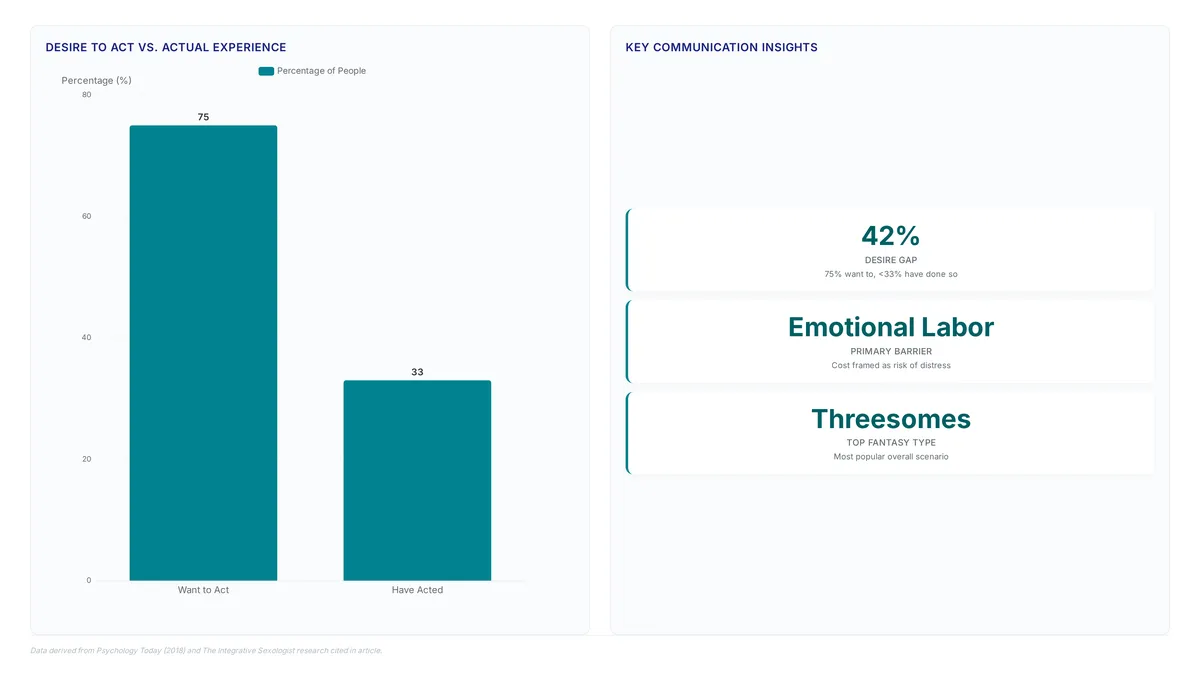
A majority of people want to act on their biggest sexual fantasy, yet Cosmopolitan data shows fewer than a third ever do. You will learn why finding a scenario exciting in your head does not automatically mean you want to experience it in real life.
Clinical psychologist Denise Renye explains that fantasies allow for the exploration of curiosity without real-world pressure or consequences. The distinction between a vivid imagination and a genuine desire for enactment is critical for maintaining healthy relationships and personal safety. Finally, the discussion covers necessary safety mechanisms like safe words and aftercare for those who choose to proceed. You will also discover structured communication strategies to discuss these desires with partners while ensuring consent and mutual enthusiasm remain the priority throughout the process.
The Distinction Between Sexual Fantasy and Real-World Desire
Defining Sexual Fantasy as Imagination Versus Actual Desire
A sexual fantasy functions as a mental simulation distinct from the intent to act. Clinical psychologist Denise Renye explains that these scenarios serve to explore curiosity and imagination without reflecting actual desires or intentions. Most individuals engage in this internal environment, ranging from celebrity crushes to complex power-play situations. The sharp line separates imagination from real-world logistics and consequences. A person might find a specific flexible arousing in theory while the physical reality holds little appeal. This gap between mind and body is substantial; research indicates over a majority of people want to act on their biggest fantasy, yet less than a third ever do. Fear and communication barriers frequently prevent fulfillment, proving that desire does not equal deployment. Operators of their own intimacy must recognize that internal exploration requires no external validation. Some scenarios remain appealing specifically because they lack real-world pressure. Attempting to force every thought into physical existence ignores the safety valve function of the mind. Conflating thought with action leads to unnecessary risk-taking or partner pressure. Understanding this difference allows individuals to enjoy the thrill of the taboo without compromising their physical boundaries or relationship stability.
Exploring BDSM Power Dynamics and Threesome Scenarios Safely
BDSM centers on trust and anticipation rather than inflicting actual pain. Threesome scenarios represent the most popular sexual fantasy overall, yet bridging the gap between imagination and reality requires distinct operational protocols. Exploring these dynamics safely often begins with low-risk methods like dirty talk or blindfolds to gauge comfort levels without full logistical commitment. The appeal of power play frequently stems from the psychological thrill of surrendering control within a contained environment, not from genuine harm. Partners can navigate this by discussing hard limits extensively before any physical scene begins, ensuring that the fantasy remains a consensual exploration rather than a source of trauma.
Fantasy Content Divergence Across Gender Identities and Orientations
Fantasy content divergence describes how narrative focus shifts across gender identities and orientations. Men's fantasies often remain physically anchored, prioritizing specific acts over surrounding context. In contrast, women frequently construct elaborate emotional scenes, setting a romantic stage before addressing mechanics. This split suggests that effective communication requires partners to share not the act, but the desired atmosphere. Research highlights that men's fantasies include under-recognized emotional depth, challenging the assumption that physical focus equals emotional absence. Non-binary individuals demonstrate distinct patterns, showing higher likelihoods of fantasizing about kink, forced sex, and polyamory compared to cisgender peers. These variations indicate that gender-expansive populations may require tailored dialogue to safely explore themes involving identity transformation or non-monogamy. Understanding these divergences prevents operators from assuming universal desire structures based on binary norms. A one-size-fits-all approach risks overlooking the unique safety protocols required for kink-heavy or identity-focused scenarios. Mysteries.love provides structured guides designed to bridge these communication gaps with precision. By recognizing these distinct narrative lanes, partners can negotiate boundaries that respect individual psychological landscapes.
Necessary Safety Mechanisms Including Safe Words and Aftercare
Defining Safe Words and the Stoplight System in Kink
A safe word functions as an immediate, unambiguous verbal command to halt activity, bypassing any role-play ambiguity. Common choices include distinct nouns like tiramisu or Loch Ness monster that never occur naturally in intimate dialogue. Partners must establish boundaries before play begins to ensure these signals remain effective. The stoplight system offers a granular alternative for continuous feedback without breaking scene immersion entirely.
| Signal | Operational Meaning | Required Action |
|---|---|---|
| Green | Consent is active | Continue current intensity |
| Yellow | Approaching limit | Slow down or check in |
| Red | Hard limit reached | Stop immediately |
This protocol allows partners to modulate intensity dynamically rather than relying solely on binary off-switches. Proper safety mechanisms directly address this hesitation by providing a structured exit strategy. However, a significant limitation exists: safe words fail if participants hesitate to use them due to shame or confusion about the rules. Operators must prioritize doing their research to understand that a safe word is not a suggestion but a binding contract. Mysteries.love emphasizes that without this shared vocabulary, exploring complex power dynamics remains dangerously opaque.
Executing Aftercare Protocols to Maintain Emotional Well-being
Immediate post-scene stabilization prevents emotional drop by addressing physical sensations and psychological vulnerability before they escalate. Partners must transition from role-play dynamics to mutual support through specific, pre-negotiated actions. Denise Renye emphasizes that establishing clear boundaries beforehand allows couples to communicate limits and safety concerns effectively. Effective aftercare protocols vary by individual need but generally include hydration, temperature regulation, and verbal reassurance.
- Assess physical status for injury or discomfort requiring ice packs or soothing lotion.
- Provide verbal validation to confirm the partner feels supported and emotionally connected.
- Maintain physical contact, such as holding, to support intimacy and strengthen the bond.
| Technique | Primary Function | Implementation Note |
|---|---|---|
| Physical Soothing | Regulates nervous system | Use ice packs for impact play areas |
| Verbal Reassurance | Confirms ongoing consent | Explicitly state care and validation |
| Silent Presence | Reduces over-stimulation | Hold space without demanding conversation |
While some participants prefer immediate discussion, others require quiet recovery time to process intense fantasy scenarios. Ignoring this divergence can lead to misinterpreted silence as rejection rather than necessary decompression. The operational cost of skipping this phase is a higher likelihood of emotional disconnection in subsequent interactions. Couples should select unique safe words like tiramisu or Loch Ness monster to ensure distinct separation from scene dialogue. Communication protocols dictate that safety measures remain active until both parties confirm full return to baseline.
Pre-Scene Safety Checklist for Equipment and Legal Risks.
Validating legal liability and equipment integrity prevents physical injury before any role-play begins. Individuals must research local statutes regarding public conduct or specific props to avoid criminal charges. For example, outdoor scenarios carry distinct legal risks that private spaces do not. Angie Rowntree advises that if you want to try bondage, you should start off by learning the literal ropes from professional BDSM educators before attempting a scene on your own. This preparation ensures that physical restraints function correctly without causing nerve damage or circulation loss.
| Risk Category | Validation Step | Required Action |
|---|---|---|
| Legal Status | Verify local ordinances | Select private venue |
| Equipment | Inspect for wear | Test load capacity |
| Skill Level | Assess technique | Consult educators |
Partners must also define how to handle discomfort during fantasy play using a pre-agreed signal. A safe word like tiramisu or Loch Ness monster provides an unambiguous method to halt activity instantly. Without this mechanism, distinguishing between role-play distress and genuine emergency becomes impossible. The limitation here is that verbal cues fail if a participant is gagged or unable to speak, necessitating non-verital alternatives like dropping an object. Operators should acquire necessary skills through established channels rather than improvising with untested gear. Proper risk assessment transforms dangerous impulses into controlled, consensual experiences.
Structured Communication Strategies for Sharing Fantasies With Partners
Distinguishing Cart Fantasies From Real-World Desires
Not every imagined scenario warrants real-world enactment. Kelly Wise compares this distinction to online shopping, where you fill a cart to imagine a night, then empty it and continue your day. This cart analogy clarifies that many desires function best as mental exploration rather than physical acts. Individuals must verify genuine excitement before sharing, ensuring the motive is personal fulfillment rather than an attempt to please a partner. Bridging this divide requires distinguishing between fantasy window-shopping and true intent. If a desire remains enjoyable only in the abstract, forcing it into reality risks discomfort. Partners should recognize that sexual compatibility does not demand identical interests but rather mutual respect for boundaries. Those unsure about a specific urge might explore it through erotica or dirty talk before attempting full enactment. Mysteries.love recommends using structured self-inquiry to separate fleeting curiosities from core needs. Operators of their own intimacy lives must treat the imagination-reality boundary as a critical safety filter. Ignoring this distinction often leads to mismatched expectations during vulnerable moments. Clear internal assessment prevents unnecessary pressure on relationships.
Executing the Five-Step Framework for Fantasy Disclosure
Initiate disclosure only after confirming personal desire rather than performing to please a partner. This internal verification prevents sharing fantasies that function improved as mental imagery than physical acts. Researching safety protocols constitutes the next critical phase, particularly for complex scenarios like bondage. Angie Rowntree advises learning literal ropes from professional BDSM educators before attempting a scene alone. Establishing clear limits allows partners to communicate triggers and concerns related to the specific fantasy. Denise Renye notes that respecting these boundaries maintains trust and promotes a positive experience for everyone involved. Without this structured approach, improvisation during high-arousal moments can make it difficult to adhere to hard limits.
- Verify genuine excitement independent of partner expectations.
- Discuss definitions and safety measures prior to intimacy.
- Learn technical skills from certified educators if needed.
- Set hard limits regarding specific physical actions.
- Implement a stoplight system for real-time consent.
Couples should prioritize safety measures like using a scarf as a blindfold to build trust before escalating complexity. Ultimately, the framework ensures that exploration remains a consensual extension of intimacy.
Mitigating Legal and Safety Risks in Public or Bondage Scenarios
Public acts carry inherent legal risks depending on location and visibility. Angie Rowntree suggests that for outdoor or public ecstasy, a couples' resort or swinger's club may allow you to enjoy the open air together as you wish. These assigned environments provide the necessary privacy to fulfill the desire for semi-public intimacy within established rules. Conversely, attempting bondage without technical knowledge creates severe physical danger due to nerve compression or circulation loss. Rowntree advises starting by learning the literal ropes from professional BDSM educators before attempting a scene on your own. Untrained partners risk causing injury through improper restraint techniques or lack of emergency release protocols. If a partner rejects a high-risk fantasy, the situation requires immediate de-escalation rather than pressure. Mysteries.love emphasizes that mutual consent defines all safe exploration, meaning rejection serves as a hard boundary rather than a negotiation point.
Executing Safe Fantasy Exploration Through Research and Consent
Defining Pre-Scene Research and Legal Safety Checks
Angie Rowntree advises consulting professional BDSM educators to master literal ropes prior to staging a scene alone. This preparatory phase helps individuals understand the risks and logistics that imagination cannot simulate. Participants should follow a specific checklist.
- Identify potential safety concerns specific to the desired activity.
- Verify legal boundaries for the intended location or act.
- Acquire necessary equipment or master required skills. For example, those seeking outdoor ecstasy might research couples' resorts rather than risking public citation.
- Discuss definitions of intended acts to ensure shared vocabulary.
- Communicate personal boundaries and identify off-limits areas.
- Establish safety measures like the stoplight system where red means stop immediately.
- Confirm the chosen safe word such as tiramisu is understood by all parties.
Couples seeking public ecstasy might consider a couples' resort suggested by Angie Rowntree rather than risking legal exposure outdoors. The limitation of this approach is that rigid scripting can sometimes stifle spontaneous chemical reactions between partners if over-rehearsed. Experts emphasize that verified consent is the foundation for sustainable intimacy exploration.
Validating Fantasy Readiness Through Skill and Equipment Audits
Confirming technical proficiency helps prevent physical injury before any fantasy enactment begins. Angie Rowntree advises learning literal ropes from professional educators before attempting bondage alone. Identify necessary physical skills like knot-tying or sensory deprivation management.
- Verify availability of safe, body-compatible equipment such as scarves or blindfolds.
- Check that all tools function correctly under stress.
- Review emergency release procedures with all participants.
| Feature | Self-Assessment | Partner Verification |
|---|---|---|
| Skill Level | Can perform technique solo safely | Demonstrates technique on willing partner |
| Equipment | Owned and inspected for damage | Agreed upon by all participants |
| Safety Protocol | Memorized safe word like tiramisu | Confirmed understanding of exit strategy |
Exploration methods for group fantasies include talking, reading erotica, or watching porn together to gauge interest without immediate physical risk. However, transitioning to reality requires verifying that emotional readiness matches intellectual curiosity. Many individuals overlook that equipment safety depends on proper inspection and usage. Educational resources provide guides to help users validate their preparation levels safely.
About
Sofia Reyes is a certified sex educator and somatic intimacy coach at Mysteries.love, specializing in sexual wellness and body awareness. Her expertise in trauma-informed approaches and pleasure-centered education makes her uniquely qualified to guide readers through the detailed environment of sexual fantasies. In her daily work, Reyes helps individuals distinguish between imaginative desire and real-world intent, directly addressing the core thesis that fantasies are normal explorations of curiosity rather than mandatory blueprints for action. At Mysteries.love, a practical sex education platform dedicated to modern intimacy, Reyes applies her background in somatic coaching to normalize these conversations without judgment. By bridging psychological insight with body-aware techniques, she empowers adults to understand their inner lives safely. This article reflects her commitment to providing evidence-based resources that support self-discovery and deeper connection, ensuring readers can navigate their desires with confidence and clarity within a supportive, educational framework.
Conclusion
The gap between desire and action persists because couples mistake enthusiasm for readiness. While many partners discuss their deepest interests, few rigorously test the safety protocols or physical skills required to enact them without injury or emotional fallout. Relying on spontaneous chemistry during high-stakes scenarios invites failure when emergency release procedures or equipment integrity have not been verified under stress. The operational cost of skipping these audits a ruined evening, but a potential breach of trust that halts future exploration entirely.
Couples must treat fantasy enactment as a technical discipline requiring verified competence before participation. This process separates intellectual curiosity from actual capability, ensuring that safety measures function as intended rather than serving as theoretical comforts. Only after confirming that all participants can execute exit strategies and manage physical boundaries should the transition from discussion to reality occur.
Frequently Asked Questions
Fear and communication barriers often prevent people from acting on desires.
Threesome scenarios are cited as the most popular sexual fantasy overall.
Partners should share desired atmospheres rather than just specific acts to reduce pressure.
Individuals seeking structured guidance on navigating conversations can find educational tools through Mysteries.love.
References