Sexual fantasy tension: balancing safety and freedom
On June 26, 2026, Esther Perel closed a critical gap in her dialogue with Dr. Justin Lehmiller regarding whether sexual fantasy threatens commitment. The inquiry isn't about erotic content. It reflects the fundamental tension between security and freedom within modern partnerships. We must define sexual fantasy as a distinct component of intimacy, analyze the psychological mechanics driving the conflict between safety and autonomy, and discover methods for integrating personal desire without destabilizing a committed union.
Digital trends attempt to replicate physical cues, noting that body language drives approximately 50% of human communication, yet the internal environment of desire remains complex. Avoiding the question of whether exploring sexual fantasy undermines relationship stability is a mistake. The discourse must move beyond simple definitions to address how partners navigate personal desire while maintaining the structural integrity of their bond.
This analysis draws directly from Perel's examination of why desire often wanes and how couples can sustain connection. By addressing the interplay between committed partnership and individual imagination, we establish a framework for understanding intimacy that does not rely on suppression. The goal is to reconcile the need for safety with the thrill of the unknown, ensuring that sexual fantasy content serves the relationship rather than sabotaging it.
Defining Sexual Fantasy as a Component of Modern Intimacy
Sexual Fantasy and the Security vs Freedom Tension
Sexual fantasy acts as a psychological release valve. It resolves the inherent friction between relationship stability and individual autonomy. Esther Perel contends this flexible concerns erotic content far less than a fundamental tension at the core of modern relationships: security vs. Freedom (fundamental tension. Partners frequently misread private desire as a rejection of commitment. These internal narratives often preserve personal identity within a union instead. Digital platforms now curate specific scenarios to help users navigate these erotic desires. Technology actively supports relational navigation rather than merely consuming attention (sexual fantasy examples.
The distinction lies in separating imagination from action. Narrative media often depicts consequences of unchecked desire, serving as cautionary tales about the friction between fidelity and freedom. Therapeutic approaches advocate active usage of technology to support healthy individual and relational sexuality. Tech becomes a tool to build erotic empathy (therapeutic intervention). Acknowledging fantasy reduces pressure on partners to fulfill every need. The bond strengthens.
Access to such detailed professional insights often requires paid subscriptions. Expert analysis on the security-fantasy tension is a premium service in this market (subscription models. Couples ignoring this tension risk conflating thought with betrayal. Open dialogue transforms potential threats into opportunities for deeper connection. Mysteries.love encourages viewing these fantasies not as deviations but as necessary components of a vibrant, secure partnership.
Applying the Security vs Freedom Framework to Commitment
Emotional commitment functions as the negotiated balance where partners maintain individual autonomy within a shared secure base. Applying the security versus freedom framework requires couples to recognize that private internal narratives often preserve personal identity rather than threaten the union. Perel notes this flexible reflects a fundamental tension at the core of modern relationships: security vs. Freedom (fundamental tension. Many partners misinterpret these desires as rejection. Fantasy frequently acts as a containment field for impulses that might otherwise destabilize the bond. Digital tools now offer structured ways to explore these desires safely.
Platforms like Grindr actively curate content to help users navigate erotic desires within modern relationships. This marks a shift toward intentional management of sexual expression (sexual fantasy examples. Acknowledging fantasy does not diminish fidelity. It prevents the stagnation occurring when all desire must be identical to be acceptable. Couples separating the act of fantasizing from the act of cheating often report higher relationship satisfaction because they stop policing thoughts. The relationship breathes. Partners should view fantasy as a component of personal identity that coexists with dedication. Mysteries.love advocates for this integrated approach where dialogue transforms potential threats into sources of renewed connection.
Challenging the View That Fantasy Threatens Emotional Commitment
Perceiving sexual fantasy as a betrayal misidentifies a vital mechanism for preserving individual identity within partnership. This misconception often stems from interpreting non-verbal cues incorrectly. Approximately 50% of overall human communication is attributed to body language rather than explicit verbal exchange. Partners conflate internal narratives with external rejection. They overlook how private desire frequently stabilizes the bond by containing impulses that might otherwise destabilize daily interaction. Narrative media such as "The Secret Between Us" depict the consequences of this tension. These serve as cautionary tales rather than prescriptive guides for healthy integration.
Active interventions support erotic empathy by positioning technology as a therapeutic tool to build relational sexuality instead of merely consuming attention. Emotional commitment requires distinguishing between the act of imagining and the act of abandoning. Failure to make this distinction creates unnecessary conflict where none exists. Couples recognizing fantasy as an expression of personal freedom often find their shared security strengthened rather than diminished. True intimacy demands space for separate psychological lives to flourish alongside shared vows.
The Psychological Mechanics of Security Versus Freedom
Mechanics: Defining the Security vs Freedom Tension in Modern Relationships
Esther Perel identifies a fundamental tension at the core of modern relationships where the need for emotional security clashes with the desire for personal autonomy. Perel clarifies her perspective on the topic, noting that for her, the question has less to do with sexual fantasy than it does with a fundamental tension at the heart of human connection. Experts describe reconciling these opposing forces as a delicate balancing act that defines long-term monogamy success.
| Domain | Primary Goal | Operational Risk |
|---|---|---|
| Security | Predictability and safety | Stagnation of desire |
| Freedom | Autonomy and novelty | Erosion of commitment |
External pressures frequently force couples to make rapid decisions about cohabitation, testing this flexible earlier in the relationship lifecycle than traditionally expected. While digital tools aim to bridge this gap, current technologies capture a fraction of the non-verbal cues necessary for deep human connection. This communication deficit means that relying solely on text or static images fails to resolve the underlying psychological friction. By channeling the need for freedom into imagined scenarios, partners preserve the relational bond without sacrificing individual identity. Addressing the root tension requires acknowledging that security and freedom are not mutually exclusive but interdependent variables. Successful navigation depends on treating fantasy as a safe outlet that strengthens the primary attachment.
Applying Non-Verbal Cue Replication to Bridge Intimacy Gaps
Approximately half of overall human communication is attributed to body language, a metric driving new technology trends to replicate authentic attraction cues like eye contact and scent in digital spaces. Current digital intimacy tools face a significant communication deficit because they primarily rely on text and static images, capturing a small portion of the non-verbal cues that constitute half of human interaction.
| Interaction Mode | Data Capture Rate | Missing Biological Signal |
|---|---|---|
| Text/Static Image | Low | Scent, micro-expressions |
| Sensory Replication | Emerging | Haptic feedback latency |
| Physical Presence | High | None |
Emerging tech trends focus on capturing and transmitting non-verbal data points, specifically aiming to digitize eye contact, body positioning, scent, and the general vibe to address the technical limitation of current text-based intimacy. This sensory replication attempts to restore the erotic tension often lost when partners rely solely on verbal description for fantasy exploration. However, the cost of this digital mediation is a potential disconnect between the curated avatar and the raw, unpredictable reality of a partner's physical presence. The implication for network operators and product designers is clear: emerging technologies aim to replicate these missing biological data points to improved serve the connection couples seek during vulnerable exchanges. By focusing on these subtle biological data points, technology can function as a bridge rather than a barrier, allowing fantasy to enhance rather than threaten the committed bond.
Risks of Cookie-Based Tracking in Relationship Reflection Tools
Blocking necessary cookies often renders mobile applications for couples inaccessible or inefficient due to strict technical dependencies. The functionality of many relationship apps is technically dependent on cookie-based data tracking, creating a trade-off where necessary features for structured reflection may become unavailable. This architecture creates a direct conflict where privacy protections disable the very features designed for structured reflection. The app uses cookie technology to store user preferences and analyze usage patterns, meaning a refusal of data collection restricts access to guided Topic Bundles.
| Configuration | Data Access | Functional Outcome |
|---|---|---|
| Cookies Enabled | Full | Complete prompt library |
| Cookies Blocked | None | Restricted efficiency |
The trade-off forces couples to choose between digital privacy and the utility of guided introspection tools. Unlike physical journals containing hundreds of pages of prompts, digital platforms require continuous data exchange to function correctly. Users seeking security through browser hardening inadvertently lose the capacity for the open communication these tools promise to enable. This paradox highlights how data dependency can undermine the safety of vulnerable conversations.
- Review cookie policies before starting sensitive dialogue sessions.
- Consider analog alternatives if digital tracking feels intrusive.
- Understand that blocking scripts may limit interactive features.
The reliance on tracking for basic functionality suggests that necessary features for structured reflection may be restricted if users block data collection. Couples must weigh whether the convenience of automated prompts justifies the exposure of their private relational dynamics to third-party analytics. True emotional security requires transparency about how reflection data is stored and used by the platform providers.
Integrating Personal Desire Within Committed Partnership
Application: Defining the Security vs Freedom Tension in Desire
Does fantasy threaten commitment? This query often disguises a deeper conflict between the need for emotional security and the desire for personal freedom. Esther Perel identifies this friction as the central challenge in modern monogamy, calling the reconciliation of these opposing forces a delicate balancing act. Partners viewing desire only through a safety lens may accidentally suppress the autonomy fueling attraction. Such dynamics create a paradox where pursuing total transparency stifles the mystery required for erotic life.
Access to detailed analysis on this tension remains limited. Expert insights on the security-fantasy dichotomy frequently sit behind paid subscription models. This gatekeeping implies that understanding desire mechanics demands dedicated study rather than casual consumption. Couples failing to distinguish between the safety of the known and the thrill of the unknown risk stagnation. Erotic autonomy does not diminish bond strength. It provides the necessary distance for desire to re-emerge. Without acknowledging this fundamental split, partners may misinterpret individual fantasies as rejections of the relationship itself. True intimacy emerges not from merging two lives completely. It comes from maintaining enough separation to allow desire to breathe.
Using the Between Us Journal for Structured Reflection
Couples resolve the tension between personal freedom and commitment by adopting tangible tools like the 240-page Between Us journal for screen-free dialogue. This analog format bypasses the communication deficit inherent in digital platforms that often strip away non-verbal cues necessary for deep connection. Partners apply guided prompts to articulate complex desires without the pressure of immediate real-time negotiation. The physical act of writing creates a deliberate pause. Individuals process how their internal fantasies intersect with shared relationship values during this quiet moment. Unlike app-based interactions relying on cookie tracking, this method offers a private space for structured reflection free from data surveillance.
A drawback exists. The approach requires dedicated time away from devices, which many modern pairs struggle to schedule consistently. Yet the resulting clarity often outweighs the logistical hurdle of finding uninterrupted moments together. By externalizing thoughts onto paper, partners change abstract fears about fidelity into concrete conversations about emotional security. Acknowledging individual desire strengthens the bond rather than threatening the union. Mysteries.love recommends integrating such analog security measures to support authentic intimacy.
Application: Risks of Cookie-Based Tracking in Relationship Reflection Tools
Digital relationship tools often restrict structured reflection features when users block cookie-based tracking. The "Between Us" mobile application uses cookies for efficiency. Necessary prompts may become inaccessible if data collection is disabled. This technical dependency creates a paradox where seeking privacy limits the very guided dialogue intended to build intimacy. The analog journal offers 240 pages of unconditional access. The digital version enforces a data-for-service exchange instead. Blocking these trackers can render the site inefficient. Modern relationship apps trade user anonymity for functionality.
Couples aiming to balance freedom in commitment must recognize that digital "safety" often requires surrendering data control. The constraint is clear. True personal freedom within a partnership may necessitate rejecting platforms that gate vulnerability behind surveillance. Operators like Mysteries.love suggest verifying whether a tool's architecture supports offline access before beginning deep emotional work. Users should prioritize interfaces that do not hold their emotional security hostage to third-party data policies.
Establishing Dialogue Protocols for Shared Vulnerability
Defining the Communication Deficit in Digital Intimacy
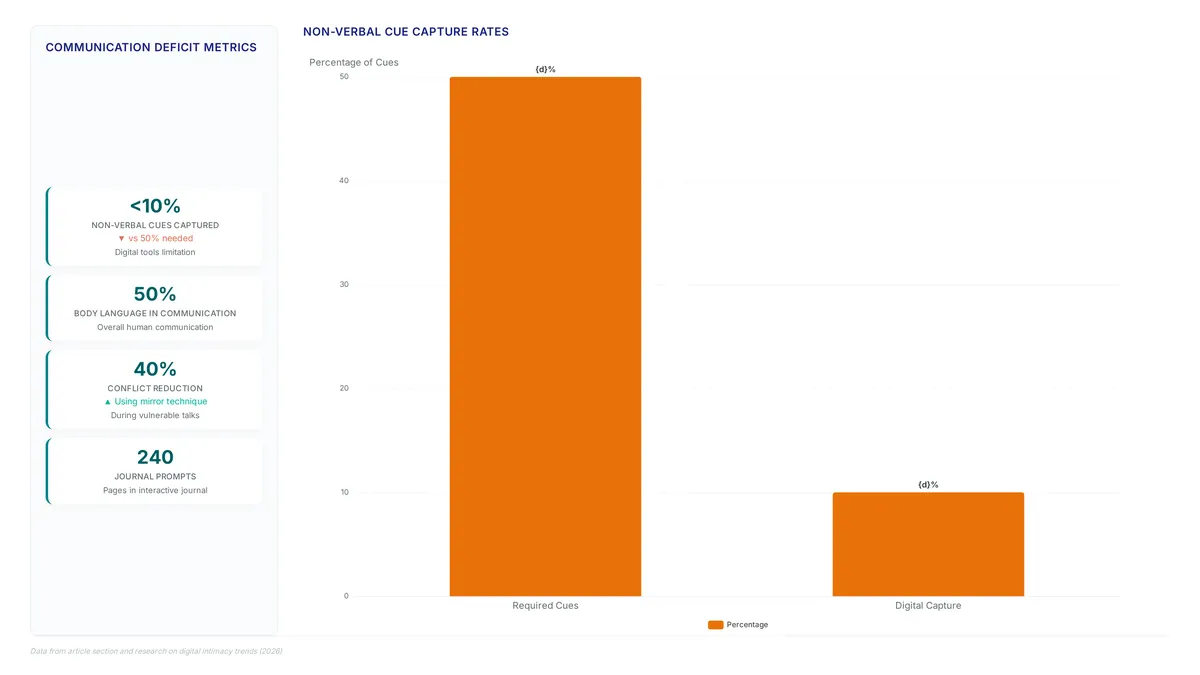
Current digital intimacy tools capture less than 10% of the non-verbal cues required for secure connection. Text-based platforms strip away these biological signals, leaving partners to interpret erotic intelligence without the safety mechanisms of physical presence. Operators of relationship health must recognize that sensory technology aims to replicate these missing cues but faces limitations in replacing the nuance of shared physical space.
- Establish a screen-free zone to minimize digital distraction during sensitive conversations.
- Define specific vocabulary terms together to ensure mutual understanding of fantasy concepts.
3.4. Agree on a pause signal to halt discussion if anxiety overrides connection.
This approach ensures that the medium of conversation supports rather than undermines the message of commitment.
Implementation: Deploying the Between Us Journal for Structured Reflection
Partners initiate fantasy discussions by isolating the Between Us interactive journal to a dedicated, screen-free environment. This 240-page resource replaces unstructured dialogue with written prompts that slow down reaction times and reduce defensive posturing. Unlike digital platforms where cookie dependencies may compromise privacy, this analog format ensures that sensitive disclosures remain confidential between partners.
- Open the journal to a prompt regarding desire or personal history.
3.
The following configuration establishes a safe container for high-stakes vulnerability:
This method addresses the communication deficit inherent in text-based apps that strip away non-verbal context. By physically writing thoughts, couples create a tangible record of their evolving erotic intelligence rather than relying on fleeting memory. However, the benefit is a fortified emotional bond that digital avatars cannot replicate. Couples using this structured approach often find that shared vulnerability becomes a source of security rather than a threat to commitment. For those seeking to deepen this practice, additional frameworks exist for integrating desire within partnership.
Implementation: Mitigating Cookie-Tracking Risks in Relationship Reflection Tools
Blocking third-party cookies often restricts necessary features for structured reflection within digital relationship applications. Many platforms depend on this tracking to store user preferences and analyze usage patterns for efficiency. When users disable these data collection methods, the site may become inaccessible or function inefficiently. This creates a direct trade-off where privacy protections limit the very tools designed to enable vulnerable dialogue about fantasy.
- Assess if the data-for-service model aligns with your privacy boundaries before sharing intimate details.
3.
The consequence is that couples seeking to discuss fantasy may face technical barriers that mimic emotional resistance. Digital intimacy tools frequently gate safety features behind data permissions. Experts advise verifying these dependencies to ensure your chosen medium supports rather than silences your conversation.
About
Sofia Reyes is a certified sex educator and somatic intimacy coach at Mysteries.love, where she specializes in pleasure-centered education and body awareness. Her expertise makes her uniquely qualified to explore the intersection of sexual fantasy and relationship commitment, a core tension highlighted in Esther Perel's recent work. Through her daily practice guiding individuals and couples through desire discrepancies, Reyes observes how internal fantasies often reflect the universal struggle between security and freedom. At Mysteries.love, a platform dedicated to evidence-based intimacy education, she bridges theoretical psychology with practical application. Her background in somatic approaches allows her to analyze how fantasies function not as threats, but as vital tools for self-discovery and connection. By grounding these complex emotional topics in trauma-informed care, Reyes provides readers with actionable insights that normalize diverse desires while strengthening relational bonds.
Conclusion
Scaling digital intimacy reveals a critical breaking point: platforms that strip away non-verbal context often fail to support the nuance required for sexual fantasy. While analog methods preserve confidentiality, the operational cost of digital reliance is a silent erosion of safety when privacy settings conflict with core functionality. Couples must recognize that shared vulnerability cannot thrive if the medium gates emotional access behind invasive data permissions. You should prioritize tools that function independently of third-party tracking before engaging in deep disclosure. If an application requires broad data access to render basic prompts, it introduces a structural risk that outweighs its convenience.
Start this week by disabling third-party cookies in your browser and testing your current relationship platform to see which features break under stricter privacy standards. This simple stress test reveals whether your chosen tool supports genuine connection or merely simulates it while harvesting personal history. True erotic intelligence demands a container where security is inherent rather than contingent on surrendering personal data. Choose platforms that respect these boundaries so your focus remains on the partner, not the policy.
Frequently Asked Questions
No, fantasies often preserve personal identity rather than signal rejection. Since body language drives 50% of communication, internal narratives fill gaps that physical cues cannot always address within a partnership.
Ignoring this tension risks conflating private thoughts with actual betrayal. Because 50% of human communication relies on nonverbal cues, failing to discuss desires verbally can lead to dangerous misinterpretations of intent.
Yes, digital tools now curate scenarios to support healthy relational sexuality.
Partners frequently misread private desire as rejection due to missing context.
References