Orgasm gap facts: Why 18% climax from penetration
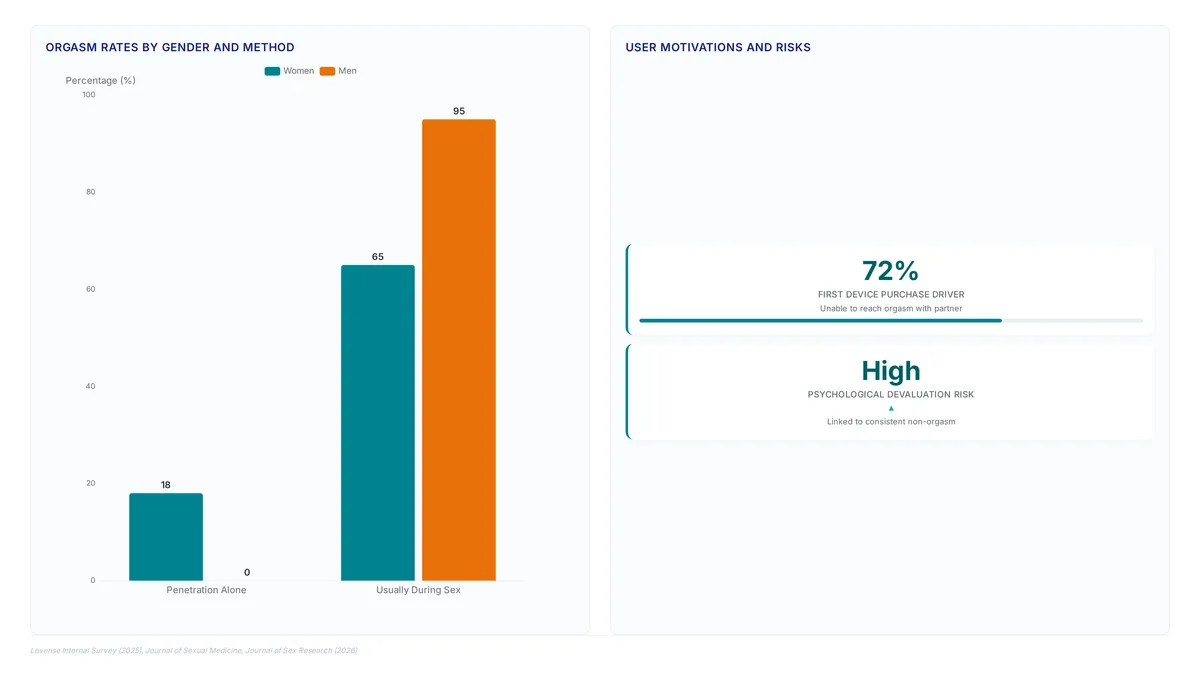
Only 65% of heterosexual women usually experience an orgasm during sex compared to 95% of men. Lovense targets this gap with synchronized technology. You need to understand how psychological devaluation erodes female pleasure, why combining clitoral and G-spot mechanics is physiologically mandatory, and how the Lovense system lets partners synchronize stimulation for shared satisfaction.
Standard sexual narratives often terminate prematurely. They ignore a hard constraint: only 18% of women reach climax through penetration alone. Research from Rutgers University published in The Journal of Sex Research indicates that women who consistently fail to orgasm may psychologically devalue their own satisfaction, creating a cycle of disengagement.
Intent alone fails here. The solution demands precise mechanical coordination that human timing frequently misses. By deploying the Lovense system, couples bridge the physical disconnect between partners. The following sections detail the psychological impact of this disparity, the specific physiological mechanics required for dual stimulation, and the practical deployment of smart devices to ensure both partners prioritize female pleasure as a shared goal rather than an afterthought.
Defining the Orgasm Gap and Its Psychological Impact
Defining the Orgasm Gap and Statistical Disparities
The orgasm gap quantifies a persistent disparity: 95% of heterosexual men usually experience orgasm during sex compared to just 65% of heterosexual women. This 30-point divergence highlights a systemic misalignment in heterosexual scripts rather than a biological deficit. Research indicates that only 18% of women reach climax through penetration alone, yet standard encounters often prioritize this single modality. The data shifts dramatically when examining partner gender dynamics; a landmark survey found that 86% of lesbian women achieve orgasms during sex, suggesting anatomy is not the limiting factor.
These statistical variances reveal that heterosexual norms frequently exclude the dual-stimulation pathways required for female pleasure. When partners rely exclusively on penetration, they bypass the clitoral engagement necessary for most women to reach climax. This exclusion creates a feedback loop where women may psychologically devalue their own pleasure needs over time. The disparity is not inevitable but rather a result of specific behavioral patterns that can be modified. Partners must recognize that satisfying heterosexual encounters often demand a departure from traditional scripts to ensure mutual satisfaction.
How the Standard Sexual Script Excludes Clitoral Stimulation
The standard sexual script prioritizes penile-vaginal intercourse despite biological data showing most females require external stimulation to climax. This conventional sequence typically progresses from foreplay to penetration, ending immediately after male ejaculation, a timeline that frequently leaves female partners unsatisfied. Because only a small fraction of women reach orgasm through penetration alone, adhering strictly to this map ignores the physiological necessity of clitoral engagement for the vast majority. Research indicates that combining internal and external pathways produces stronger, quicker orgasms than either method in isolation, yet the dominant narrative often omits this dual approach entirely.
Devaluation occurs when women who consistently fail to orgasm with partners begin minimizing the importance of their own pleasure. This specific psychological mechanism, identified in a 2026 Rutgers University study, creates a self-reinforcing cycle where unmet needs are reclassified as unnecessary rather than addressed. Instead of seeking alternative stimulation methods, individuals internalize the deficit, effectively editing their expectations to match the limitations of the standard script. The risk extends beyond immediate dissatisfaction; it fundamentally alters how partners negotiate intimacy over time.
Market behavior reflects this silent adjustment, as 72% of device purchasers cited inconsistent partnered orgasms as their primary motivation for buying technology. This statistic reveals a critical tension: women are actively seeking solutions externally because the internal relationship flexible has stalled. When pleasure is deemed optional, the emotional investment required to explore complex physiological pathways diminishes. The consequence is a relationship environment where female satisfaction becomes an optional upgrade rather than a baseline expectation. Addressing this requires recognizing that psychological devaluation is not merely personal resignation but a barrier to mutual intimacy that demands shared attention and revised physical scripts.
Physiological Mechanics of Dual Stimulation and Arousal
Dual Pathway Mechanics: Clitoral and G-Spot Anatomy
Female orgasm relies on two distinct anatomical pathways: the external clitoral network and internal G-spot tissue. Vaginal penetration alone fails to induce climax in over 90 percent of women, proving that internal pressure rarely suffices without concurrent external input. Data indicates that 36 percent of women state clitoral stimulation is necessary for them to achieve an orgasm, while another 36 percent say their orgasms feel improved with it. These nerves and tissues function as interconnected components rather than isolated zones. Most standard scripts focus entirely on penetration, activating only the internal layer while neglecting the external trigger most bodies require. Effective intimacy education must prioritize simultaneous engagement of both zones to align physical capability with desired outcomes.
Penetration-Only Limits Versus Combined Stimulation Efficacy
Relying solely on vaginal penetration ignores the physiological reality that less than 10 percent of women can climax through this single modality. This mechanical limitation creates a binary outcome where pleasure is either immediate or entirely absent, forcing many partners to abandon the attempt rather than adjust the technique. Dual stimulation resolves this by simultaneously engaging external clitoral nerves and internal G-spot tissue, a configuration that aligns with the anatomical requirements for female climax. Data indicates that 36 percent of women identify external stimulation as necessary, while an equal portion report enhanced sensation when it is included.
The persistence of penetration-only scripts often stems from a misunderstanding of female anatomy as merely an extension of male experience, leading to repetitive cycles of frustration. Shifting focus to combined pathways requires dismantling the assumption that penetration is the definitive act of sex rather than one component of a broader repertoire. Partners must recognize that excluding external stimuli results in non-climax for the vast majority of female partners. Without this mechanical adjustment, the orgasm gap remains a fixed feature of the interaction rather than a solvable problem. Research suggests two layers must work together to close the gap: Physical combining clitoral and G-spot stimulation, and Emotional involving partner investment. This shift moves intimacy from a solo fix to a collaborative solution, aligning with trends toward dyadic ecosystems that prioritize mutual satisfaction over individual release. Devices enabling real-time control allow one partner to modulate sensation based on immediate feedback. This tactile dialogue fosters the emotional investment required to sustain arousal. Ignoring this mechanical reality perpetuates the pursuit gap, leaving physical needs unmet despite emotional closeness.
Deploying Lovense System for Synchronized Intimacy
Lovense System Hardware and Remote App Sync Mechanics
The Osci 3 hardware executes dual-pathway stimulation by oscillating internally against the G-spot while vibrating the external clitoris. This mechanical configuration engages both anatomical requirements for female climax simultaneously, bypassing the limitations of penetration-only scripts. Partners apply the Lovense Remote App to establish a synchronized connection where rhythm and intensity adjustments translate instantly across distances. Technical architecture relies on smartphone connectivity that enables one partner to control the device pattern in real-time, effectively closing the physical separation gap for non-cohabitating couples. Reviews of the Lovense Couple Set highlight how this synchronization allows partners to maintain intimacy through shared tactile feedback rather than relying solely on video or text communication. Unlike biofeedback tools designed for solitary self-discovery, this system prioritizes the "two-partner" flexible necessary for mutual satisfaction. When partners actively adjust rhythm and intensity, the technology enables a shared tactile experience that bridges emotional investment.
| Feature | Function | Outcome |
|---|---|---|
| Osci 3 | Dual oscillation and vibration | Simultaneous internal and external engagement |
| Remote App | Real-time pattern control | Shared tactile experience across distance |
| Sync Mechanism | Instant latency transmission | Mutual rhythm alignment |
Executing Dual Stimulation and Music-Sync for Sensory Integration
Initiate dual stimulation by positioning the Osci 3 to engage internal oscillation and external vibration simultaneously. This configuration addresses the physiological requirement for combined pathways, ensuring both clitoral and G-spot tissues receive concurrent attention. Partners can then apply the Lovense Remote App to establish a synchronized link, allowing real-time control over rhythm and intensity. This remote capability transforms Long-Distance Intimacy by enabling tactile feedback that mirrors physical presence, effectively bridging geographical separation.
For sensory integration, activate the music-sync feature within the system to pair device vibrations with audio rhythms.
Begin by acknowledging that female pleasure is an necessary component of intimacy rather than an optional extra. This psychological shift addresses the risk of devaluation, a trend where women minimize their own needs after repeated exclusion from climax.
- Treat the disparity as a shared problem requiring joint investigation rather than individual failure.
- Replace penetration-only routines with dual stimulation techniques that engage both internal and external pathways.
- Use the Lovense Remote App to synchronize physical feedback, ensuring real-time awareness of partner response.
While hardware enables connection, technology remains merely a tool for recognizing deeper communication barriers. Dan Liu notes that solving this issue requires helping people fully recognize the problem before deploying solutions. The industry is shifting toward Purposeful Pleasure, moving beyond hedonism to address specific relational equity.
| Focus Area | Action Item | Outcome |
|---|---|---|
| Awareness | Discuss the gap openly | Shared vocabulary |
| Physicality | Integrate external vibration | Dual-pathway engagement |
| Investment | Prioritize her climax timing | Mutual fulfillment |
True intimacy emerges when both participants actively invest in closing the divide through consistent, conscious effort.
Strategies for Mutual Emotional Investment and Satisfaction
Defining Emotional Investment and Sensory Immersion in Sex

Partner investment, shared attention, and sensory immersion form the bedrock of emotional investment during sex. This framework directly confronts the pursuit gap, a scenario where men actively chase their own climax with support while women frequently prioritize facilitating theirs. Closing this divide requires physical and emotional layers to function in unison. Repeated failure to reach orgasm can cause women to psychologically minimize their own pleasure, a process researchers label devaluation. Genuine sensory immersion happens when arousal grows through context, specifically rhythm, anticipation, and the feeling that a partner notices how her body reacts. Static physical scripts lack this depth. The standard narrative often fixates on penetration, a method that statistically fails to produce orgasm for most women. Couples who shift focus to partner investment build an environment where rhythm and anticipation drive satisfaction more than friction alone.
Tension arises when prioritizing a partner's pleasure feels like a performance task instead of an intimate connection. Sensory immersion collapses if it becomes a checklist item rather than a lived experience. Satisfaction demands both people work toward the goal. This realization transforms intimacy from a solo pursuit into a collaborative act.
Applying Shared Attention and Rhythm to Promote Mutual Pleasure
Addressing psychological devaluation requires stopping the cycle where women minimize needs after repeated exclusion from climax. Lovense issued a call to action on June 22, 2026, regarding the orgasm gap that has persisted between couples for decades. The company encourages both partners to take an active role in addressing the disparity, making female pleasure a shared priority. Market trends show a shift toward Purposeful Pleasure, where consumers seek products solving specific relational issues instead of generic hedonism. Technology acts as the medium for this emotional investment. One partner controls rhythm and intensity in real-time via the Lovense Remote App.
Treating technology as a replacement for attentiveness causes sensory immersion to fail. Using audio-sync features to pair vibrations with narrative rhythms ensures physical stimulation follows an organic, anticipated tempo. This method transforms the device from a mere tool into a conduit for tactile feedback, making the partner's effort physically perceptible. Closing the gap demands that both individuals recognize female pleasure as an necessary component of intimacy rather than an optional extra.
The Risk of Psychological Devaluation When Orgasm Is Inconsistent
This internal shift creates a feedback loop where the brain begins to treat female satisfaction as optional rather than necessary. Ignoring this pattern reinforces conditions where women focus on facilitating their partner's orgasm without achieving their own. Emotional distance persists even when physical techniques improve because the psychological priority has already collapsed. Partners alter this cycle by making her pleasure a shared priority. Physical tools remain ineffective if the underlying belief system remains unchanged while emotional context is ignored. True sensory immersion requires both participants to believe the outcome matters equally. Technology alone cannot solve the problem without addressing this cognitive layer. The limitation of inaction is the continued psychological devaluation of women's pleasure.
About
Sofia Reyes, a certified sex educator and somatic intimacy coach at mysteries.love, brings necessary expertise to the critical conversation surrounding the orgasm gap. Her daily work focuses on pleasure-centered education and body awareness, directly addressing the disparities highlighted in recent Rutgers University research. As a specialist in somatic and trauma-informed approaches, Reyes understands that closing this gap requires more than just intent; it demands practical tools and open communication between partners. Her role involves guiding couples through desire discrepancies and normalizing discussions about sexual wellness, making her uniquely qualified to analyze Lovense's new initiative. By bridging the gap between modern sextech and relationship psychology, Reyes helps readers translate high-level concepts into actionable intimacy practices. Her background ensures that the discussion remains evidence-based and inclusive, offering couples the grounded guidance needed to make female pleasure a shared priority in their relationships.
Conclusion
The operational failure at scale is not a lack of hardware, but the persistent cognitive framing of female satisfaction as an optional extra rather than a core metric of intimacy. When couples rely on technology solely for novelty while ignoring the underlying psychological devaluation, they incur a compounding cost of emotional distance that no amount of haptic feedback can repair. The data confirms that without a shared commitment to prioritizing this outcome, even advanced tools fail to bridge the divide because the brain continues to treat the result as secondary.
Partners must explicitly restructure their intimate interactions by treating her climax as a required success condition before considering the encounter complete. This shift requires moving beyond generic hedonism toward Purposeful Pleasure, where the specific mechanics of stimulation are addressed with the same rigor as any other shared goal. Start by auditing your current routine this week to identify if you are using devices as replacements for attentiveness or as conduits for tactile feedback. Integrate audio-sync features to ensure physical stimulation follows an organic, anticipated tempo that makes effort physically perceptible. True sensory immersion only occurs when both participants believe the outcome matters equally, transforming the device from a mere tool into a catalyst for genuine connection.
Frequently Asked Questions
Only 18% of women reach orgasm through penetration alone, making standard scripts ineffective for most. Couples must add external clitoral stimulation to engage both necessary pathways for female satisfaction.
Consistent failure to climax causes women to psychologically devalue their own satisfaction needs over time. This process creates a cycle where partners ignore the specific dual stimulation required for success.
Yes, 86% of lesbian women achieve orgasms during sex, proving anatomy is not the barrier. This statistic confirms that changing the sexual approach rather than biology closes the disparity gap.
Devices like the Osci 3 stimulate the G-spot and clitoris simultaneously to match female needs. This dual action addresses the physical dimension where traditional penetration-focused methods consistently fall short.
About 72% of buyers purchased their first device because they could not consistently reach orgasm with a partner. These users seek technology to bridge the gap left by conventional sexual scripts.
References