Emotional intimacy takes time, not quick fixes
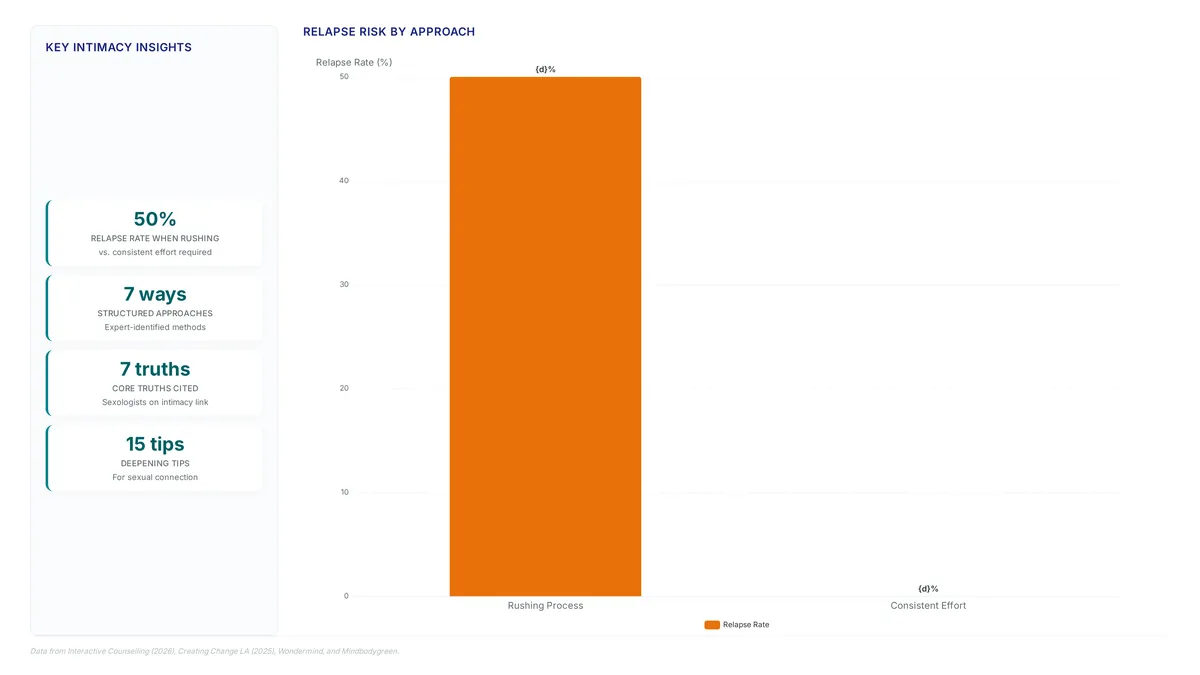
Rushing intimacy rebuilding triggers a 50% relapse rate, proving quick fixes fail.
The central thesis asserts that emotional intimacy functions as the non-negotiable bedrock of relational durability, requiring slow, deliberate cultivation rather than hurried repair. You will learn why accelerating this process often backfires and how specific communication mechanics drive genuine partner connection. The discussion also covers implementing daily practices designed to reconstruct fractured bonds without triggering further withdrawal.
Psychology Today defines this bond as the result of deep vulnerability and mutual understanding, yet many couples neglect the time required to sustain it. While open communication and quality time are standard prescriptions, the data suggests that impatience is the primary architect of failure. Interative Counselling reports that couples who rush the process face a 50% relapse rate, highlighting the danger of seeking immediate results.
True restoration demands a shift away from performance and toward consistent, low-pressure engagement. By focusing on the mechanics of listening and the discipline of presence, partners can avoid the pitfalls of superficial reconnection. This approach ensures that the resulting closeness is durable rather than temporary.
The Definition of Emotional Intimacy as Relational Foundation
Defining Emotional Intimacy as Vulnerability and Connection
Emotional intimacy constitutes the bond forming through deep feelings of connection, understanding, and vulnerability between partners. This relational foundation relies on the capacity to open up, share affection, and maintain a mutual understanding of needs rather than depending on physical attraction alone. Couples exhibiting high levels of this closeness experience greater partner satisfaction, improved communication, and reduced conflict. Strengthening this closeness can lead to increased happiness, trust, and durability. The mechanism requires creating a judgment-free environment where partners freely share deepest wishes and anxieties. When partners care for their emotional bond, they gain profound knowledge of each other's boundaries. Sexology perspectives indicate emotional needs must often be met before sexual connection can improve. Rushed attempts to restore this depth face significant challenges, proving that true reconnection demands time and consistent effort. Without this foundation, relationships risk increased conflict, diminished desire, and profound disconnection.
| Component | Function | Outcome |
|---|---|---|
| Vulnerability | Enables risk-taking | Deepens trust |
| Understanding | Validates experience | Reduces isolation |
| Connection | Bridges separate selves | Enhances durability |
Speed often defeats depth in reconnection efforts because safety vanishes under pressure. The constraint here is temporal; accelerating the process triggers defensive responses that halt progress. Sustainable bonds form when partners actively build safety and vulnerability rather than expecting intimacy to occur automatically. Practitioners recognize that genuine openness cannot be forced through urgency.
Applying Emotional Intimacy to Enhance Sexual Well-Being
Emotional intimacy functions as the core mechanism for sexual well-being for many women, transforming vulnerability into a tangible driver of desire. Research identifies this closeness as the primary element required to overcome barriers that physical techniques alone cannot address. When partners cultivate deep emotional bonding, they create a safe environment where sexual satisfaction can flourish without the interference of unresolved disconnection. The absence of this bond often manifests as a specific blockage to intimacy, particularly affecting female sexual response. Addressing the lack of connection serves as the critical first step before attempting to enhance physical interactions. This approach shifts the focus from performance metrics to relational safety, allowing desire to emerge naturally from feelings of being valued.
- Partners must prioritize open communication to dismantle emotional walls.
- Shared vulnerability fosters the trust necessary for sexual exploration.
- Consistent emotional availability reduces anxiety during intimate moments.
- Mutual respect creates space for honest feedback without fear.
- Patience allows natural rhythms of desire to resurface over time.
Neglecting the emotional substrate risks rendering physical efforts ineffective, as desire frequently stalls without psychological safety. The cost here is significant; rebuilding trust demands patience that immediate physical gratification cannot substitute. Couples who invest in this relational infrastructure report increased happiness and durability against external stressors. This strategic focus on emotional depth ensures that sexual expression remains a source of mutual fulfillment rather than a site of conflict or obligation.
Risks of Rushing Intimacy and Lacking Emotional Bonds
Accelerating the reconstruction of emotional intimacy triggers high relapse rates, proving that speed actively undermines relational repair. Attempting quick fixes bypasses the necessary processing of vulnerability, leaving the underlying relational foundation unstable and prone to collapse. This premature push for connection often fails to address unresolved trauma, which can act as a significant barrier to trust. The consequence is a cycle where partners feel pressured to perform closeness without the safety required for genuine openness. Such acceleration prevents the deep understanding needed to navigate complex emotional situations effectively. Without this necessary bond, relationships frequently deteriorate into patterns of increased conflict and diminished sexual desire. Partners may coexist physically while experiencing profound loneliness or disconnection internally. The absence of shared emotional safety erodes trust, making future attempts at reconciliation increasingly difficult.
| Consequence | Impact on Relationship |
|---|---|
| Increased Conflict | Escalation of minor disagreements into substantial disputes |
| Diminished Desire | Reduction in sexual interest and physical affection |
| Emotional Loneliness | Feeling isolated despite physical proximity |
Current guides explicitly warn that true reconnection demands consistent effort over time rather than accelerated timelines. Ignoring this temporal requirement risks significant setbacks to the partnership structure. Sustainable healing requires patience, allowing vulnerability to emerge naturally instead of forcing it through urgency. *Disclaimer: This content provides educational information on relationship dynamics and does not constitute professional therapy. Individuals facing severe relational distress or trauma should consult a licensed mental health provider.*
Communication Mechanics Driving Deep Partner Connection
Oxytocin Release and Active Listening Mechanics
Active listening triggers oxytocin release, creating the physiological basis for trust. This neurochemical response transforms simple conversation into a bonding event. When partners maintain mindful presence during interactions, they report significantly higher levels of emotional connection. Such attentiveness signals safety to the nervous system, lowering defensiveness. Couples engaging in regular affectionate behavior strengthen these neural pathways. The mechanism relies on consistent, distraction-free engagement rather than intensity. Partners must prioritize being "in the moment" to activate this biological reward system. Distractions like smartphones interrupt the signal, preventing the hormone cascade required for deep bonding. Speed undermines the very safety required for vulnerability. Effective affection requires slowing down to match the brain's chemical processing speed. Operators of relationships must recognize that biological bonding cannot be forced. The cost of impatience is a measurable loss of ground. Sustainable bonds form only when communication mechanics align with biological realities. Partners should focus on consistency over dramatic gestures. This approach ensures that affection effectively builds a resilient foundation.
Executing Mindful Presence by Removing Digital Distractions
Silencing mobile notifications creates the necessary signal-to-noise ratio for active listening. Physical separation from devices prevents the cognitive fragmentation that mimics poor communication patterns. When partners engage in activities without distractions, such as putting away phones, they support genuine closeness. This deliberate removal of digital interference allows the nervous system to transition from alert status to social engagement.
- Place all devices in a separate room before initiating conversation.
- Maintain eye contact to reinforce non-verbal feedback loops.
- Verbalize internal states to reduce potential misunderstandings.
Openly expressing emotions reduces misunderstandings and builds trust within the dyad. The absence of screens ensures that attention remains fixed on the speaker's facial micro-expressions. Partners who are more mindful and present during interactions report higher levels of emotional connection. True reconnection requires significant time rather than quick fixes.
| Distraction Mode | Impact on Bond |
|---|---|
| Phubbing | Signals low priority |
| Multitasking | Reduces retention |
| Full Presence | Increases safety |
The limitation of this approach is the initial discomfort of silence without digital filler. Many individuals mistake this awkwardness for a lack of chemistry rather than a reset period. Addressing this barrier directly prevents the escalation of minor disconnections into substantial relationship fractures.
Sequential Dependency Checklist for Meeting Emotional Needs
Meeting emotional needs must precede sexual willingness to prevent relational deadlock. This sequential dependency functions as a biological gatekeeper rather than a mere preference. When partners bypass this order, communication breakdowns occur because the nervous system remains in a defensive state.
- Validate current emotional safety before initiating physical contact.
- Confirm mutual understanding of daily stressors.
- Explicitly verbalize readiness for deeper connection.
| State | Primary Focus | Outcome |
|---|---|---|
| Misaligned | Physical urgency | Rejection or dissociation |
| Aligned | Emotional safety | Enhanced sexual ability |
Experts identify seven distinct pathways to build the required intimacy foundation. Ignoring this sequence often leads to diminished desire and increased conflict. The cost of skipping these steps is a measurable decrease in relationship satisfaction over time. Partners who fail to establish this baseline frequently report feeling disconnected despite physical proximity. A critical limitation exists when past trauma blocks the initial validation step entirely. In such cases, standard checklists fail without professional intervention to rebuild the capacity for vulnerability. Operators of healthy relationships must recognize that sexual access is technically unavailable until the emotional protocol completes successfully. This constraint protects the bond from the erosion caused by unaddressed resentment.
Implementing Daily Practices to Rebuild Emotional Bonds
Defining Open Communication as the Foundation of Trust
Open communication functions as the primary mechanism for reducing misunderstandings by establishing a shared vocabulary of vulnerability between partners. This practice transforms abstract feelings into concrete data points that couples can address, directly countering the isolation often caused by unexpressed expectations. Research indicates that partners engaging in regular, honest dialogue report significantly higher relationship satisfaction and deeper emotional intimacy (Gottman & Silver, 2015). The critical insight often overlooked is that transparency without established safety protocols can initially increase conflict rather than resolve it. Couples who fail to create a safe and supportive environment with clear boundaries frequently find themselves unable to sustain the very openness they seek. The limitation of self-guided efforts becomes apparent when past trauma creates rigid defensive structures that standard conversation cannot penetrate. In these scenarios, professional therapy provides the necessary intervention to dismantle deep-seated trust issues that hinder connection. Ultimately, active listening and emotional transparency serve as the non-negotiable prerequisites for any lasting bond. Without these elements, attempts at closeness remain superficial and vulnerable to external stressors.
Application: Executing Mindful Presence by Removing Digital Distractions
Physical removal of smartphones creates the necessary void for active listening to function effectively. Partners who maintain mindful presence during interactions report significantly higher levels of emotional connection and satisfaction compared to those allowing digital interruptions.
- Place all devices in a separate room before beginning conversation.
- Maintain eye contact to signal full cognitive engagement.
- Reflect partner statements before offering personal responses.
- Schedule these distraction-free intervals at consistent daily times.
The mechanism relies on eliminating divided attention, which fragments the emotional safety needed for deep disclosure. While removing distractions feels restrictive initially, the alternative is a superficial exchange that fails to rebuild trust. A significant limitation involves the discomfort of silence; without the habit of filling gaps with screen time, partners may feel awkward. This tension between immediate comfort and long-term intimacy requires deliberate navigation. The cost of ignoring this protocol is a relationship stuck in low-bandwidth communication patterns. True reconnection demands consistent effort rather than quick fixes, transforming simple proximity into a sustainable bond. By prioritizing undivided attention, couples create the conditions where gratitude practices and honest dialogue can finally take root.
Validating Long-Term Health Benefits Through Shared Goal Alignment
Partners who align their long-term objectives create a shared future that directly correlates with longer, healthier lives. This synchronization allows couples to work collectively toward mutual well-being rather than managing conflicting individual trajectories. Without this alignment, the stress of divergent life paths can erode the very bond intended to provide safety.
| Alignment State | Health Outcome | Relational Flexible |
|---|---|---|
| High Sync | Enhanced longevity | Collaborative problem solving |
| Low Sync | Increased stress response | Isolated coping mechanisms |
Couples failing to establish a safe and supportive environment often struggle to maintain the goal congruence necessary for these benefits. Ignoring this strategic planning leaves relationships vulnerable to drift when external pressures mount. To validate your trajectory, partners must regularly audit their individual goals against their collective mission. This practice transforms abstract affection into a tangible engine for sustained mental and physical wellness.
Addressing Trauma and Disconnection Barriers in Relationships
How Past Trauma and Attachment Styles Block Emotional Vulnerability
Neglect, abuse, or previous relationship trauma installs immediate physiological roadblocks to emotional vulnerability. Children who grew up without consistent nurturing often find expressing emotions impossible, making standard communication attempts fail before they begin. This specific flexible clarifies exactly when self-help stops working: deep-seated trust issues prevent the initial disclosure required for any connection to form.
- Avoidance of vulnerable topics to prevent re-traumatization
- Misinterpretation of partner neutrality as emotional abandonment
- Inability to regulate nervous system arousal during conflict
- Automatic withdrawal when perceived threat levels rise
A large segment of the population cannot disclose feelings because past hurt created a quantifiable barrier that usually needs third-party intervention to cross. Knowing about insecure attachment styles helps, yet knowledge alone cannot override a nervous system conditioned for survival. The constraint is structural; attachment patterns formed in early development dictate adult relational capacity until actively reprocessed through specialized modalities. Professional couples therapy offers the external guidance needed to navigate these landmines safely. Partners frequently reinforce existing trauma loops rather than healing them without this scaffolding. Deep connection remains out of reach regardless of mutual affection or commitment levels if these blocks stay ignored.
Applying Intentional Work to Overcome Attachment-Based Disconnection
Targeted intervention on attachment styles turns childhood neglect from a permanent wall into a manageable variable for adult connection. Partners who identify specific triggers rooted in early lack of nurturing alter the automatic cycle of withdrawal and pursuit that sustains disconnection. This intentional awareness lets couples pause reactive behaviors before they spiral into relationship-threatening conflicts. Self-guided efforts frequently stall when deep-seated trust issues block the initial vulnerability required for repair. Professional therapy provides the necessary structure for individuals whose trauma responses override standard communication attempts. Experts outline structured methods to build emotional intimacy, offering a roadmap when organic interaction fails due to past conditioning. Attempts at closeness may inadvertently re-traumatize partners rather than heal them without first establishing a safe and supportive environment. The hidden costs of ignoring these attachment wounds include:
- Chronic misinterpretation of neutral partner behaviors as abandonment
- Persistent emotional fatigue from constant hyper-vigilance
- Erosion of sexual desire due to unresolved safety deficits
- Expanding resentment over unmet but unspoken needs
- Steady decline in overall relationship satisfaction scores
Couples failing to address these core blocks often watch relationship satisfaction diminish over time despite surface-level stability. Awareness acts as the catalyst, yet sustained change frequently requires guided support from trained professionals to ensure lasting durability. Healing relational trauma demands more than good intentions; it requires specific tools to rebuild trust from the ground up. Understanding and addressing these traumas, often with a therapist, can pave the way for building intimacy.
Decision Framework: When Poor Communication Habits Require Therapy
Assuming a partner intuitively knows your feelings creates a silent communication barrier that actively prevents deeper connection. This specific habit of avoidance often masks underlying trauma, rendering self-guided repair efforts ineffective for those with deep-seated trust issues. The relationship requires structured intervention rather than simple patience when past hurt blocks the ability to disclose emotions. Professional guidance becomes necessary when internal safety mechanisms override the desire for closeness, a state where standard advice fails to penetrate.
- Recurrent misinterpretation of neutral partner behavior as abandonment
- Persistent avoidance of vulnerable topics due to fear of re-traumatization
- Inability to initiate difficult discussions without escalating conflict
- Escalating tension during attempts to discuss future plans
Individuals unaccustomed to emotional disclosure represent a specific case where third-party facilitation is mandatory to bypass these defense layers. Therapy offers a controlled environment to process relational trauma that self-help cannot safely address alone. Delaying this intervention costs couples their relational durability, leaving them stuck in cyclical disconnection. Couples should seek professional support when poor communication habits persist despite intentional efforts to change. Professional intervention becomes necessary in some cases to overcome obstacles to emotional intimacy. Addressing these barriers through specialized care transforms vulnerability from a threat into a sustainable foundation for intimacy.
About
Dr. Ethan Voss is a relationship psychologist and intimacy educator at mysteries.love, specializing in attachment theory and the neuroscience of desire. His expertise makes him uniquely qualified to explore emotional intimacy, as his daily work involves translating complex clinical research into actionable strategies for couples seeking deeper connection. At mysteries.love, Dr. Voss bridges the gap between academic psychology and practical intimacy, focusing on how emotional safety underpins sexual wellness and relationship durability. This article directly reflects his professional mission to normalize conversations about vulnerability and communication patterns. By using evidence-based insights from his practice in Amsterdam, he illuminates how emotional closeness serves as the foundation for lasting fulfillment. His approach aligns with the platform's commitment to providing non-judgmental, body-aware education that empowers adults to navigate desire discrepancies and build trust. Through this lens, Dr. Voss connects theoretical frameworks to the real-world challenges couples face, offering a science-backed path toward more meaningful relationships.
Conclusion
Scaling emotional repair fails when couples treat vulnerability as a singular event rather than a sustained operational practice. Waiting for intuition to bypass deep-seated defense mechanisms is a strategic error that solidifies disconnection. You must recognize that self-guided efforts often hit a hard ceiling when relational trauma dictates the response pattern.
Commit to professional facilitation immediately if neutral behaviors trigger abandonment fears or if conflict escalates before topics are fully discussed. This timeline is critical because delaying intervention allows avoidance habits to calcify into permanent relational barriers. The emerging focus on 2026 guides signals that future-proofing your bond requires acknowledging evolving dynamics now, not later. Do not rely on the hope that time alone will heal wounds that specific tools are designed to address.
Start this week by scheduling a consultation with a trained therapist if you notice persistent avoidance of vulnerable topics. This single step moves you from cyclical disconnection toward a framework where vulnerability becomes a sustainable foundation rather than a threat. True durability comes from addressing these barriers through specialized care before the pattern becomes irreversible.
Frequently Asked Questions
Rushing reconnection triggers defensive responses that halt progress entirely. Data shows rushing leads to a 50% relapse rate, proving quick fixes fail. Partners must prioritize slow, deliberate cultivation to avoid triggering further withdrawal and ensure durable closeness.
Emotional bonding serves as the primary driver for sexual well-being in many women. Without this foundational safety, physical efforts often stall due to unresolved disconnection. Partners should focus on vulnerability first to naturally restore desire and overcome specific intimacy barriers.
Lack of open dialogue increases conflict and diminishes sexual desire significantly. Relationships missing this bond face higher risks of loneliness and disconnection over time. Consistent, honest sharing reduces misunderstandings and builds the trust required for long-term relational resilience.
Being fully present without distractions fosters deeper emotional closeness between partners. Active listening validates experiences and reduces isolation effectively. Couples who prioritize quality time report higher satisfaction levels than those who neglect these intentional engagement mechanics.
Trauma often creates specific blockages that physical techniques alone cannot address properly. While some couples improve with patience, deep vulnerability is required to dismantle emotional walls safely. Professional guidance helps navigate these complex barriers to prevent recurring relationship failures.
References