Desire discrepancy isn't a glitch: it's flexible
Desire differences are the norm, not the exception, according to psychologists Dr Lauren Fogel Mersy and Dr Jennifer Vencill. Readers will learn to distinguish between spontaneous desire and responsive desire, identify how stress triggers an avoidance cycle, and implement direction conversations to restore intimacy.
Most media representations only reflect spontaneous desire, where arousal appears without effort, ignoring those who require specific conditions for responsive desire to emerge. The authors emphasize that fatigue, medication side effects, and an imbalanced mental load frequently suppress interest, creating a false narrative of incompatibility. By cataloging these personal variables, partners can stop viewing low libido as a personal rejection and start addressing external stressors.
Effective resolution requires moving discussions about sexual needs outside the bedroom to ensure privacy and reduce vulnerability. Instead of forcing spontaneity, couples are encouraged to cultivate pleasure through intentionality and clear communication about what impacts their experience. This approach reframes the conversation from a deficit model to one of mutual accommodation and strategic planning.
Defining Desire Discrepancy and Libido Architectures
Defining Desire Discrepancy as a Perpetual Flexible
Stop treating desire discrepancy as a glitch to be patched. It is a persistent relational flexible, not a temporary mismatch requiring immediate correction. Partners frequently encounter divergent libido levels; expecting identical sexual ideals is fundamentally unrealistic. This gap often triggers an avoidance cycle, a feedback loop where pressure suppresses interest and widens the initial distance between partners. The British Psychological Society identifies this pattern as a normative feature of long-term connections, noting that desire differences represent the rule rather than the exception seven ways to tackle desire discrepancy and the. Forcing synchronization frequently backfires because sex functions as an incentive-motivation system, not a mechanical drive. Motivation erodes and resentment builds when one partner consistently prioritizes the other's preferences without reciprocal pleasure.
Therapeutic approaches now emphasize reframing these differences from deficits into valid, distinct desire styles. Reducing the frequency of initiations does not resolve underlying tension. Shifting focus from performance metrics to shared pleasure creates sustainability. Matching frequencies exactly matters less than establishing open conversations specifically structured around desire exploration open conversations. Understanding this distinction allows couples to stop fighting the flexible. They start managing it through intentional communication strategies.
| Flexible Type | Primary Driver | Outcome Without Intervention |
|---|---|---|
| Temporary Mismatch | External stressors | Self-resolving fluctuation |
| Perpetual Flexible | Divergent libido architectures | Escalating avoidance cycle |
Identifying Spontaneous Versus Responsive Libido Styles
Spontaneous desire manifests as an urge arising effortlessly. Responsive desire emerges only after physical arousal begins. This distinction clarifies why some individuals initiate sex readily while others require intentionality to engage. Media representations heavily favor the spontaneous model, creating a false standard where libido should develop without effort or specific context. Partners often misinterpret the need for cultivation as a lack of attraction, fueling relational tension. Recognizing these architectures prevents the erasure of individual needs during intimacy. Sex becomes a performance obligation rather than a shared incentive if a partner with responsive desire consistently prioritizes a spontaneous schedule.
Consider Rivka and Chaim. Their struggle illustrates how differing preferences create a cycle where one partner's satisfaction dominates the interaction. The lower-desire partner may eventually associate sex with duty, causing interest to vanish entirely. Couples should discuss their predominant styles to decouple initiation from rejection. Reframing these differences as valid but distinct pathways reduces the pressure to conform to a single norm. This approach shifts the narrative from a deficit model to one acknowledging diverse but functional desire systems. Understanding that responsive desire requires time to cultivate allows partners to create necessary space for arousal to build.
| Feature | Spontaneous Style | Responsive Style |
|---|---|---|
| Onset | Immediate, unprompted | Gradual, context-dependent |
| Trigger | Internal biochemical shift | External sensory input |
| Effort | Low intentionality required | High intentionality needed |
Identifying your specific libido architecture enables honest dialogue about timing and touch. Partners who share these findings often find that mismatched frequencies stem from different ignition mechanisms rather than incompatible affection levels.
How Ironic Process Theory Fuels the Avoidance Cycle
Trying to suppress sexual thoughts strengthens them. This is ironic process theory, a cognitive mechanism where mental control efforts backfire. Daniel Wegner's research demonstrates that "trying to suppress a thought actually has the opposite effect and instead tends to strengthen that very thought." Participants instructed not to think of the animal verbalized the concept more frequently when tracking occurrences in his famous white bear study. This paradox directly intensifies the avoidance cycle within relationships experiencing desire gaps. The suppressed urge gains cognitive weight when a higher-libido partner attempts to stop initiating to reduce pressure, or a lower-libido partner forces arousal to meet expectations. Mental energy required for suppression keeps sexuality at the forefront of awareness, increasing anxiety rather than diminishing drive.
| Suppression Target | Unintended Cognitive Result |
|---|---|
| Stopping initiation | Heightened fixation on rejection |
| Forcing arousal | Increased performance anxiety |
| Ignoring urges | Amplified mental intrusions |
The strategy of thought avoidance creates a feedback loop where sex becomes associated with stress rather than pleasure. Reframing this flexible requires acknowledging that mental resistance fuels the very fixation partners hope to eliminate. Authentic connection deteriorates as both individuals react to internal monitoring rather than present sensation. Breaking this pattern demands abandoning thought control in favor of open dialogue about differing libido styles.
Mechanics of the Avoidance Cycle and Stress Response
The Stress-Libido Suppression Mechanism
Physiological stress activates the sympathetic nervous system, which directly inhibits sexual arousal pathways. This biological fact confirms that anything impacting general well-being also impacts libido. Environmental pressures such as work demands or relational conflict elevate cortisol levels. The body subsequently prioritizes survival over reproduction, effectively shutting down desire. Personal variables like fatigue or medication side effects compound this suppression, creating a complex barrier to intimacy. Stress affects individuals differently. Some people experience increased sexual interest during stressful periods as a coping mechanism. Others find their capacity for responsive desire entirely blocked by mental load. This divergence often fuels an avoidance cycle cycle where one partner withdraws while the other pursues, deepening the disconnect. The distinction between spontaneous and responsive desire matters here because stress disproportionately affects those relying on spontaneous cues.
Relational operators must recognize that desire discrepancy is frequently a physiological response to external load rather than a compatibility issue. Forcing intimacy without addressing underlying stressors reinforces the suppression mechanism. Effective intervention requires shifting focus from performance goals to identifying specific inhibitors. Partners should catalog these stressors to understand how environmental factors uniquely shape their sexual environment.
Mapping Mental Load Imbalances to Sexual Friction
Relational challenges such as an imbalanced mental load function as active barriers to intimacy by consuming the cognitive bandwidth required for arousal. When one partner manages disproportionate domestic logistics, the resulting fatigue acts as a physiological suppressor. This reality confirms that anything impacting daily functioning also impacts libido. Such friction often traps couples in an avoidance cycle where stress reinforces disinterest rather than resolving it Avoidance Cycle.
Partners must explicitly list specific negative and positive factors influencing their sexual experience to interrupt this feedback loop. Creating this inventory shifts the flexible from personal rejection to shared problem-solving regarding external stressors. Individuals asking when to address libido differences should initiate these conversations once specific friction points are identified on paper. Desire cannot emerge spontaneously when the brain is occupied with unresolved logistical survival tasks. Addressing the mental load imbalance often resolves the sexual discrepancy without requiring changes to innate drive levels. Partners who fail to separate logistical resentment from sexual desire risk pathologizing normal stress responses as relationship failure.
The Avoidance Cycle Feedback Loop in Desire Discrepancy
Relational stress initiates a self-reinforcing loop where mismatched interest solidifies into a permanent avoidance cycle Avoidance Cycle. Environmental factors like work stress directly suppress physiological arousal, causing the lower-desire partner to withdraw to prevent conflict. This withdrawal signals rejection to the higher-desire partner. That partner then increases pressure for connection, inadvertently raising stress levels further. The result is a feedback mechanism where the attempt to manage discrepancy actually widens the gap between partners. Constant monitoring for rejection or pressure consumes cognitive resources, making spontaneous connection impossible. Partners must recognize that environmental factors function as active agents in this loop rather than mere background noise. Breaking the cycle requires stopping the pressure-withdrawal pattern before addressing frequency goals. Communication strategies often fail without interrupting this specific feedback architecture because the physiological barrier remains intact.
Implementing Pleasure-Focused Communication Strategies
Defining Direction Conversations for Sexual Desire
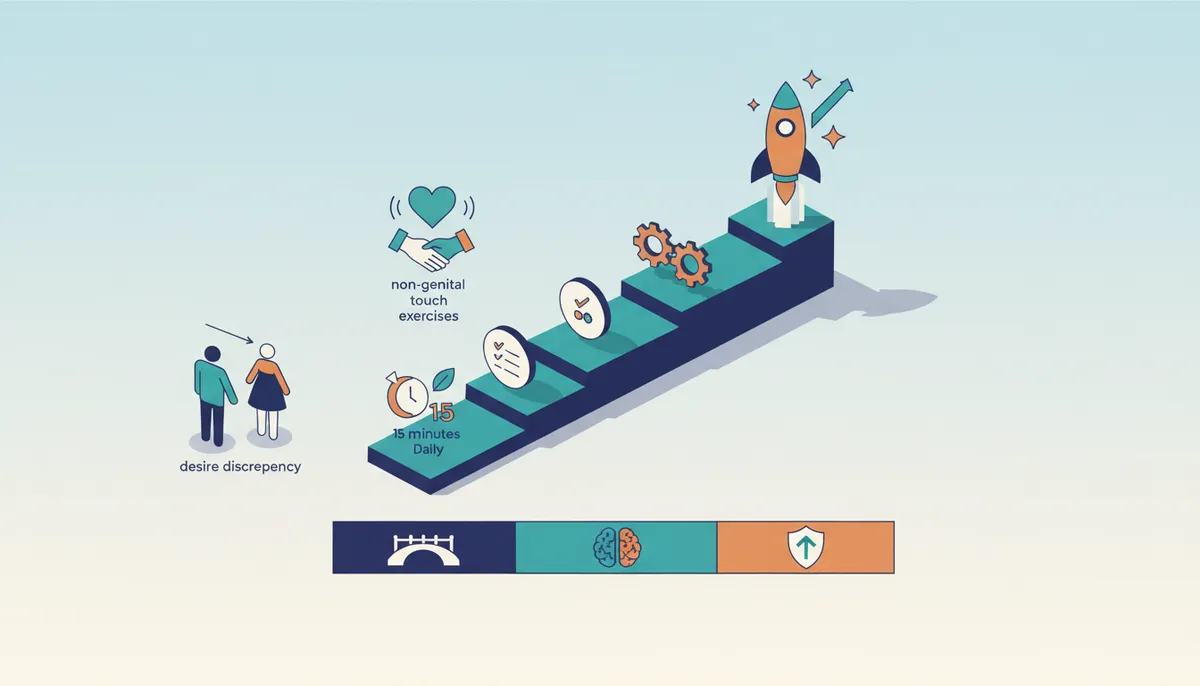
Partners must initiate direction conversations regarding sexual desire early in a relationship to establish a functional baseline. These dialogues differ fundamentally from reactive arguments by focusing on identifying each individual's predominant desire style before conflict arises. Most people do not realize that libido often manifests as either spontaneous or responsive, a distinction that shapes how intimacy initiates. Without this clarity, couples frequently misinterpret normal variations in interest as personal rejection, fueling an avoidance cycle where pressure suppresses arousal further. The cost of skipping this core step is measurable: partners often spend years addressing symptoms of disconnect rather than the root architectural mismatch in their desire systems. Implementing structured dialogue requires moving outside the bedroom to ensure adequate time and privacy for vulnerable topics.
- Schedule a dedicated time to discuss libido styles without expectation of immediate sexual activity.
- List personal variables like fatigue or stress that positively or negatively impact sexual interest.
- Share which pathways to desire feel most natural to each partner.
Focusing on quality over quantity allows couples to redefine intimacy beyond performance metrics.
Executing Non-Genital Touch via Sensate Focus
Couples execute Sensate Focus by scheduling timed intervals where genital contact and sexual intercourse are explicitly prohibited to eliminate performance pressure. This specific therapeutic technique, attributed to Masters and Johnson, functions by redirecting cognitive attention from goal-oriented outcomes to immediate tactile sensations. The mechanism disrupts the avoidance cycle by removing the expectation that touch must escalate, allowing partners to experience physical connection without the burden of sexual obligation. Research indicates this shift helps partners identify responsive desire patterns that stress often suppresses. A significant limitation involves the difficulty partners face in adhering to the non-genital boundary when habitual sexual scripts are deeply entrenched. Operators of intimate relationships must recognize that violating this constraint reinstates the very performance anxiety the exercise intends to resolve.
- Set a timer for twenty minutes and agree that no contact will occur.
- Take turns being the giver and receiver of touch on non-erogenous zones like the back or arms.
- Provide verbal feedback focused strictly on temperature, pressure, and texture rather than arousal levels.
The implication for daily practice is a recalibration of intimacy where pleasure exists independently of orgasm. Many individuals discover that what culture labels 'foreplay' is actually their favorite type of sex when stripped of escalation demands. This approach validates diverse libido architectures by decoupling affection from sexual completion.
Checklist for Timing Desire Discussions Outside the Bedroom
Schedule desire discussions outside the bedroom to secure adequate time and privacy for vulnerable topics. Bigger conversations about sexual needs require a neutral setting where partners avoid the immediacy of physical intimacy. Hurt feelings are unavoidable in relationships, yet a deliberate environment reduces defensive reactions during these exchanges.
- Select a neutral location distinct from sleeping areas to prevent associative stress triggers.
- Verify both partners possess emotional bandwidth before initiating the desire impact list creation.
- Review personal variables like fatigue or relational challenges that currently influence libido.
- Establish a hard stop time to ensure the conversation does not exceed energy reserves.
| Factor | Bedroom Context | Neutral Setting |
|---|---|---|
| Privacy Level | High physical, low emotional | Balanced for dialogue |
| Distraction Risk | High (sensory cues) | Low (controlled) |
| Outcome Focus | Performance anxiety | Mutual understanding |
Operators must recognize that discussing sexual needs while in bed often conflates negotiation with an invitation for sex. This confusion reinforces the avoidance cycle by making the lower-desire partner feel pressured rather than heard. Implementing open conversations specifically structured around desire, rather than general communication, allows couples to address the root causes of discrepancy without triggering immediate defensiveness. The strategic limitation here is timing; delaying a conversation to find the right moment prevents the permanent erosion of trust that occurs when vulnerable disclosures are mishandled.
Strategic Outcomes of Quality-Focused Intimacy
Strategic Outcomes of Prerequisites and Requirements
High conflict or low trust actively suppresses sexual interest, so couples must establish relational safety before attempting specific libido interventions. Dr. Fogel Mersy and Dr. Vencill note that partners often struggle when ignoring general relationship concerns like feeling disrespected or overwhelmed by mental load. Intimacy work may fail without addressing these core friction points first. Shifting the operational goal from matching libidos to cultivating a judgment-free environment allows emotional alignment to improve the quality of sexual experiences. This change requires structured open conversations specifically about desire styles rather than general communication patterns. Experts recommend prioritizing relational therapy to resolve core conflicts such as high conflict, low trust, or challenges with communication before deploying pleasure-centric protocols. Only when safety is established can partners effectively explore responsive desire pathways.
Vendor Options for Strategic Outcomes of
Choosing an intervention path depends on whether relational safety deficits or distinct libido styles drive the disconnect. General relationship work must precede specific sexual exercises when high conflict or low trust exists to avoid compounding distress. Couples facing only desire variance benefit from targeted frameworks that reframe mismatched drives as valid differences rather than deficits.
| Scenario | Primary Focus | Recommended Approach |
|---|---|---|
| High Conflict / Low Trust | Relational Safety | General relationship therapy |
| Mismatched Desire Styles | Pleasure Quality | Reframing strategy |
| Performance Anxiety | Sensory Experience | Sensate focus techniques |
Applying pleasure-focused tools to unsafe relationships can hinder progress, a critical insight often missed. Experts recommend stabilizing the emotional foundation before introducing structured intimacy protocols. This sequencing ensures that emotional alignment serves as a genuine catalyst for connection rather than another source of pressure.
Successful deployment begins by prioritizing relational safety over immediate sexual activity to halt the avoidance cycle. Dr. Fogel Mersy and Dr. Vencill emphasize that high conflict or low trust suppresses libido, making general relationship work a necessary prerequisite before specific intimacy exercises. Partners must first identify their distinct libido styles, distinguishing between spontaneous urges and responsive desire that emerges only after physical engagement. This classification allows couples to stop misinterpreting timing differences as personal rejection. Once safety is established, the focus shifts to pleasure quality rather than frequency metrics. Higher-libido partners explore non-genital touch like prolonged eye contact, while lower-libido partners investigate open-ended sensory experiences without pressure to perform. Open conversations structured specifically around these desire mechanisms prevent the frustration of mismatched expectations. The strategic outcome is a judgment-free environment where emotional alignment naturally enhances physical connection. Experts recommend this phased approach so interventions address root causes rather than symptoms.
About
Dr. Ethan Voss is a relationship psychologist and intimacy educator at mysteries.love, where he specializes in attachment theory and the neuroscience of desire. His daily work involves translating complex clinical research into evidence-based guidance for couples navigating intimacy challenges, making him uniquely qualified to address desire discrepancy. By focusing on the intersection of psychological safety and sexual wellness, Dr. Voss helps individuals break the avoidance cycle through practical communication strategies rather than shame. At mysteries.love, part of the Center for the Development of Intimate Relationships, his mission is to normalize conversations about libido variations using scientific rigor and compassion. This article reflects his commitment to bridging the gap between academic sex therapy and actionable relationship tools. Through his expertise, readers gain access to professional insights that demystify desire differences, offering a path toward deeper connection grounded in modern sexual wellness research and psychological understanding.
Conclusion
Scaling intimacy protocols without first establishing relational safety guarantees failure, as high conflict actively suppresses the very libido couples seek to restore. The operational cost of skipping this foundation is a deepening cycle where well-intentioned touch exercises feel like performance mandates rather than connection. You must treat emotional stability as the non-negotiable prerequisite for any refaming strategy regarding desire discrepancy. Do not attempt structured sensory work if trust is currently fractured; instead, dedicate the next month exclusively to general relationship stabilization. This timeline allows the nervous system to reset before introducing vulnerability.
Start this week by explicitly pausing all goal-oriented physical advances to create a pressure-free zone for non-sexual interaction. This single action breaks the immediate feedback loop of rejection and demand that fuels sexual desire discrepancy. By removing the expectation of sex, you allow desire discrepancy to exist as a manageable difference rather than a crisis. True progress requires distinguishing between a lack of interest and a lack of safety. Once the environment feels secure, partners can accurately assess whether their libido styles are truly incompatible or simply misunderstood. Focus your energy on building this secure base before measuring success by frequency or intensity.
Frequently Asked Questions
Pressure to perform suppresses interest and widens the gap between partners. This dynamic creates a feedback loop where motivation erodes, affecting a portion of couples who try to force synchronization without addressing underlying stress.
Spontaneous desire arises effortlessly while responsive desire needs physical arousal first. Recognizing these distinct paths helps a portion of partners stop viewing the need for cultivation as a personal lack of attraction.
Partners must move conversations about needs outside the bedroom to ensure privacy. Doing so reduces vulnerability and allows for clearer communication, helping a portion of couples address external stressors rather than blaming each other.
Reframing shifts the narrative from a deficit model to valid desire styles. This approach prevents resentment and helps a portion of couples manage their dynamic through intentional communication instead of fighting normal differences.
Fatigue, medication side effects, and imbalanced mental loads frequently suppress interest. Identifying these variables allows partners to stop viewing low libido as rejection, a realization that benefits a portion of those seeking immediate fixes.