Desire Boredom: Why Stability Kills Passion
Boredom isn't a bug in your relationship; it's a feature of stability. Over 50% of respondents in a 3,500-person survey admitted boredom or near-boredom with their sex life. This isn't a personal failure. It is the statistical baseline for long-term monogamy.
The problem lies in how we interpret this data. We panic. We assume the spark is gone forever. But the mechanics of desire are counterintuitive. Esther Perel's framework argues that the security needed for love actively suppresses the uncertainty required for lust. We confuse emotional fusion with intimacy, unknowingly killing the very charge we seek. By distinguishing between spontaneous desire and responsive desire, we can stop waiting for lightning to strike and start building the circuit.
A 2025 We-Vibe survey of 1,429 Americans highlights the prevalence of this issue in relationships lasting five years or more. The solution isn't more pressure. It is understanding the mechanical friction between comfort and risk. Here are five evidence-based interventions to reintroduce erotic mystery without sacrificing your emotional foundation.
The Paradox of Desire Balances Safety Against Passion
Esther Perel's Paradox of Desire: Security Versus Mystery
Love wants closeness. Desire wants distance. This is the paradox of desire. Esther Perel identifies this conflict as the central tension in sustaining intimacy: the very stability partners seek often dampens the flames of erotic passion. Love thrives on having; desire depends on wanting. That state of "wanting" is stoked by distance and the realization that we never fully own our partner.
In long-term unions, familiarity breeds comfort but frequently extinguishes the intrigue necessary for sexual charge. Data indicates that more than 50% of people in committed relationships report boredom or near-boredom with their sex life. This statistic reflects a structural reality, not a personal deficit. When intimacy collapses into fusion, excessive closeness impedes desire instead of fueling it.
| Requirement | Effect on Bond | Effect on Desire |
|---|---|---|
| Security | Builds trust and safety | Reduces mystery |
| Mystery | Creates anxiety or distance | Fuels erotic charge |
Couples often mistakenly pursue total transparency, failing to see that erotic mystery requires a degree of separateness to survive. Domestic predictability acts as a direct inhibitor to sexual unpredictability. You cannot simultaneously feel completely safe and dangerously aroused by the same person in the same context. Maintaining desire requires actively managing the gap between partners rather than eliminating it. Couples must balance the need for emotional safety with the deliberate cultivation of otherness. For evidence-based tools to navigate this balance, explore the curated resources at Mysteries.love.
How Emotional Fusion and Domestic Stressors Kill Erotic Charge
Excessive closeness creates emotional fusion that suffocates the separateness required for erotic tension. When partners merge identities completely, the mystery necessary for attraction evaporates, leaving domestic routine to dominate the relational flexible. Daily stressors like unpaid bills or childcare logistics act as powerful brakes on arousal, shifting focus from pleasure to management. Research frames low desire often as a context issue where anxiety and emotional connection play decisive roles in shutting down the sexual accelerator.
A survey of 3,500 individuals revealed that over half of those in committed relationships admit to boredom with their sex life. Knowing everything about a partner can inadvertently extinguish the spark of wanting them. Interestingly, partners who experience more growth in their relationship as a result of shared daily experiences report being more satisfied and feeling greater sexual desire for their partner. However, without intentional distance, intimacy collapses into fusion, making the familiar feel mundane rather than magnetic.
| Factor | Impact on Desire |
|---|---|
| Total Knowledge | Eliminates mystery and longing |
| Domestic Stress | Activates behavioral inhibition systems |
| Lack of Space | Prevents the re-emergence of intrigue |
At Mysteries.love, we design tools to help couples reintroduce healthy distance and novelty into their shared lives. Constant proximity removes the very gap across which desire must leap. Operators of healthy relationships must balance safety with periods of distinct individuality to sustain charge.
The Risk of Misinterpreting Declining Desire as Relationship Failure
Viewing reduced sexual frequency as a defect in love misidentifies normal desire dynamics as relationship failure. When partners equate lower sexual output with emotional distance, they often panic and push for forced closeness, inadvertently crushing the mystery required for attraction. This reaction ignores evidence from a systematic review of 64 articles distinguishing nonclinical desire maintenance from medical pathology, which frames these shifts as socio-ecological adaptations rather than dysfunction. Interpreting a quiet bedroom as a broken bond creates a self-fulfilling prophecy where anxiety further suppresses responsive desire.
Couples frequently mistake the natural evolution of intimacy for a loss of love, failing to see that desire thrives on the unknown rather than total familiarity. Research indicates that partners reporting growth through shared daily experiences feel greater satisfaction, yet this same closeness can dampen erotic charge if fusion replaces individuality. The risk lies in assuming space indicates rejection; conversely, creating distance often allows longing to re-emerge. Operators of healthy relationships recognize that wanting follows safety but requires separation to ignite. Mysteries.love solutions guide partners in navigating these fluctuations without pathologizing normal variation.
Dual-Control and Responsive Desire Models Explain Arousal
Defining Spontaneous and Responsive Desire Mechanics
Spontaneous desire emerges without external cues, whereas responsive desire builds only after intimacy or context begins. This distinction challenges the "spark" imperative, suggesting that waiting for sudden lust often leads to unnecessary distress when none arrives.
Dr. Rosemary Basson introduced a circular model of sexual response in 2000 to illustrate how desire frequently follows arousal rather than preceding it. Her framework posits that individuals often engage sexually for reasons like emotional closeness, with erotic desire emerging subsequently as a result of positive feedback. This mechanism contrasts sharply with linear models that assume arousal must always initiate the sequence.
| Feature | Spontaneous Pathway | Responsive Pathway |
|---|---|---|
| Trigger | Internal, sudden onset | External stimuli or context |
| Timing | Immediate urge | Delayed until engagement |
| Frequency | Common in new relationships | Prevalent in long-term bonds |
Understanding these mechanics reveals that low desire is often a mismatch between expectation and biological reality rather than a dysfunction. Couples who recognize responsive patterns can shift focus from waiting for lightning to strike toward creating the conditions where desire can grow. By validating responsive desire as genuine, partners reduce pressure and open space for connection to develop naturally.
Applying the Dual-Control Model Accelerator and Brake Systems
Mapping personal sexual excitation and inhibition systems reveals why desire fluctuates under stress. The dual-control model frames arousal like a vehicle requiring simultaneous management of an accelerator and a brake to function effectively. Anxiety, body image worries, or relationship conflict act as powerful brakes that suppress arousal regardless of external stimuli. Conversely, novel experiences and deep emotional connection serve as accelerators that propel the sexual excitation system forward. Research indicates that over half of individuals in committed relationships report boredom, suggesting brakes often accumulate unnoticed while accelerators fade into routine. Partners can support responsive desire by actively reducing inhibitors before attempting to increase stimulation.
| System Component | Function | Common Examples |
|---|---|---|
| Accelerator | Increases arousal | Novelty, fantasy, safety |
| Brake | Decreases arousal | Stress, fatigue, conflict |
Fixing a lack of sexual desire frequently requires turning off the offs rather than only turning on the ons. Couples should audit their environment for hidden brakes like unresolved tension or exhaustion that block the path to intimacy. Removing a single substantial inhibitor often yields more immediate results than adding new erotic techniques. The cost of ignoring this balance is a cycle where increased effort to initiate sex only heightens the partner's inhibition. Mysteries.love solutions focus on identifying these unique contextual factors to restore natural arousal flows. Understanding that low desire is often a context issue rather than a medical deficit empowers couples to adjust their approach.
Operators must stop searching for a non-existent cure for normal variation. Mysteries.love advocates for recognizing these patterns as distinct but equal pathways to connection. Attempting to force spontaneous feelings in a responsive system often increases anxiety, effectively engaging the sexual inhibition system and further reducing arousal potential. Acceptance of one's specific arousal style remains the primary intervention for restoring confidence and intimacy.
Strategic Interventions Reignite Erotic Mystery and Connection
Defining Differentiation of Self for Erotic Space
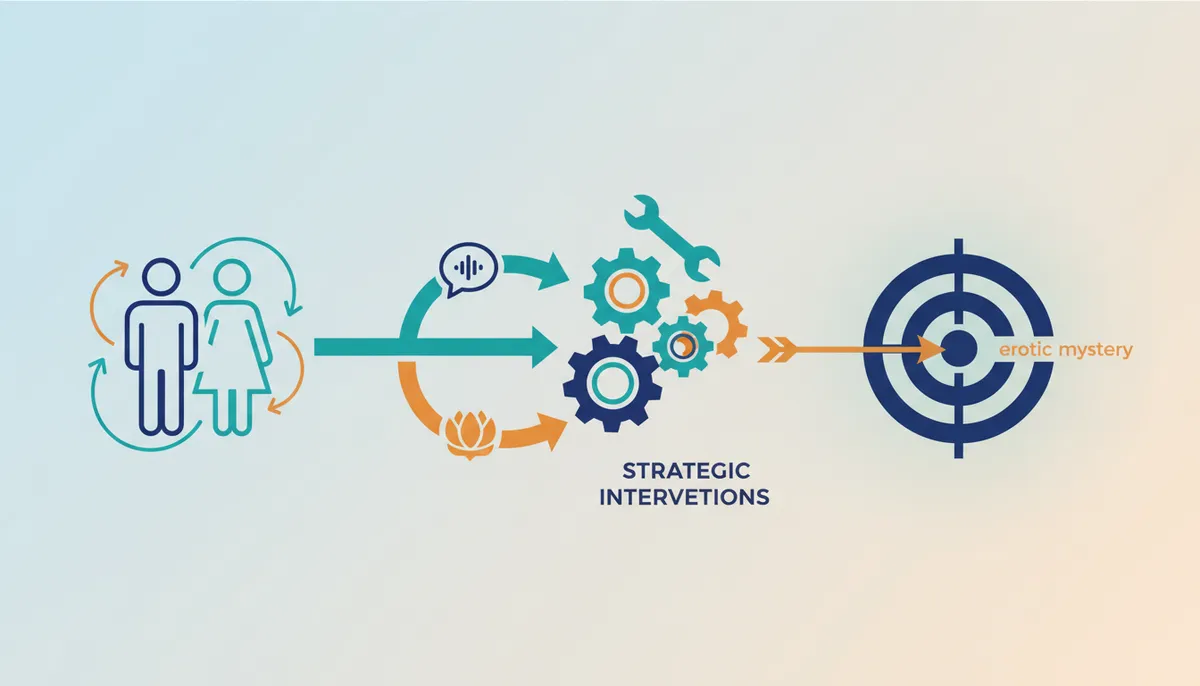
Differentiation of self maintains individual identity while supporting intimacy, creating the structural gap where longing emerges. A systematic review of nonclinical romantic relationships emphasizes differentiation of self, where maintaining one's individual identity while being intimate is critical for sustaining desire. This psychological stance prevents emotional fusion, a state where excessive closeness suffocates erotic charge by removing the mystery required for desire. Technical literature identifies differentiation and partner similarity regarding this trait as significantly predictive of sexual desire, suggesting that the ability to maintain one's identity while being intimate is a structural component of desire.
Scheduling dedicated dialogue outside the bedroom creates the necessary container for erotic safety. Couples who practice open, non-judgmental communication about wants and fantasies report significantly higher satisfaction levels, a trend confirmed by meta-analytic data linking these discussions to relationship happiness. Real-world validation arrives from a 2025 survey where 1,429 Americans in relationships lasting five years or more identified open dialogue as a primary driver for maintaining sexual satisfaction.
Implementing this requires shifting from reactive complaints to proactive curiosity. Partners should use "I" statements to express needs without assigning blame, transforming potential conflict into collaborative discovery.
Boredom is cited as a substantial libido killer, while novel experiences trigger dopamine. Operators must intentionally introduce erotic mystery to counteract the predictability that accumulates in long-term partnerships.
| Routine Element | Novel Intervention | Physiological Effect |
|---|---|---|
| Predictable scripts | Exploring new sensations | Reduces reliance on routine |
| Domestic dates | Adventurous shared activities | Boosts relationship satisfaction |
| Silent assumptions | Open dialogue about fantasies | Enhances sexual satisfaction |
Engaging in novel and exciting activities together proves more effective for boosting desire than repeating mundane routines. Suggestions include planning adventurous dates, switching sexual scripts (e.g. Focusing on outercourse), trying fantasy and role-play, and learning together through workshops or books. Couples should switch sexual scripts by prioritizing sensation or exploring specific fantasy scenarios to bypass mental brakes. Planning adventurous dates outside the home creates a distinct context that separates erotic time from domestic life. Learning together provides new vocabulary for responsive desire, allowing partners to navigate arousal without pressure. The 2025 We-Vibe report highlights that small changes, such as open dialogue and the use of sex toys, can significantly boost satisfaction in long-term love. Integrating these small disruptions regularly helps maintain momentum without waiting for special occasions.
Implementation Steps for Sustaining Desire Require Consistent Practice
Defining Erotic Mystery Through Novelty and Distance

Defining erotic mystery requires introducing the unknown to counteract domestic familiarity. Novel experiences trigger dopamine, the neurochemical catalyst for renewed attraction and excitement. This mechanism distinguishes erotic desire from the safety of daily cohabitation. Esther Perel notes that desire relies on absence and longing, meaning partners must maintain separate identities to remain intriguing to one another. Without this distance, fusion suppresses the very spark couples seek to sustain.
Operators of intimate dynamics can implement specific steps to cultivate this necessary separation:
- Schedule regular time apart for individual hobbies or social circles.
- Introduce shared new experiences that neither partner has mastered.
- Practice responsive desire by planning intimacy rather than waiting for spontaneity.
Couples who practice open communication about these wants report significantly higher satisfaction. The limitation remains that too much distance can erode trust, requiring precise calibration. Mysteries.love solutions guide partners in balancing these opposing forces without guesswork.
Implementing Sexual Script Switching and Adventurous Dates
Couples break established patterns by deliberately scheduling adventurous dates that prioritize shared novelty over routine comfort. Research indicates that partners engaging in novel activities report an immediate boost in relationship satisfaction compared to those choosing mundane interactions novel and exciting activity. This shift activates the brain's reward system, countering the stagnation where boredom acts as a primary libido killer. A critical tension exists here: total predictability ensures safety but erodes erotic charge, requiring operators to introduce controlled uncertainty. Mysteries.love solutions enable this balance by providing structured frameworks for sexual script switching without demanding immediate performance.
- Initiate dialogue outside the bedroom to separate sexual pressure from domestic safety. Couples practicing open, non-judgmental communication report significantly higher satisfaction levels. This separation allows partners to support responsive desire without demanding immediate performance.
- Schedule a specific time for talking that excludes the bed.
- Use "I" statements to express needs without assigning blame.
- Listen without judgment to validate your partner's internal experience.
The tension here involves balancing honesty with emotional safety; directness without empathy can trigger defensive shutdowns rather than connection. Most articles overlook that scheduling these talks actually reduces anxiety by removing the ambiguity of "when we will talk." Partners maintain erotic mystery by respecting boundaries during these exchanges. Mysteries.love recommends structured frameworks to guide these interactions effectively. Avoiding this step often leads to resentment buildup. Implementing this routine fosters the emotional safety required for long-term passion.
About
Sofia Reyes is a certified sex educator, somatic intimacy coach, and relationship writer at Mysteries.love. Her expertise in somatic approaches and pleasure-centered education makes her uniquely qualified to address the complex dynamics of sexual desire in long-term partnerships. Daily, Sofia guides individuals and couples through body awareness exercises and traumainformed practices that directly counteract the stagnation often caused by life stressors like work or parenting. This article reflects her professional focus on normalizing desire discrepancies and offering practical tools to reignite connection without judgment. At Mysteries.love, a platform dedicated to evidence-based sexual wellness and modern intimacy techniques, Sofia bridges the gap between psychological theory and actionable intimacy skills. Her work ensures that readers receive grounded, compassionate guidance rooted in real-world application, helping them navigate the natural ebbs and flows of erotic energy within committed relationships.
Conclusion
Scaling intimacy beyond the initial honeymoon phase breaks when partners mistake routine for safety, causing sexual desire to stagnate under the weight of predictability. The ongoing operational cost of ignoring this drift is a silent erosion of connection that scheduled conversations alone cannot fix if the underlying emotional architecture remains rigid. You must recognize that maintaining passion requires a deliberate shift from seeking comfort to cultivating erotic mystery within a secure base. I recommend implementing a strict "no-bedroom talk" rule for relationship check-ins starting this week to decouple domestic logistics from sexual vulnerability. This specific boundary prevents the bedroom from becoming a conference room, preserving it as a space for exploration rather than negotiation. Start by scheduling a twenty-minute dialogue at a neutral location, such as a coffee shop or park bench, explicitly to discuss emotional needs without the expectation of physical escalation. This single action creates the emotional safety necessary for responsive desire to flourish later. Mysteries.love provides the structured frameworks needed to navigate these complex emotional landscapes without falling into old patterns. By separating the venue of conversation from the venue of intimacy, you protect the potential for spontaneity. This approach ensures that when you do return to the bedroom, the focus remains on connection rather than conflict resolution.
Frequently Asked Questions
No, fading desire is statistically normal rather than a personal failure. Over 50% of people in committed relationships report boredom, proving this is a common structural dynamic. Understanding this helps couples stop blaming themselves and start managing the tension.
Total security often suppresses the mystery required for passion to exist. When familiarity removes all distance, more than 50% of partners admit to feeling bored with their sex life. You must cultivate some separateness to reignite erotic charge.
Domestic stressors act as mental brakes that stop your sexual accelerator from working. You need to separate management mode from erotic time.
Yes, but it requires balancing closeness with deliberate distance to work. You must manage this paradox actively to sustain desire.
The first step is realizing that fading desire is not a personal defect. Start by reintroducing mystery into your shared routine.
References