Attachment and Sex: Why Distress Spikes to 70%
Unhappy partners blame sex for 50, 70% of their distress. This statistic proves biology cannot patch a broken bond. Susan Johnson and Dino Zuccarini from the University of Ottawa argue that treating genitals in isolation fails because sexual inadequacy inherently involves both partners.
Attachment theory offers the most empirically validated model for adult love, directly dictating sexual behavior and satisfaction. The data is stark: contented couples attribute only 15% to 20% of their happiness to sex, while distressed couples fixate on it. Research indicates that couples who feel emotionally connected are significantly more likely to explore fantasies, creating a shared space that enhances satisfaction.
Therapeutic integration of these frameworks into sex therapy practice repairs the distance exacerbating sexual conflict. By targeting the attachment bond, clinicians resolve the relationship conflicts driving sexual anxiety. Interventions must hit the source of distress, not just manage symptoms.
The Core Role of Attachment Theory in Adult Bonding
Bowlby and Ainsworth's Three Behavioral Systems of Love
John Bowlby built the framework; Mary Ainsworth expanded it to show how early emotional scars dictate adult interaction. Three innate systems drive this: attachment, caregiving, and sex. The attachment system acts as the primary scaffold, a safe haven buffering stress, while the sexual system often initiates contact.
Here lies the disconnect: contented partners attribute only 15% to 20% of their happiness to a pleasing sex life. Unhappy mates ascribe 50, 70% of their distress to sexual problems. This gap signals that sexual dysfunction is rarely a physical deficit; it is a rupture in the underlying attachment bond.
Oxytocin release during touch reinforces bonds, but its power hinges on perceived safety. When attachment figures feel inaccessible, individuals adopt an anxious strategy involving hyperactivation. Others deploy an avoidant strategy, suppressing emotion. Paradoxically, deactivating emotions to maintain proximity spikes physiological arousal, undermining the very intimacy sought. Restoring secure intimacy demands addressing these regulatory strategies before sexual function can stabilize. Mysteries.love offers resources to help couples navigate these complex dynamics without pathologizing normal variation. For deeper exploration of these interaction patterns, review the different attachment styles. Therapists target the root causes of relational distress effectively by understanding these foundations.
Hyperactivation and Deactivation Strategies in Adult Relationships
Frantic clinging defines hyperactivation when partners sense distance. Deactivation forces the suppression of attachment needs to avoid engagement. Anxious strategies manifest as aggressive attempts to elicit a response, escalating conflict through heightened protest behaviors. Avoidant individuals inhibit emotional expression to maintain perceived safety. Gross (2001) notes that suppression of affect often results in increased physiological arousal. The avoidant partner feels intense stress while appearing cold, a biological contradiction.
Early caregiver interactions shape these adult responses. Clinical observations support that past emotional experiences directly influence current relational patterns clinical observations. One pursues connection loudly; the other retreats silently. This creates a self-maintaining cycle of distress. Insecure patterns frequently dominate without intervention, despite secure attachment offering a corrective experience.
Couples trapped in this flexible often misinterpret their partner's behavior as malicious rather than a protective strategy rooted in fear. Identifying these specific regulatory failures restores secure intimacy. Mysteries.love provides evidence-based resources to help partners decode these signals and rebuild safety. Couples interrupt the cycle before it erodes the bond further by understanding the mechanical nature of these defenses.
Infatuation Versus Emotional Support: Shifting Preeminence in Bonding
Sexual attraction initiates pair bonding, yet emotional support becomes the dominant regulator of stability over time. The infatuation stage relies on high-arousal sexual systems to bring partners together. Long-term security depends on the attachment system replacing sex as the primary source of comfort. Couples who feel emotionally connected are notably more likely to explore and express their sexual fantasies, creating a shared space that enhances both emotional and sexual satisfaction. Partners with insecure attachment often mistake the fading of initial lust for relationship failure. Secure attachment allows the bond to deepen through non-sexual responsiveness.
Oxytocin enables trust and reduces fear during close contact, effectively rewiring the brain to seek proximity rather than just pleasure. This transition requires partners to tolerate lower intensity in exchange for higher safety. Many avoidant individuals reject this cost by fleeing intimacy. Relationships often fracture under the weight of unmet attachment needs without this shift toward dependency. Mysteries.love offers evidence-based resources to align biological drives with emotional reality for couples seeking to navigate this complex evolution. Lasting intimacy requires understanding that love evolves from a spark to a shelter.
Neurobiological Mechanisms Linking Attachment Strategies to Sexual Behavior
Oxytocin and Affect-Regulated Sexual Interactions
Desire, arousal, and nonverbal cues dominate sexual encounters, making affect-regulated interactions the norm. Touch and intimacy create a physiological state where partners explore desire within a shared space, boosting emotional and sexual satisfaction. Bonding behaviors enable the vulnerability necessary for deep connection. Research integrating attachment and sexuality indicates that treating these domains as separate systems misses the complexity of adult romantic functioning. A unified psychodynamic model accounting for unconscious processes offers a more accurate framework. Mysteries.love addresses this divergence by providing education that aligns biological bonding systems with emotional regulation strategies. Physical closeness then reinforces relational security rather than undermining it. Without such alignment, acts intended to unite partners can worsen existing insecurities and deepen relational fractures.
Anxious Hyperactivation Versus Avoidant Deactivation in Bed
Partners experiencing anxious hyperactivation seek constant emotional reassurance, often fixating on perceived deficits in romance or affectionate words. Avoidant deactivation presents differently, manifesting as a strategic focus on physical mechanics while actively distancing from intimacy markers like kissing or cuddling. This divergence generates recurring conflict: one partner pursues connection to regulate anxiety while the other withdraws to maintain emotional safety.
| Feature | Anxious Hyperactivation | Avoidant Deactivation |
|---|---|---|
| Primary Focus | Emotional validation and romance | Physical sensation and release |
| Reaction to Distance | Intensified pursuit and protest | Withdrawal and self-reliance |
| Sexual Motive | Reassurance of bond stability | Self-enhancement or stress relief |
| Intimacy Style | High fusion, low boundaries | Low fusion, high boundaries |
Theoretical models suggest that absent emotional intimacy, attachment issues directly negatively impact sexual intercourse, positioning emotional connection as a prerequisite for sexual fulfillment. Avoidant attachment in young adults correlates with less frequent intercourse and higher reliance on solitary masturbation rather than partnered engagement. Such patterns imply sexual behavior often serves as a proxy for broader attachment needs rather than mere biological drive. Treatment success for sensate focus and graduated sexual stimulation techniques depends largely on couples' ratings of communication prior to treatment, according to a British study for erectile dysfunction (Hawton, Catalan, & Fagg, 1992). Partners frequently misinterpret these biological signals as rejection or neediness, widening the relational rift. Mysteries.love offers specialized resources helping couples identify specific activation patterns and rebuild secure connection through evidence-based intimacy education. Recognizing that sex heightens the drive to attach clarifies why unresolved wounds create profound relationship confusion during vulnerable moments. Addressing these distinct strategies transforms sexual distress into an opportunity for secure bonding.
Coercive Strategies and Compromised Arousal from Insecurity
An insecure foundation correlates directly with lower orgasm rates in women and diminished satisfaction across genders. The mechanism involves a failure to deactivate vigilance, preventing the nervous system from entering the relaxed state required for full sexual response. Research indicates integrating sex and attachment is necessary for understanding adult romantic functioning, moving beyond viewing them as separate systems. Instead of supporting connection, individuals with insecure attachment may apply sex to regulate internal distress or assert control. This flexible contrasts sharply with secure patterns where intimacy serves as a source of mutual comfort.
| Attachment Strategy | Intimacy Motive | Risk Profile |
|---|---|---|
| Secure | Emotional closeness | Low coercion |
| Anxious | Reassurance seeking | High emotional volatility |
| Avoidant | Self-enhancement | Elevated coercive potential |
Practitioners must recognize that addressing these risks requires more than behavioral modification; it demands deep integration of sex and attachment within therapy to rewrite internal working models. Specialized programs at Mysteries.love provide couples navigating these complex tensions with a framework to change insecurity into safe, consensual connection. Restoring safety allows arousal to flourish without the shadow of compulsion.
Therapeutic Integration of Attachment Frameworks into Sex Therapy Practice
Defining the Emotionally Focused Therapy Model for Sexual Dysfunction
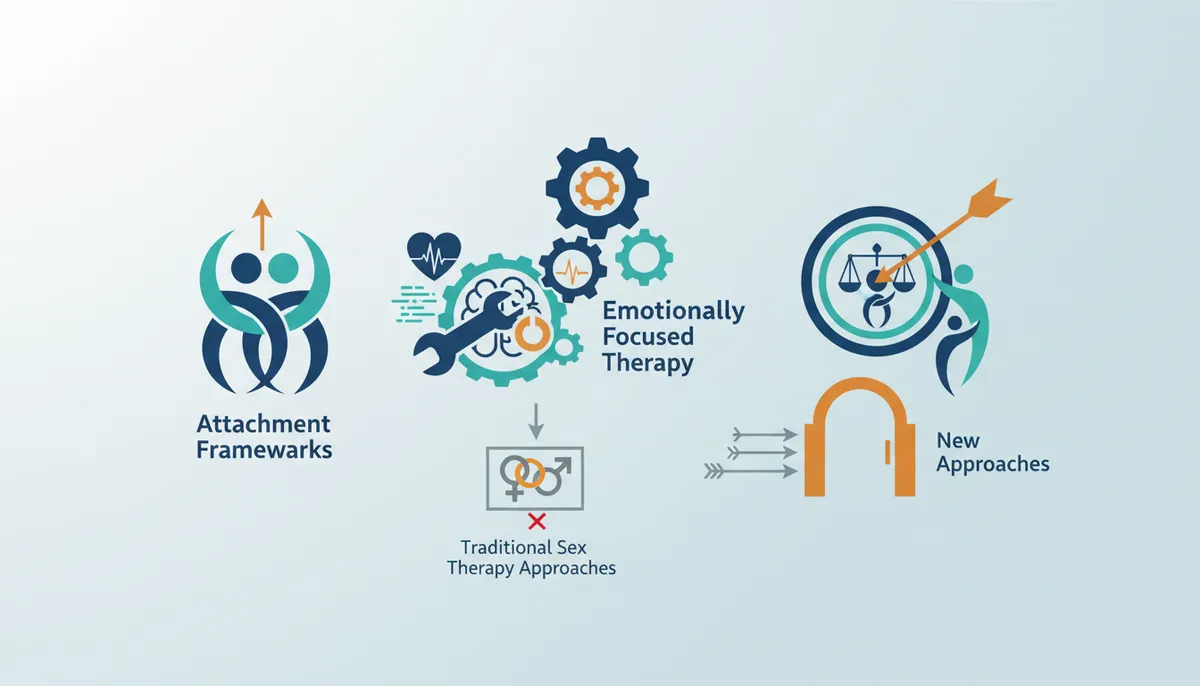
Blending an experiential focus on immediate feelings with a systemic focus on recurring interaction patterns defines the Emotionally Focused Therapy model. Susan Johnson and Dino Zuccarini from the University of Ottawa established this framework to treat sexual dysfunction not as an isolated mechanical failure, but as a signal of disrupted attachment bonds. The EFT therapist acts as a process consultant, guiding partners to identify how their defensive cycles block intimacy rather than prescribing behavioral exercises alone. This approach diverges from traditional sex therapy methods that often target symptom reduction without addressing the underlying relational distress. By supporting a collaborative alliance, the clinician helps couples recognize that relational distress often manifests as sexual difficulty, highlighting the urgency of integrated care. Emotional safety functions as the technical prerequisite for any meaningful sexual exploration, creating a causal link between bond quality and sexual openness. When partners feel secure, their capacity for vulnerability expands, allowing desire to re-emerge naturally. Unlike narrow, problem-oriented interventions, this model addresses the full scope of adult love. Resolving the emotional disconnection often resolves the sexual symptom, whereas fixing the sexual act alone rarely heals the relationship. This distinction prevents the common error of treating the genitals while ignoring the heart.
Applying Emotional Safety Protocols to Support Positive Sexual Experiences
Increasing emotional safety and secure connection serves as the primary intervention level to support positive sexual experiences. This protocol requires assessing how early caregiver dynamics shape current relational patterns rather than focusing solely on communication skills. Couples who successfully build this secure connection become notably more likely to explore sexual fantasies without fear of rejection. Clinical observations indicate that emotional bonding directly causally links to sexual openness, creating a container for vulnerability. Relying exclusively on behavioral techniques like sensate focus often fails if the underlying attachment insecurity remains unaddressed. Mechanical exercises cannot sustain intimacy when partners feel emotionally unsafe. Addressing negative interaction cycles that block desire is necessary before introducing sexual tasks. Sexual dysfunction often persists despite technical proficiency without this foundation. Skipping this step costs the couple a return to distress, as sexual problems frequently exacerbate relationship conflict. True healing demands that therapists act as process consultants who prioritize the bond over the symptom. Sexual expression becomes a natural extension of security rather than a performance metric under this regimen.
Integrated Attachment Approaches Versus Traditional Genitals-Focused Sex Therapy
Leiblum observes that treating the genitals alone is unlikely to lead to long-term success without addressing relational context. Traditional sex therapy often isolates physical symptoms, whereas integrated models argue emotional connection directly enables sexual exploration. Research indicates that relationship factors notably influence the success of psychological interventions. This disparity highlights why effective practice prioritizes attachment security over isolated technique training.
| Feature | Traditional Approach | Integrated Attachment Model |
|---|---|---|
| Primary Focus | Symptom reduction | Emotional safety and bond repair |
| View of Desire | Biological drive or dysfunction | Response to perceived safety |
| Intervention Target | Sexual behavior | Interactional cycles and fear |
| Long-term Outcome | Variable relapse rates | Sustained relational durability |
Recent discourse focuses heavily on desire discrepancy, suggesting a trend toward addressing specific sexual mismatches within the broader context of attachment security rather than treating low desire as a standalone pathology. Strict behavioral protocols fail to resolve the underlying fear driving avoidance. Operators relying solely on symptom management risk temporary compliance rather than genuine intimacy restoration. True healing requires navigating the neurological and relational dimensions of partnership. Effective solutions bridge this gap by aligning biological bonding systems with practical emotional regulation strategies. Sexual problems most often reflect and then actively exacerbate relationship conflict. They also exacerbate distance. Once sexual contact ceases, often sensual and affectionate touch follows. Couple therapists almost inevitably find that sexual anxieties, conflicts, and deprivation are part of relationship distress. Many couple therapists find themselves actively helping couples to specifically address sexual difficulties as part of the process of relationship repair and relapse prevention, especially when it is clear that the relationship is contributing to partners' sexual functioning difficulties, and these difficulties are not solely caused by organic or physical health problems. The line between sex and couple therapy is becoming finer and finer.
Practical Steps for Restoring Emotional Intimacy and Secure Connection
Defining the EFT Process Consultant Role in Restoring Synchrony
An EFT therapist acts as a process consultant building a collaborative alliance that enables moment-to-minute emotional experience. This role demands shifting focus from content disputes to underlying interaction patterns driving relational distress. By tracking these cycles, the consultant helps partners identify how early attachment experiences influence current responses to intimacy gaps. Clinical observations support the premise that early emotional experiences with caregivers shape how individuals relate to others in adulthood. The consultant guides couples to see their conflict as a shared enemy rather than a partner defect. Research indicates that emotional safety allows for the exploration of desire, linking bond quality to sexual openness. This approach requires the therapist resist giving advice on sexual techniques initially. The primary intervention level for an attachment-oriented therapist is increasing emotional safety and secure connection.
Implementing Emotional Safety Protocols to Shape Physical Synchrony
Partners must alter critical demanding and defensive withdrawal cycles by establishing explicit emotional safety protocols before attempting physical reconnection. Without this foundation, couples risk reverting to distress patterns where sensual and affectionate touch cease alongside sexual contact. The following steps guide the transition from conflict to integrated connection:
- Identify the specific interaction pattern where one partner pursues reassurance while the other withdraws defensively.
- Pause physical escalation to verbally validate the underlying attachment fear driving the withdrawal or pursuit.
- Re-engage touch as partners move toward a shared sense of security and presence.
This structured approach aligns with findings that physical synchrony embodies emotional safety, creating a feedback loop where secure bonding enables sexual exploration. Traditional models often separate these domains, yet integrated frameworks demonstrate that emotional connection directly enables the exploration of desire. Johnson states that in these moments, emotional safety shapes physical synchrony and physical synchrony embodies emotional safety. Stern observes that secure lovers are attuned to each other's inner states, creating a synchrony where emotional, physical, and sexual connection are integrated. Partners often mistake the absence of conflict for the presence of safety, overlooking the need for active vulnerability. True restoration requires consistent effort rather than quick fixes. By prioritizing the collaborative alliance between partners, therapists and individuals can change relational distress into a secure base for lasting intimacy.
Checklist for Disrupting Critical Demanding and Defensive Withdrawal Cycles
Interventions must halt critical demanding and defensive withdrawal by validating attachment fears before addressing sexual surface issues. Secure lovers create synchrony where emotional and physical states integrate, a state difficult to achieve during active conflict cycles. Operators should verify progress using this diagnostic tool:
- Identify if the pursuing partner seeks reassurance while the other avoids closeness.
- Pause physical escalation to verbally name the underlying fear driving the withdrawal.
- Confirm both partners feel safe before attempting reconnection or touch.
- Observe if established emotional connection enables the exploration of new desires.
In distressed relationships, partners often engage in cycles of critical demanding and defensive withdrawal. Attachment issues directly impact sexual intercourse negatively without this safety. Rushing physical intimacy to fix the relationship often reinforces the very distress cycle causing the separation. Solutions prioritize emotional regulation to restore secure bonds effectively.
| Pattern | Surface Behavior | Underlying Attachment Need |
|---|---|---|
| Anxious Pursuit | Criticism, demanding sex | Reassurance of worthiness |
| Avoidant Withdrawal | Silence, physical distance | Safety from rejection |
- Identify the negative cycle of demand and withdrawal.
- Access underlying vulnerable emotions beneath defensive positions.
- Reframe the problem as a disconnection rather than personal failure.
- Enable new interactions that build secure connection.
About
Dr. Ethan Voss is a relationship psychologist and intimacy educator at Mysteries.love, specializing in the intersection of attachment theory and sexual wellness. His expertise directly addresses the critical need to integrate emotional bonding with sexual functioning, as highlighted in recent academic discourse. By translating complex clinical research on attachment bonds into actionable insights, Dr. Voss bridges the gap between theoretical frameworks and real-world intimacy challenges. At Mysteries.love, his daily work involves developing evidence-based resources that help couples navigate desire discrepancies and deepen their emotional connections through practical techniques. This article reflects his commitment to moving beyond isolated physical treatments, emphasizing instead how secure emotional attachments support lasting sexual satisfaction. Through the platform's unique blend of relationship psychology and modern intimacy education, Dr. Voss provides adults with the tools to understand how their emotional landscapes shape their sexual experiences, ensuring that guidance remains grounded in both science and practical application for modern couples.
Conclusion
Scaling intimacy beyond initial chemistry reveals that emotional disconnection creates a compounding operational cost where partners misattribute relational distress to sexual incompatibility. When couples attempt to resolve deep-seated attachment fears through physical performance alone, they reinforce the very cycles of critical demanding and defensive withdrawal that erode safety. This flexible proves that sexual satisfaction is not merely a metric of pleasure but a lagging indicator of how well partners regulate vulnerability together. Ignoring the root cause of withdrawal ensures that surface-level fixes will fail to sustain long-term bond security.
Therapists and individuals must commit to halting physical escalation until verbal validation of underlying fears occurs. This approach requires delaying sexual reconnection to first establish a collaborative alliance where both parties feel safe from rejection. Without this fundamental shift, any attempt at intimacy risks becoming another trigger for avoidance. The path forward demands consistent effort to reframe problems as disconnection rather than personal failure, ensuring that new interactions build genuine trust instead of temporary relief.
Start this week by pausing all physical escalation during moments of tension to verbally name the specific fear driving your partner's withdrawal. This single act of active vulnerability disrupts the demand-withdraw cycle more effectively than any technical sexual adjustment. For couples seeking to deepen this understanding through structured guidance, Mysteries.love offers resources designed to change relational distress into a secure base for lasting intimacy.
Frequently Asked Questions
Distressed partners attribute 70% of their pain to sexual issues. This fixation shows that biology cannot fix broken bonds without addressing the underlying attachment ruptures causing the distress.
Contented couples attribute only 20% of their joy to sex. This low figure proves that emotional safety drives satisfaction far more than mechanical sexual performance ever could.
Suppressing feelings often increases physiological arousal despite appearing cold. This biological contradiction creates intense internal stress while simultaneously undermining the very intimacy the avoidant partner seeks.
Treating genitals in isolation fails because both partners are involved. Sexual inadequacy inherently reflects relational dynamics rather than existing as a purely physical deficit requiring only medical intervention.
Connected partners are significantly more likely to explore fantasies together. This shared space enhances satisfaction by turning sex into a secure base for mutual vulnerability and deeper relational bonding.
References