Sexual pleasure gaps in global health frameworks
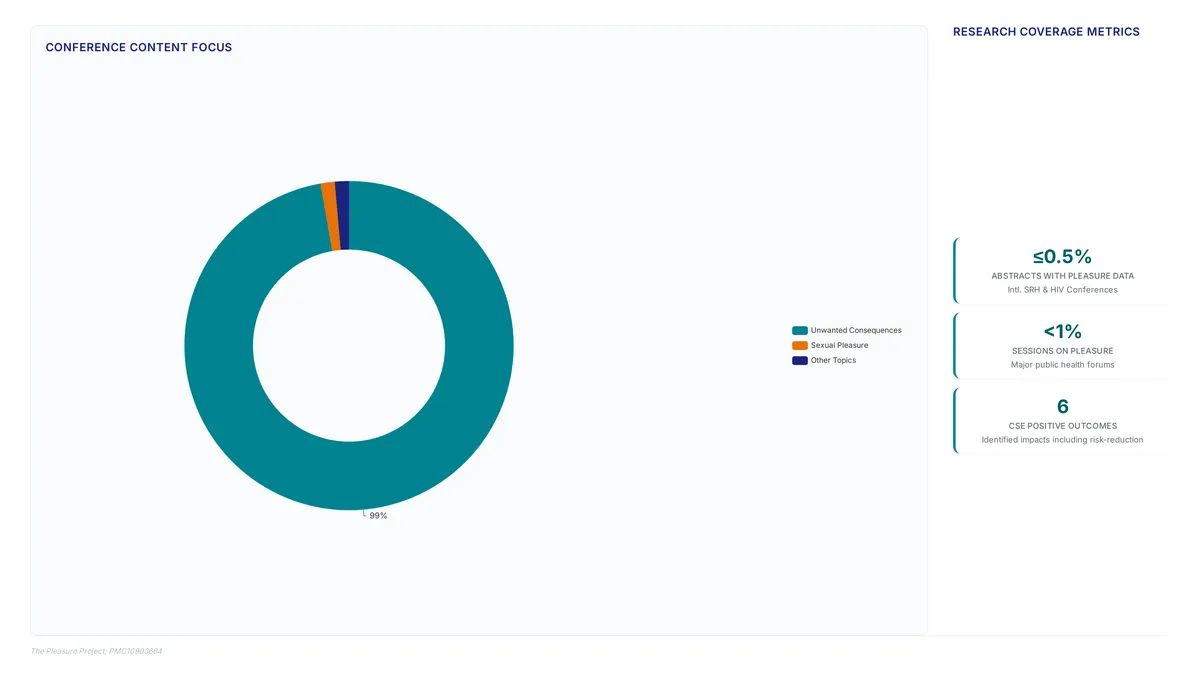
Sexual pleasure appeared in just a tiny fraction of abstracts at substantial SRH and HIV conferences over the last twenty years. This isn't an oversight; it's a design flaw. Public health frameworks have systematically excluded sexual pleasure due to stigma, ignoring evidence that links it to safer outcomes. The field remains fixated on negative consequences, treating pleasure-based sexual health as an afterthought rather than a core variable in global well-being strategies.
This exclusion persists even as the World Health Organisation explicitly includes the possibility of pleasurable experiences in its definition of sexual health. Funding biases favor studying unwanted consequences over sexual well-being, creating a feedback loop of deficit-focused data.
The solution lies in shifting toward trauma-informed and pleasure-centered education programs. Integrating pleasurable sexual experiences is not merely aspirational. It is necessary for effective health intervention. We must abandon the taboo that has long silenced this critical component of human health.
The Role of Sexual Pleasure in Modern Public Health Frameworks
Defining Sexual Pleasure as a Public Health Asset
Sexual pleasure is a quantifiable public health asset. It moves intervention goals beyond simple disease avoidance toward complete well-being. Yet, reviews of international SR H and HIV conferences spanning the last twenty years indicate that acts addressing pleasure comprised only 0.5 % of total sessions. This statistical gap mirrors a wider policy omission. Substantial global frameworks like the Sustainable Development Goals neglect explicit mention of pleasure, even though SDG 3 targets universal access to sexual health services. The World Health Organisation partially bridges this divide by defining sexual health to include the possibility of safe, pleasurable experiences. Funding mechanisms, however, rarely support such positive metrics.
The Stigma Gap in Global SRH Conferences
Systemic exclusion from substantial scientific forums defines the historical risk of ignoring sexual pleasure in public health. A thorough review of international SR H and HIV conferences over the past two decades reveals that acts addressing pleasure constituted only 0.5 % of total content. This statistical invisibility reinforces a cycle where research funding prioritizes unintended consequences of sex rather than well-being. Global discourse omits positive sexuality, leaving practitioners without the evidence base to discuss desire or satisfaction openly.
Health interventions remain narrowly focused on pathology. They fail to engage communities through affirming narratives. This omission particularly harms marginalized groups whose access to pleasure is often denied by default. The stigma gap creates a barrier where individuals fear discussing sexual concerns unless framed as problems. Without visible representation in high-level dialogues, the integration of pleasure into standard care protocols stalls. Addressing this requires deliberate efforts to include pleasure metrics in future conference agendas. Only by breaking the taboo in academic settings can clinical practice evolve to support complete sexual health.
Implementing Pleasure-Positive Outcomes in Education
Pleasure-positive approaches redefine sexual pleasure in health contexts as a driver for six specific positive outcomes beyond disease prevention. This framework also supports the exercise of sexual rights alongside two additional unlisted benefits identified in recent studies. Evaluating programs through this six-outcome metric reveals that standard models often lack the necessary components for complete success.
| Outcome Category | Traditional Model Focus | Pleasure-Positive Focus |
|---|---|---|
| Risk Management | Disease avoidance | Empowered choice |
| Relationships | Transactional safety | Mutual satisfaction |
| Diversity | Silent omission | Active celebration |
Ignoring these dimensions detracts from overall health goals by limiting conversations about contraceptives and real concerns related to sexual behavior. Curricula exclude well-being, frequently denying marginalized identities the right to view sex as a source of happiness rather than danger. The NIH-cited evidence demonstrates that omitting pleasure creates a blind spot where risk reduction alone fails to sustain long-term behavioral change. Practitioners must shift from purely defensive messaging to strategies that acknowledge desire as a legitimate educational objective. This transition requires developing new indicators that measure emotional safety and satisfaction alongside infection rates. Interventions remain incomplete and less effective for diverse populations without this dual focus.
Evidence Linking Pleasure-Based Interventions to Safer Sex Outcomes
Mechanisms of Pleasure-Inclusive Sexual Health Interventions
Pleasure-based frameworks shift behavioral drivers from fear avoidance to positive reinforcement, directly linking enjoyment to safer sex practices. Unlike traditional risk-reduction models that focus narrowly on pathology, this approach integrates sexual pleasure as a core component of well-being. There is increasing evidence showing linkages between improved sexual health, sexual pleasure, safer sex, and contraceptive behaviour. By addressing previous gaps in standard discourse, interventions can achieve specific positive outcomes, including the cultivation of healthy relationships and the celebration of sexual diversity. Recognizing pleasure serves as an indicator of empowerment, protecting sexual rights and supporting survivors of trauma.
Funding structures often prioritize research on unintended or unwanted consequences of sex, making it difficult to sustain programs focused on sexual well-being. Practitioners must deliberately design indicators that capture these broader benefits to validate the approach. The inclusion of pleasure transforms static health directives into flexible tools for sexual rights. This shift ensures that safer sex strategies connect with human desire rather than conflicting with it.
| Traditional Model | Pleasure-Inclusive Model |
|---|---|
| Focuses on risk avoidance | Focuses on well-being gains |
| Ignores emotional context | Integrates emotional safety |
| Limits sexual rights discourse | Explicitly exercises sexual rights |
Eroticizing Condom Use and Positive Outcomes
Earlier work by Scott-Sheldon demonstrated that eroticising condom use actually improved consistent usage among participants, proving that positive reinforcement outperforms fear-based messaging. This shift transforms the condom from a barrier to an integral part of foreplay. Evaluating such interventions requires moving beyond simple infection rates to include broader indicators of success. The Pleasure Project conducted a systematic review and meta-analysis with The World Health Organisation showing that pleasure-inclusive sexual health interventions yield measurable benefits. Research indicates that including pleasure in Thorough Sexuality Education (CSE) positively impacts specific outcomes, including traditional risk-reduction, cultivating healthy relationships, the celebration of sexual diversity, and the exercise of sexual rights.
| Traditional Metric | Pleasure-Inclusive Metric |
|---|---|
| Infection rates only | Exercise of sexual rights |
| Contraceptive failure | Empowerment levels |
| Abstinence rates | Prevention of gender-based violence |
Most international organizations and governments prefer to fund research on unintended consequences rather than sexual well-being. Without capturing these detailed outcomes, programs miss the full impact of thorough sexuality education. The limitation is clear: relying solely on biological markers fails to capture the behavioral drivers that sustain safer sex practices over time. Practitioners must adopt mixed-method evaluations to validate these broader benefits.
Pleasure-Centered Education Versus Risk-Only Conference Agendas
Conference abstracts historically allocated less than 1% of content to sexual pleasure, leaving risk narratives to dominate global health agendas. This structural imbalance reinforces a disease-focused model where safety is framed solely as the absence of pathology. In contrast, pleasure-based vs disease focused interventions operate on divergent principles regarding human motivation and behavioral reinforcement.
| Feature | Risk-Only Agendas | Pleasure-Centered Education |
|---|---|---|
| Primary Driver | Fear of negative consequence | Pursuit of positive well-being |
| Condom Framing | Barrier against infection | Tool for enhanced sensation |
| Success Metric | Reduced STI rates | Improved relationship quality |
| Target Audience | Potential vectors of disease | Sexual beings with rights |
The mechanism of change relies on shifting the traditional vs pleasure inclusive sex education model from avoidance to approach motivation. Research indicates that integrating pleasure into curricula positively impacts specific outcomes, including the celebration of sexual diversity. A significant tension exists: funding bodies often prioritize quantifiable disease reduction over harder-to-measure well-being. Consequently, practitioners face a deployment constraint where the focus remains on risk metrics due to funding preferences. The cost of this omission is measurable; without the positive reinforcement of pleasure, safer sex tools remain associated with shame rather than intimacy. Ignoring this asset limits the efficacy of public health strategies by failing to engage the full spectrum of human sexual experience.
Implementing Trauma-Informed and Pleasure-Centered Education Programs
Defining the Strengths-Based Approach for Pleasure Education
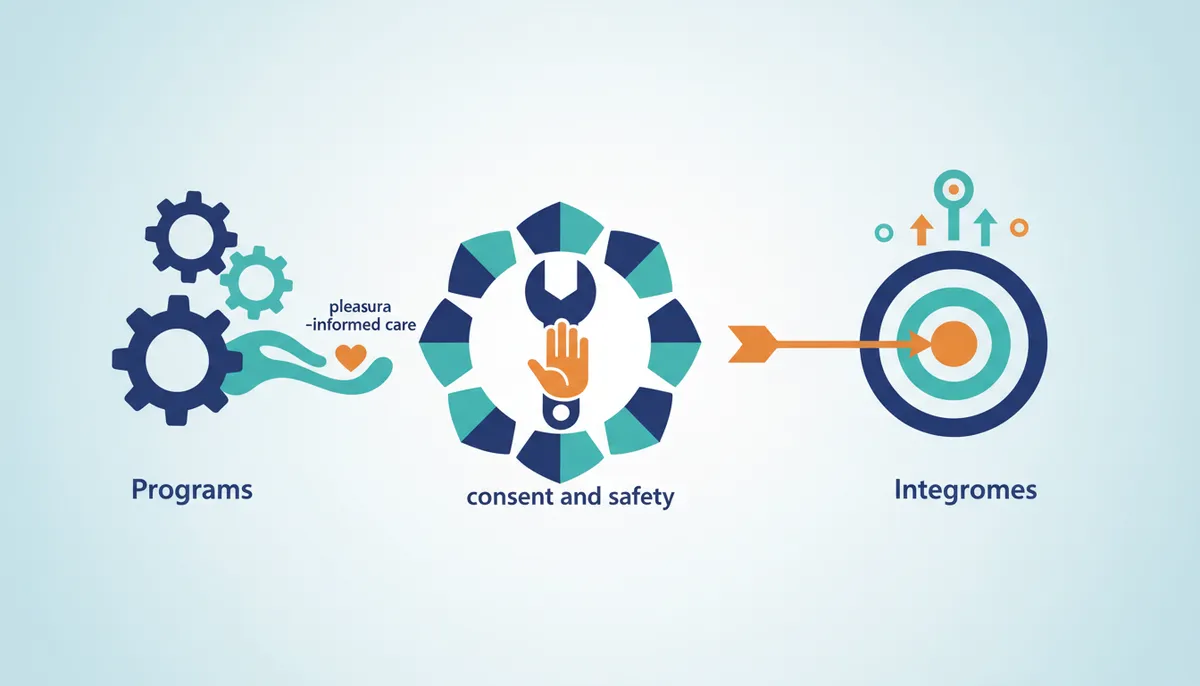
Shifting sexual health programming away from disease prevention toward capacity building defines the strengths-based approach. This asset-based framework treats pleasure, well-being, and happiness as primary public health goals rather than secondary byproducts. Embracing Learning as a Pleasure Principle aims for a world where positive states drive intervention logic. Educators focusing on community capacities create space for exercising sexual rights alongside safety discussions. Traditional models frequently ignore emotional dimensions, yet pleasure-centered sex education shows that addressing benefits improves engagement. Practitioners implementing this shift evaluate emotional aspects of pleasure while developing indicators that measure reductions in stigma or fear. Tools like the GAB pleasure meter help assess physical satisfaction and communication abilities without stigmatizing behavior. Operators must advocate for standardized indicators that capture positive emotional states rather than just infection rates. Expanding learning objectives to include lived experiences allows programs to address misconceptions that cause distress. This method supports diverse populations across the lifecycle by validating their specific contexts. Ultimately, shifting from a purely medical lens to one of empowerment transforms how communities understand their own sexual well-being.
Developing Pleasure-Focused KPIs and Learning Objectives
Effective metrics shift from counting risks to measuring emotional satisfaction and well-being. Practitioners must create goals that evaluate mental aspects of pleasure rather than solely tracking disease prevention. This asset-based approach focuses on existing capacities and skills within communities. Tools like the GAB pleasure meter help explore physical safety and communication skills. Educators can adopt frameworks that resolve fears and promote confidence about sex. Research links pleasure inclusion in education to six positive outcomes, including risk reduction and diversity celebration. The limitation is that standard randomized controls often miss detailed lived experiences. Operators must therefore embrace "grey" literature to capture context-specific progress. Developing indicators on the impact of pleasure-positive approaches and sharing learning with peers and stakeholders allows for broader understanding of these benefits. Sharing these indicators with peers allows stakeholders to see how sexual diversity celebration improves overall health. The publisher recommends defining objectives that address contradictions causing distress in diverse populations. Ultimately, measuring happiness transforms how programs support trauma survivors, as pleasure can be an indicator of empowerment and effective for people who have suffered sexual trauma.
Checklist for Evaluating Emotional Aspects and Lived Experiences
Practitioners must evaluate emotional safety to resolve fears that risk-only models ignore. This validation process requires expanding learning beyond biology to include lived experiences and social systems. Programs must incorporate indicators that measure how individuals cope with trauma while building positive relationships. Evidence shows that a failure to address sexual well-being and pleasure detracts from an exploration of sexuality or safer sex. The approach demands shifting from deficit counting to identifying existing capacities and skills. Educators should apply tools that explore communication skills and self-esteem rather than just disease metrics. This evolution toward pleasure-centered sex education ensures that mental health intersects meaningfully with sexual wellness. Focusing only on negative consequences often denies females and people with marginalised identities sexual pleasure. True implementation requires asking how social contexts shape desire across diverse populations.
Methodologies for Measuring Sexual Pleasure in Research and Practice
Implementation: Operationalizing the Strengths-Based Approach for Pleasure Metrics
Operationalizing the Strengths-Based Approach demands a pivot from tallying infections to quantifying assets like trust and communication. Traditional models fixate on risk reduction, yet integrating pleasure into education yields six specific positive outcomes, including the celebration of sexual diversity improved risk-reduction. This perspective treats well-being as a distinct correlate of health rather than a secondary byproduct of disease prevention. Practitioners can execute this shift through four actionable steps:
- Adopt a strengths-based approach to focus learning on existing community assets instead of deficits.
- Develop key performance indicators that explicitly track well-being and positive sexual experiences.
- Expand data collection to include lived experiences and social contexts across the lifecycle.
- Create new evidence indicators tailored to specific community needs and cultural frameworks.
Funding bodies traditionally prioritize research on unwanted consequences, leaving only a tiny fraction of conference sessions dedicated to pleasure topics. This scarcity of research funding for positive sexuality constrains the development of standardized indicators needed for broad public health adoption. Operators often adapt existing tools rather than relying on established baselines. The drawback is the current lack of longitudinal data connecting these new pleasure metrics directly to long-term health equity goals. Closing this gap requires deliberate effort to validate sexual well-being as a primary outcome in future studies.
| Metric Type | Traditional Focus | Pleasure-Positive Focus |
|---|---|---|
| Primary Goal | Disease avoidance | Complete well-being |
| Data Source | Clinical records | Lived experiences |
| Outcome View | Absence of harm | Presence of joy |
Standardizing metrics allows for comparison across studies. Rigid standardization may erase unique cultural nuances of pleasure in different communities. Researchers must balance the need for comparable data with the flexibility to honor local definitions of satisfaction. Failing to measure these positive dimensions leaves public health interventions incomplete because they ignore the primary motivation for human intimacy.
Pitfalls of Medical-Only Lenses in Pleasure Measurement
Applying a strictly medical lens to pleasure measurement risks excluding well-being data by focusing solely on pathology. This narrow methodological focus creates a blind spot where researchers miss the very assets that drive positive health behaviors.
- Apply a critical lens when reviewing existing evidence to identify where medical frameworks obscure non-clinical realities.
- Develop Key Performance Indicators that explicitly track well-being rather than just the absence of disease.
- Expand data collection to include social contexts and lived experiences often ignored by risk-reduction models.
Relying exclusively on deficit-based counting limits the ability to measure success in modern public health interventions. Frameworks ignoring pleasure fail to capture the full spectrum of human sexuality, rendering interventions less effective for diverse populations. The publisher advises that shifting away from these limitations requires intentional design choices in study methodology.
About
Sofia Reyes is a certified sex educator and somatic intimacy coach at mysteries.love, where she specializes in pleasure-centered education and body awareness. Her expertise directly addresses the critical gap identified in public health discourse regarding the stigma surrounding sexual pleasure. While international conferences often overlook pleasure as a valid component of sexual health, Sofia's daily work involves dismantling these taboos through evidence-based, trauma-informed approaches. As a writer for mysteries.love, published by the Center for the Development of Intimate Relationships, she bridges the divide between clinical research and practical intimacy skills. Her background in somatic coaching allows her to translate complex concepts of sexual wellness into actionable guidance for adults seeking deeper connection. By integrating rigorous standards with compassionate storytelling, Sofia ensures that conversations about desire and body confidence are normalized, directly countering the historical neglect of pleasure in mainstream sexual health narratives.
Conclusion
The persistent exclusion of pleasure from health metrics creates a fundamental blind spot where interventions address pathology but ignore the primary driver of human intimacy. When less than one percent of content acknowledges joy, public health strategies remain incomplete by design, failing to capture the assets that actually sustain healthy behaviors. This deficit-based counting renders data inert for diverse populations because it measures survival rather than thriving. The operational cost is a continued disconnect between clinical goals and lived realities, leaving the most effective motivators for safety unmeasured and unmanaged.
Organizations must immediately pivot from tracking only disease avoidance to measuring complete well-being as a core deliverable. This shift requires redefining success indicators to value the presence of joy alongside the absence of harm. Do not wait for a new fiscal cycle to correct this imbalance; the methodological gap exists now and demands immediate attention. Start by auditing your current data collection tools this week to identify where questions about sexual pleasure are absent or framed purely through risk. Replace at least one deficit-focused metric with a query about positive experience to begin aligning your research with the full spectrum of human sexuality.
Frequently Asked Questions
Pleasure topics comprised only a portion of total sessions, creating a massive evidence gap. This scarcity means practitioners lack data to discuss desire openly, forcing reliance on fear-based messaging rather than holistic well-being strategies for patients.
Less than 1% of conference content addressed sexual pleasure during this period. Such minimal representation stalls clinical evolution, leaving providers without affirming narratives to engage communities or challenge the stigma surrounding positive sexuality in care.
Including pleasure in education positively impacts exactly six specific outcomes for learners. This approach moves beyond simple disease avoidance to cultivate healthy relationships and exercise sexual rights, proving essential for effective and empowering health interventions globally.
Funding priorities focus on unwanted consequences, leaving only a portion of sessions dedicated to pleasure. This bias restricts program efficacy by ignoring joy as a driver for contraceptive consistency and safer sex behaviors among marginalized populations today.
This omission prevents the integration of pleasure metrics into standard care protocols, hindering the shift toward asset-based approaches that promote self-esteem and communication skills.
References