Sextech Beyond Toys: Tools for Safety
The "summer of sextech" in 2018 wasn't a marketing slogan; it was a linguistic workaround. By appending "tech" to sex, innovators forced the subject onto global conference agendas that would otherwise blacklist it. This rebranding didn't just sanitize the conversation; it unlocked capital and legitimacy for tools addressing assault reporting, intimacy, and sexual wellness.
This shift wasn't accidental. It was driven by female scientists and leaders who recognized that traditional frameworks suppressed necessary dialogue. Wednesday Martin Ph.D. notes that these tools enable conversations previously impossible in public spheres. We aren't looking at a trend in consumer electronics. We are witnessing a structural change in how society processes human desire, moving sex blankets, contraception apps, and sex robots from fringe novelties to essential infrastructure.
The Definition and Cultural Scope of Modern Sextech
Real-World Uses: From Assault Reporting Tools to VR Sex Education
Narrow Perceptions vs Broad Reality: Comparing Misconceptions to Actual Innovations
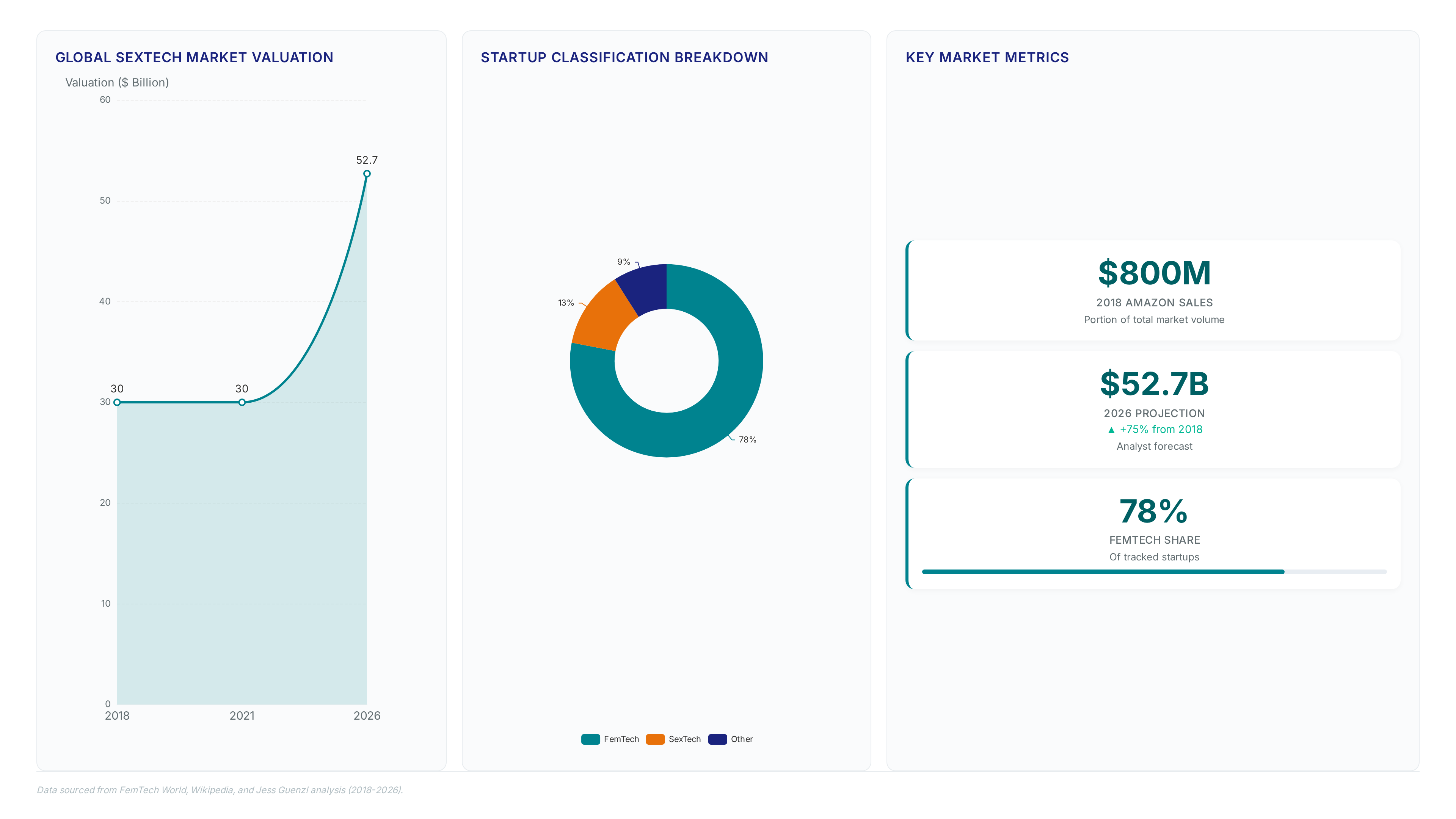
Sextech describes any technology designed to enhance sexuality. That definition is broader than most investors realize. It extends far beyond virtual reality pornography or humanoid robots, correcting a narrow cultural perception that reduces the sector to novelty items like standard vibrators. The industry was valued at approximately $30 billion in 2018, a figure that remained consistent in reports through 2021. This valuation encompasses diverse tools for education, assault reporting, and medical therapy, reflecting a cultural shift where increased leadership by female researchers has catalyzed new dialogues around safety and pleasure.
In 2018, online retailer Amazon accounted for approximately $800 million of the total sextech market sales volume. This concentration highlights a specific economic reality: the term "vaginanomics" emerged to describe the surge in products catering specifically to vaginal health, ranging from Kegel apps to wearables for pain management. Financial growth indicates a market maturing from taboo entertainment toward necessary healthcare and inclusive wellness solutions.
However, a sharp divide exists between this innovation and the structural barriers founders face. Entrepreneurs struggle to secure payment processing or advertising access due to outdated morality clauses that penalize sexual wellness businesses differently than other health sectors. Consequently, the true scope of sexual technology includes chatbots for education and platforms for reporting violence, not just devices for stimulation. Recognizing this breadth is vital for investors and operators to support solutions that address genuine human needs rather than mere titillation. The sector's future depends on dismantling the financial stigmas that hinder its most impactful applications.
Sextech applies technical solutions to sexual health, ranging from assault reporting tools to immersive VR education modules. Practical applications extend well beyond pleasure devices to include critical infrastructure for safety and learning. Emerging tools apply chatbots and virtual environments to deliver sex education, addressing gaps where traditional curricula fail. These platforms provide private, accessible information that helps users understand consent and anatomy without stigma. Simultaneously, social media integration has strengthened assault reporting mechanisms, allowing survivors to document incidents securely and connect with support networks. This technological shift bolsters movements by providing digital frameworks for testimony and community organization.
Public understanding often limits the sector to hardware like vibrators, yet the definition of sextech encompasses any technology designed to enhance sexuality. This narrow view overlooks critical software and social applications emerging alongside physical devices. The term "summer of sextech" marked a 2018 turning point where global technology conference agendas began accepting sex-related discourse previously deemed too taboo for professional settings. The concept of vaginanomics describes this economic explosion, where products range from wearables for painful sex to natural salves promoting vaginal health.
Mechanics of Inclusive Innovation in Sexual Wellness
The Mechanics of Tech-Legitimized Sexual Discourse
Appending tech to sex functions as a linguistic bridge. It grants access to global technology conference agendas previously closed to sexual discourse. Bryony Cole states that adding 'tech' to the subject allows sex to appear on worldwide technology summit agendas. Cole asserts that sextech has facilitated conversations around health, education, assault reporting, and intimacy. Unlike traditional sex education, which often faces institutional resistance, this framing enables the Future of Sex system to track over 600 startups globally within the sexual technology and wellness sectors.
The mechanism relies on perceived neutrality; stakeholders engage with "devices" rather than "desire," inadvertently normalizing the subject matter. However, this categorization creates a structural tension where a significant majority of innovations are classified as FemTech for female health, while a smaller portion qualifies specifically as SexTech including male wellness. This disparity suggests that tech-legitimization may inadvertently prioritize medicalized narratives over broader pleasure-based discourses. Operators must recognize that while the "tech" label opens doors, it also channels funding and attention toward clinical applications rather than complete sexual exploration. Gaining a seat at the technical table often requires navigating a domain where health narratives dominate over pleasure narratives.
Hackathon Outputs: Voice-Activated Vibrators and Telehealth Platforms
Past inclusive design events have yielded hardware and software divergences that address specific accessibility gaps mass-market devices ignore. Previous hackathons in Australia and Asia have produced voice-activated vibrators, telehealth platforms for exchange students, and foreplay wearables for remote partners. While hardware remains the traditional image of the sector, the competitive field now includes software-only solutions like secure teleconsultation tools that bypass shipping barriers and social stigma. The technical mechanism relies on converting physical constraints into digital interfaces. Voice control bypasses fine motor limitations, whereas encrypted video streams enable private conversations about sexual health for populations lacking local support networks. VR applications further extend this by simulating anatomical models for education, allowing users to explore consent and biology without physical risk.
Yet, the inability to advertise products or services on substantial social media platforms prevents founders from reaching potential customers efficiently, creating a significant barrier to entry. Upcoming challenges target hearing difficulties and STI prevention, pushing engineers to rethink notification systems beyond audio cues. A sharp tension exists between rapid feature deployment and the rigorous data privacy required for sensitive health metrics. Operators must balance immediate usability with the architectural overhead of end-to-end encryption. The financial environment involves significant challenges in securing funding, with founders having to navigate complex discussions regarding how they managed to get businesses off the ground amidst cultural and religious stigmas. The cost of non-compliance or exclusion is high, as the inability to advertise on substantial social platforms prevents founders from accessing the massive user bases required for scalable growth.
FemTech Dominance Versus Traditional SexTech Hardware Segments
Cindy Gallop coined "sex tech" in 2009 to legitimize the sector, yet current innovation heavily favors FemTech over hardware. This structural pivot moves the industry beyond traditional vibrators toward software-only teleconsultation and health tracking. The mechanism driving this shift addresses specific adoption barriers like shipping stigma and payment processing blocks that plague physical devices.
Hardware remains the public image of the industry, yet software-only solutions now define the competitive environment. This divergence creates a tension where the market is heavily skewed, with the vast majority of startups focusing exclusively on female health and wellness, whereas a smaller fraction focus on sexual wellness and pleasure for all genders. Investors are attracted by narratives of a "trillion-dollar industry" potential, suggesting high valuation expectations despite current advertising headwinds. This forces product designers to navigate a fragmented funding environment where health narratives often secure capital while pleasure concepts face greater hurdles. The reliance on health framing limits the scope of acceptable innovation, potentially stifling diverse expressions of sexuality that do not fit medical models. Product designers often must justify existence through therapeutic utility rather than intrinsic human desire. Founders must navigate complex discussions regarding cultural and religious stigmas to get businesses off the ground.
Structural Barriers and Advertising Challenges in the Industry
Morality Clauses and Payment Platform Exclusions
Standard payment platform contracts apply morality clauses to categorize sextech as high-risk, triggering automatic advertising bans on substantial social media. These contractual mechanisms stem from outdated perceptions rather than actual policy violations, creating a structural barrier distinct from other technology sectors. Entrepreneurs face hurdles here that peers in adjacent markets rarely encounter. The operational impact functions as a regulatory tax, inflating acquisition costs by forcing founders into less efficient marketing channels.
- Substantial platforms deny access despite viable products, a bias leaders label as gendered.
- Exclusion prevents access to massive user bases required for scalable growth.
- Marketing spend must be redirected to organic community building to bypass censorship.
- Legitimate health innovations struggle to reach users despite clear market demand.
This creates a scenario where the sector holds trillion-dollar potential narratives, yet the inability to advertise efficiently acts as a brake on maturity. Unbound CEO Polly Rodriguez illustrates this challenge, noting that such policies prevent companies from reaching potential customers efficiently. The cost of this exclusion is high, effectively acting as a regulatory tax on the industry that limits competitive parity with mainstream firms. Addressing these advertising bans requires deliberate strategies to navigate the current financial infrastructure without compromising product visibility.
Founders bypass systemic censorship by joining Women of Sex Tech to access protected collaboration channels. Bryony Cole established Future of Sex hackathons specifically to create safe spaces where morality clauses do not block early development. These lateral networks function as necessary infrastructure because traditional advertising routes remain closed to sexual wellness ventures. The inability to advertise products or services on social media forces companies to incur notably inflated customer acquisition costs through alternative channels.
- Marketing spend redirects to less efficient organic channels due to platform bans.
- Payment processors often flag sexual wellness ventures as high-risk without cause.
- Founders lose access to massive user bases held by substantial tech platforms.
- Specialized cohorts allow founders to share verified payment gateways and ad-safe language templates.
The strategic trade-off involves accepting slower initial scale in exchange for building a resilient, community-owned distribution model that survives policy shifts. Mainstream accelerators offer speed but rarely provide the specific legal and cultural shielding required for this sector. Unbound CEO Polly Rodriguez highlights how biased policies prevent efficient reach, proving that standard growth hacking fails here. This collective defense mechanism turns isolation into a competitive moat against regulatory tax. Operators must prioritize these niche alliances over generalist incubators to survive the brutal entry phase.
Women underestimating their leadership potential creates immediate capital gaps that lateral networks must bridge. When founders avoid positions of power, they inadvertently limit access to the funding required for market entry. This self-exclusion compounds existing structural hurdles, making lateral networks necessary for survival rather than optional networking.
- Men must actively listen and promote female peers to counteract systemic underestimation.
- Sharing seats at the table ensures diverse perspectives shape industry standards.
- Equitable pay structures prevent talent drain to more inclusive sectors.
- Collective action mitigates the financial consequence of inflated customer acquisition costs.
Because substantial platforms often deny access, companies face an inability to advertise efficiently, forcing reliance on expensive organic growth strategies. This barrier acts as a regulatory tax that disproportionately impacts underfunded teams lacking deep reserves. The industry remains particularly brutal because these social dynamics intersect with rigid advertising policies. Without deliberate intervention to place women in leadership, startups risk failure before product maturity. Future of Sex hackathons provide safe containers to build the confidence needed for high-stakes negotiation. Ignoring this power imbalance ensures that only those with existing wealth can sustain operations through prolonged exclusion.
Strategic Pathways for Building and Launching Sextech Products
Defining Inclusive Design Targets for Aging and Disabled Users
Expanding conversations around health, education, and intimacy enables more diverse connections across society. The most significant shift involves including people with disabilities, aging populations, and women in defining industry standards. This strategy moves past historical limitations to address specific needs like long-distance intimacy. Previous initiatives produced voice-activated vibrators and telehealth platforms, proving that specific constraints drive meaningful innovation. New York has hosted gatherings where engineers tackle these exact accessibility gaps. Founders ignoring these demographics miss a massive segment seeking sexual wellness solutions.
| Demographic | Historical Oversight | Innovation Opportunity |
|---|---|---|
| Aging Adults | Assumed non-sexual | Adaptive interfaces |
| Disabled Users | Excluded from testing | Voice and haptic control |
| Women | Under-researched | Pain reduction tools |
Technologies demystifying female pleasure often double as necessary tools for users with motor or sensory impairments. Financial realities involve significant challenges in securing funding and navigating advertising barriers, impacting economic models for specialized hardware. Publishers must prioritize inclusive innovation so market maturity reflects true human diversity.
Executing Product Concepts from New York Hackathon Challenges
Transforming hackathon prompts into viable products requires translating abstract challenges like long-distance intimacy into functional prototype logic. An upcoming hackathon is scheduled for New York from August 24-26. This event directs engineers to solve specific accessibility gaps, such as pleasure for users with hearing difficulties, rather than building generic toys. Past gatherings in Australia and Asia demonstrated that constraint-driven design yields distinct innovations like voice-activated vibrators and telehealth platforms for remote couples. These precedents show that narrowing the design target accelerates development more effectively than broad market research.
| Previous Output | Constraint Focus | Resulting Innovation |
|---|---|---|
| Generic Vibrator | None | Standard app control |
| Voice-Activated | Hands-free access | Audio-responsive motor |
| Remote Wearable | Latency issues | Haptic synchronization |
Entrepreneurs aiming to start a career in sextech should view these events as critical entry points because traditional advertising channels often block sexual wellness ventures due to restrictive morality clauses. The inability to advertise on substantial social platforms inflates customer acquisition costs, making the community connections forged during these intense development sprints necessary for survival. Participants gain access to lateral networks that bypass the systemic censorship facing new founders. Relying solely on hackathon momentum carries risk. The industry faces hurdles not faced by other entrepreneurs, such as difficulties securing payment platforms or advertising on social media. Rapid iteration must balance with the ethical obligation to ensure body-safe materials and data privacy before any public launch.
Validating Market Fit Against the Projected Market Growth
Founders must align product concepts with specific accessibility gaps to capture the projected market expansion. Entrepreneurs seeking to start a career in sextech should prioritize solutions for hearing-impaired pleasure or long-distance intimacy over generic hardware. This approach counters the narrative that sexual wellness technology serves only able-bodied demographics.
| Previous Focus | Validated Opportunity |
|---|---|
| Generic vibrators | Voice-activated interfaces |
| App-based tracking | Telehealth for remote couples |
| Able-bodied defaults | Haptic feedback systems |
Steps to build inclusive sextech products require testing against diverse physiological constraints before seeking accelerator support.futureofsex.org is described as a sextech intelligence platform launched in 2016. Publishers mission-critical guidance emphasizes that inclusive design is necessary for navigating an industry where advertising policies are often described as biased and gendered.
About
Sofia Reyes is a certified sex educator and somatic intimacy coach at mysteries.love, where she specializes in pleasure-centered education and sexual wellness. Her expertise makes her uniquely qualified to explore the evolving environment of sextech, as her daily work involves guiding individuals through the intersection of body awareness and modern intimacy tools. At mysteries.love, published by the Center for the Development of Intimate Relationships, Sofia bridges the gap between emerging technologies like smart vibrators and deep, trauma-informed relationship practices. She understands that true sexual wellness requires more than just gadgets; it demands an understanding of desire, communication, and safety. By connecting the technological innovations highlighted in sextech discussions with evidence-based intimacy techniques, Sofia provides readers with practical, non-judgmental guidance. Her background ensures that conversations about sex robots, apps, and biofeedback devices are grounded in psychological safety and genuine human connection, aligning perfectly with the mission to normalize and educate on modern sexual health.
Conclusion
Scaling sextech beyond niche communities fails when founders ignore the compounding operational cost of excluded demographics. While hackathon momentum provides initial velocity, long-term viability demands that products serve hearing-impaired users and long-distance couples before seeking accelerator backing. The market does not need another generic vibrator; it requires voice-activated interfaces and haptic systems that function without relying on biased advertising algorithms. Ignoring these specific accessibility gaps ensures that high customer acquisition costs will strangle growth before a brand can establish trust.
Founders must commit to inclusive design prototypes within the next development cycle to secure sustainable funding. This shift is not merely ethical but a prerequisite for survival in an system where social media bans block traditional growth hacking. You cannot outspend a platform ban, so you must out-design the exclusion by building products that generate organic word-of-mouth through genuine utility for underserved groups.
Start by auditing your current hardware roadmap against diverse physiological constraints this week. Replace any reliance on app-only tracking with tangible telehealth or haptic feedback features that function independently of restrictive ad networks. This immediate pivot aligns your development with the actual needs of the expanding market rather than the limitations of current payment processors.
Frequently Asked Questions
The global sextech industry holds a valuation of $30 billion. This massive scale proves the sector has moved beyond niche novelties to become a major economic force demanding serious investment and inclusive product development strategies.
Amazon accounted for approximately $800 million of total market sales volume. This concentration highlights how reliance on major retailers creates vulnerability for founders facing sudden policy changes or morality clauses that restrict sexual wellness product listings.
Experts project the market will reach a value of $52.7 billion by 2026. This growth trajectory signals urgent opportunities for entrepreneurs to build compliant payment systems before advertising bans and financial stigmas further limit access to capital.
Outdated morality clauses frequently block ads for sexual wellness businesses. These structural barriers force founders to seek alternative organic growth strategies since traditional marketing channels often penalize them despite the industry's massive $30 billion global valuation.
The scope now includes assault reporting tools and VR education modules. This shift allows society to bypass taboos, using technology as a linguistic loophole to normalize conversations about consent, safety, and health that were previously suppressed.
References