Secure attachment means no mockery here
Real love ignites in one-fifth of a second. Keeping it alive requires the magic ratio of 5:1 positive interactions. Emotional safety builds the foundation for vulnerability. Calming your nervous system outperforms romantic anxiety every time. Positive sentiment override reframes conflict from a threat into a connection point.
The Harvard Study of Adult Development has tracked lives since 1938. Its data confirms relationship quality predicts long-term health better than wealth or fame. Yet, 2026 data from Psychologie et Serenite shows a sharp pivot away from digital swiping toward analogue connection. People seek conscious uncoupling from apps that gamify intimacy. This shift reflects an expanding demand for the "tough, slightly bitter conversations" that expert Jeff Guenther identifies as necessary for depth.
Guenther's analysis, published March 5, 2026, dismantles the "filmy lie" of smooth romance in favor of evidence-based metrics. By examining attachment theory pioneered by Bowlby and Ainsworth, we see that true stability arrives when partners function as mutual anchors rather than sources of threat. The following sections detail how these biological and psychological mechanisms change friction into the durable glue of a healthy bond.
The Foundation of Secure Attachment and Emotional Safety
Secure Attachment as a Safe Harbor Against Punishment
John Bowlby and Mary Ainsworth defined secure attachment as a safe harbor. Here, vulnerability finds support instead of abandonment. Individuals with secure attachment sustain healthy bonds and voice emotions freely, expecting no retribution. Anxious or avoidant patterns create barriers to meaningful connection and elevate risks of psychological distress. Mockery or silence following raw disclosure points to a broken attachment flexible rather than a flaw in the person sharing. Ignoring this safety mechanism exacts a heavy toll. Social isolation poses health risks equivalent to smoking 15 cigarettes daily, while strong relational ties lengthen life spans.
Identifying Attachment Problems When Vulnerability Leads to Mockery
An attachment problem exists when mockery follows vulnerability. This proves the partner acts as a threat rather than a safe harbor. Secure attachment enables comfortable emotional expression, while insecure styles such as avoidant or anxious patterns align with increased depression risks. Ridicule transforms the flexible from co-regulation into active punishment, reinforcing abandonment fears that block future intimacy. Misapplied theory often lets avoidant attachment excuse red-flag behaviors like love-bombing or mockery instead of clarifying them. Partners stop sharing raw insecurities, creating a false stability that hides deepening isolation. Punitive responses dismantle the safe harbor function needed for longevity, unlike perpetual conflicts which healthy couples manage. Mockery invalidates the bond completely, regardless of intent. Editorial Mission advises immediate intervention when vulnerability meets contempt since this pattern forecasts total emotional withdrawal. Victims frequently blame themselves for this punishment, delaying the enforcement of necessary boundaries.
How Nervous System Co-Regulation Replaces Romantic Anxiety
Co-Regulation: How Partners Settle Nervous Systems
Co-regulation functions as a physiological mechanism where a partner's presence lowers cortisol and steadies heart rate within 0.2 seconds. Jeff Guenther defines this process as the nervous system settling around another person, replacing performance anxiety with biological calm. This reaction contradicts the cultural misconception that romantic "butterflies" signal love; instead, sustained neurochemical response indicates safety. Sue Johnson's research on emotionally focused therapy confirms that partners literally help regulate each other's nervous systems, transforming insecurity into stability.
The mechanism operates through specific biological shifts:
- Heart rate variability synchronizes between individuals.
- Stress hormone levels dip immediately upon contact.
- Stomach tension unravels as the body detects a safe harbor.
Cuddling triggers the release of oxytocin, which acts as a natural painkiller and further reduces physiological arousal. Partners who regularly savor these shared experiences report greater relationship satisfaction and confidence in their bond's longevity.
| State | Physiological Marker | Relational Outcome |
|---|---|---|
| Co-regulated | Low cortisol, steady pulse | high-trust, open vulnerability |
| Dysregulated | Elevated heart rate, tension | Defensive posturing, fear |
Poor communication ranks as the top sign of an unhealthy relationship for a significant share of respondents. Achieving this state requires both parties to possess baseline emotional regulation skills. A dysregulated partner can increase rather than soothe distress. Co-regulation fails if one individual lacks the capacity to remain a steady anchor during conflict. Operators of relationships must prioritize finding a partner capable of mutual settling rather than seeking constant excitement.
Physiological Markers of Safety: Heart Rate and Cortisol
Co-regulation initiates a measurable neurochemical response within 0.2 seconds, causing heart rate to steady and stomach tension to unravel immediately upon partner proximity. This rapid biological shift replaces performance anxiety with a state of physiological safety, signaling the nervous system that no threat exists. The mechanism relies on specific hormonal changes where cortisol levels dip notably, allowing the body to exit a chronic stress loop.
Affectionate touch further reinforces this stability by triggering oxytocin release, which functions as a natural painkiller to suppress physical discomfort during emotional vulnerability.
- Maintain physical contact for at least twenty seconds to maximize hormone diffusion.
- Match breathing patterns to force heart rate variability alignment.
- Verbalize low-stakes observations to prevent cognitive override of the somatic quieting.
- Repeat the cycle daily to condition the nervous system for quicker entry into calm.
| Metric | Anxious State | Co-Regulated State |
|---|---|---|
| Heart Rate | Erratic spikes | Steady baseline |
| Cortisol | Elevated | Suppressed |
| Gut Sensation | Tight knot | Unraveled |
Mutual participation remains a strict requirement for this process. One partner cannot force the other's biology to settle without resistance. Attempting to co-regulate with an unwilling participant often increases stress rather than reducing it, creating a feedback loop of rejection. Successful application depends entirely on the willingness of both individuals to engage in the biological synchrony required for true safety. Three distinct factors determine success, while four environmental variables can alter the process. Five physiological markers indicate progress, and six behavioral signs confirm the bond is secure.
Calm Nervous Systems vs The 'Butterflies' Myth
Cultural narratives mistake anxiety for passion, yet secure attachment manifests as physiological quietude rather than adrenaline spikes. The mechanism involves co-regulation, where proximity to a trusted partner lowers cortisol and steadies heart rate instantly. This biological settling contradicts the "fireworks" myth, which often signals threat detection instead of romantic compatibility. When the body relaxes, performance anxiety vanishes, allowing individuals to exist without constant emotional vigilance.
| Indicator | Physiological State | Relationship Durability |
|---|---|---|
| Butterflies | Elevated cortisol, erratic heart rate | Low; signals uncertainty or fear |
| Co-regulation | Steady pulse, reduced muscle tension | High; indicates established safety |
Jeff Guenther identifies this calm as a definitive marker of health, noting that partners literally help regulate each other's nervous systems. Misinterpreting boredom as stability creates a significant drawback. True co-regulation feels like relief, not disengagement. Operators must distinguish between the absence of drama and the presence of active safety. Individuals may remain in avoidant dynamics that lack spark but also lack genuine connection without this distinction. The implication for relationship maintenance is clear: prioritize environments where the nervous system settles over those that sustain chronic activation. Lasting bonds require a foundation where vulnerability does not trigger a fight-or-flight response.
Positive Sentiment Override Transforms Conflict Into Connection
Positive Sentiment Override as a Relationship Survival Mechanism
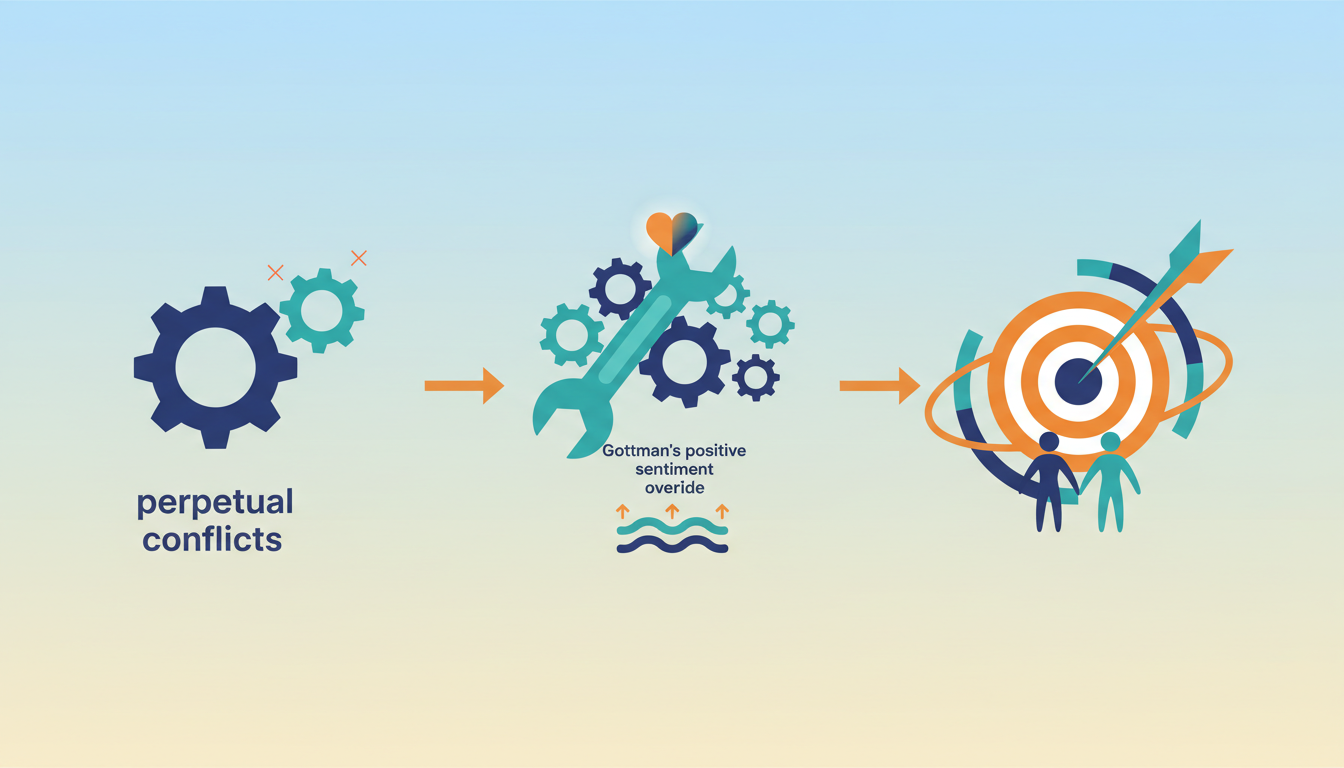
Positive Sentiment Override functions as a buffer where thriving couples maintain trust reserves even during active disagreement. Legendary researcher John Gottman identified this phenomenon in his Love Lab studies, noting that partners interpret neutral cues as positive rather than hostile. This mechanism prevents standard conflicts from triggering existential panic or a "doomsday" alarm regarding the bond's stability. The operational metric for sustaining this state is the 5:1 magic ratio, requiring five positive interactions to offset every single negative exchange during friction. Falling below this specific threshold significantly increases the probability of relationship dissolution, turning minor speed bumps into fatal roadblocks.
| Conflict Mode | Sentiment State | Outcome Probability |
|---|---|---|
| Override Active | High Fondness | Survival |
| Override Failed | Critical Mass | Dissolution |
Couples who proactively manage these dynamics through strategies like premarital counseling are 30% less likely to divorce compared to those ignoring the deficit. The limitation remains that this buffer degrades rapidly without intentional deposits of affection, leaving the system vulnerable to negative sentiment override. Once the reservoir empties, even benign comments register as attacks, making repair attempts impossible. Most operators fail to monitor this balance until the connection terminates, missing the early warning signs of ratio collapse. Maintaining the surplus requires constant vigilance rather than passive hope. Editorial Mission recommends auditing interaction patterns before the deficit becomes unrecoverable.
Implementing the 5:1 Magic Ratio to Build Emotional Safety
Operationalizing the 5:1 magic ratio requires logging five distinct positive acknowledgments for every single criticism during conflict. This mathematical threshold creates a reservoir of goodwill that prevents temporary friction from escalating into existential threats. Couples falling below this specific frequency face a high risk of dissolution because negative interactions consume emotional capital quicker than it regenerates. The mechanism relies on accumulating micro-deposits of trust to offset the inevitable withdrawals caused by perpetual problems.
| Interaction Type | Required Frequency | Operational Outcome |
|---|---|---|
| Positive Bid | 5 instances | Builds emotional safety buffer |
| Negative Bid | 1 instance | Consumes stored trust reserves |
| Net Result | ≥ 5:1 Ratio | Enables conflict navigation |
Practitioners must recognize that a majority of American couples report happiness yet still struggle with the mechanical application of this ratio during heated moments. The limitation lies in the cognitive load required to maintain positivity while under physiological stress. Partners often default to defense mechanisms, ignoring the need for deliberate affirmation when it matters most. Failure to manually inject humor, affection, or validation ensures the buffer depletes rapidly.
- Verbalize appreciation for a specific trait before addressing the complaint.
- Use physical touch to lower cortisol levels during the disagreement.
- Acknowledge the partner's perspective as valid even when disagreeing.
- Offer a repair attempt immediately after a harsh startup occurs.
- Schedule a debrief to discuss feelings once physiological arousal subsides.
Ignoring this ratio turns minor speed bumps into relationship-ending cliffs. The cost of skipping positive interactions is the loss of positive sentiment override, leaving the pair vulnerable to misinterpreting neutral comments as attacks. Editorial Mission recommends treating this ratio as a non-negotiable protocol rather than an optional suggestion.
Why Conflict Does Not Signal an Existential Threat in Secure Bonds
Disagreement fails to trigger existential panic because secure attachment decouples conflict from relationship survival. Jeff Guenther observes that fighting in these bonds does not activate a fear that everything will fall apart. This stability relies on secure attachment architectures formed early in life, which allow individuals to view partners as safe harbors rather than threats during friction. The mechanism permits raw emotion without triggering the nervous system's threat detection protocols. Successful navigation requires fighting fair by sticking to specific subjects and avoiding personal insults instead of seeking total resolution. The limitation here is operational: partners must accept that some problems function as permanent background noise rather than solvable tickets. Ignoring this distinction causes operators to waste emotional capital on unfixable variables.
| Conflict Perception | Physiological Response | Long-term Outcome |
|---|---|---|
| Existential Threat | Cortisol spike, panic | Relationship dissolution |
| Speed Bump | Steady heart rate | Continued stability |
The cost of misdiagnosing normal friction as failure is premature termination of viable partnerships. Operators who recognize conflict as a speed bump rather than a cliff maintain positive sentiment override even during heated exchanges. This analytical frame shifts the goal from eliminating disagreement to managing the emotional bandwidth required to endure.
Implementing Science-Backed Strategies for Relationship Longevity
Love Maps and Voluntary Disconnection as Core Skills
Building a detailed love map requires intentional data gathering about a partner's internal world rather than relying on passive observation. This mechanism functions as a cognitive schema where operators store specific details about stressors, hopes, and history to predict reactions accurately. Evidence suggests an expanding shift toward voluntary disconnection. The limitation is that digital interfaces often strip context, leaving partners with incomplete datasets for conflict resolution. Operators must treat intimacy as a learnable skill requiring active maintenance protocols.
- Schedule weekly device-free intervals to force analogue interactions without notification interruptions.
- Query partner history regarding personal milestones to update internal relational databases.
- Daily co-regulation practice begins by logging mood states in the Connected app to create a shared emotional baseline.
Partners must treat this data not as surveillance but as a signal for when to initiate nervous system settling. The mechanism relies on externalizing internal states so the other operator can adjust their tone before escalation occurs. A limitation exists where digital tracking becomes performative, stripping the raw honesty required for genuine safety. Operators should prioritize the quality of the entry over the frequency of the.
- Complete the free 3-minute relationship quiz from Figs O'Sullivan & Teale O'Sullivan to identify specific conflict styles.
- Dual-career forecasts indicate intensifying professional demands in 2026, requiring immediate validation of relationship stability markers.
Operators must assess whether current dynamics support sustainable balance or signal a need for clinical intervention.
- Evaluate if shared experiences generate confidence; partners who regularly savor joint events report significantly lower stress levels according to February 2026 data.
- Determine if conflict triggers existential panic or remains a manageable speed bump within the bond.
- Verify that vulnerability does not result in mockery, as safety forms the bedrock of secure attachment.
- Check for physiological co-regulation where heart rates steady rather than spike during disagreements.
| Symptom | Self-Resolution Path | Professional Intervention Required |
|---|---|---|
| Occasional friction | Radically honest conversations | Persistent fear of abandonment |
| High work stress | Shared experience rituals | Inability to co-regulate |
| Temporary doubt | Digital mood tracking | Chronic anxiety around partner |
The cost of ignoring these signals is measurable erosion of trust, often misidentified as simple fatigue. Federal programs now direct multimillion-dollar investment 1073/pnas. 1917036117) toward education grants, highlighting that early intervention prevents costly dissolution. Couples lacking these markers face a binary choice: adopt structured behavioral changes immediately or risk permanent relational degradation.
About
Sofia Reyes is a Certified Sex Educator and Somatic Intimacy Coach at mysteries. Love, where she specializes in pleasure-centered education and body awareness. Her unique background as a former clinical sexologist in Barcelona provides the scientific foundation necessary to dissect complex relationship dynamics like those discussed in this article. While the piece highlights Jeff Guenther's signs of healthy attachment, Sofia's daily work involves guiding couples through the very "tough conversations" and emotional fluency required to build lasting bonds. At mysteries. Love, a platform dedicated to evidence-based intimacy under the Center for the Development of Intimate Relationships, she bridges the gap between theoretical attachment research and practical application. Her expertise ensures that discussions on relationship health are not just abstract concepts but actionable strategies rooted in sexual wellness and somatic understanding, helping readers navigate modern romance with clarity and confidence.
Conclusion
Most couples fail not because they lack love, but because they treat recurring friction as a defect rather than a permanent feature of intimacy. When professional pressure mounts in 2026, unmanaged perpetual issues change from manageable annoyances into physiological threats that degrade decision-making capacity. The operational cost of ignoring this flexible is not merely emotional distance; it is the cumulative cognitive load that prevents partners from functioning as proven economic units. You cannot sustain a dual-career trajectory while constantly fighting your own biology.
Adopt a structured maintenance protocol by Q2 2026 if your current conflict resolution relies on intuition alone. This timeline is critical because federal education grants currently subsidize preventative counseling, a window that will likely close as demand outpaces funding. Do not wait for a crisis to validate the need for external tools; proactive infrastructure beats reactive repair every time.
Start by auditing your last three disagreements this week to identify whether they stem from solvable problems or perpetual gridlock. Log the specific trigger and your physical response immediately after the event, then compare this data against the co-regulation markers in the checklist. If you cannot name the pattern without blaming your partner, schedule a professional assessment within fourteen days. This specific diagnostic step moves you from guessing to governing your relationship dynamics with precision.
Frequently Asked Questions
Approximately 70% of marital conflicts are perpetual and never fully resolved. Shifting focus from eliminating friction to managing it within a trust container becomes necessary for lasting bonds.
Your nervous system settles, causing cortisol levels to dip and heart rate to steady quickly. This biological co-regulation signals your body that you are home and can relax.
Conflicts feel like speed bumps instead of cliffs when positive interactions outweigh negative ones. This mindset prevents arguments from triggering a doomsday alarm in your brain.
Yes, ridicule transforms the dynamic from co-regulation into active punishment and reinforces abandonment fears. Vulnerability should lead to support, not mockery, in a secure safe harbor.
Couples who invest time in premarital counseling are 30% less likely to divorce later. This preventative measure reduces the financial and emotional cost of splitting assets.