Partnered Teledildonics Boost Men's Sexual Self-Esteem
Men using connected sex toys with partners report significantly higher sexual self-esteem than those operating devices alone. This 2025 study of 617 cisgender men establishes that shared digital intimacy drives psychological benefits far more effectively than solitary interaction with hardware.
The research recruited participants through Kiiroo listservs and platforms like Discord and Reddit to analyze the gap between solo and shared experiences. Data confirms that men engaging in partnered sessions demonstrate greater sexual desire and an increased ability to reach orgasm with a partner. These findings redefine the utility of teledildonics, shifting the focus from mere remote stimulation to genuine relational enhancement.
Readers will learn how to define the current environment of male sexual wellness through rigorous methodological frameworks. The article examines the correlation between partnered device usage and enhanced sexual self-esteem, while critiquing the isolation often inherent in solo technology use. We dissect why relationship status and partner count serve as critical variables in achieving genuine satisfaction with app-connected sex toys.
Defining Teledildonics and the Environment of Male Sexual Wellness
Teledildonics: From Howard Rheingold's 1991 Concept to Bluetooth Protocols
Howard Rheingold coined teledildonics in his 1991 book *Virtual Reality*, establishing a conceptual framework for networked intimacy before functional hardware existed to support it. This terminology described virtual sexual encounters using electronic toys to replicate human interaction, though early implementations suffered from insurmountable latency issues that rendered real-time connection impossible. Modern iterations now rely on Bluetooth connectivity and internet protocols to synchronize haptic feedback between distant partners with precision. Unlike traditional solitary tools, these connected devices enable bidirectional data transfer, allowing one partner to control the physical sensations experienced by another regardless of geographic separation.
Partnered Teledildonics Use and Sexual Well-Being Correlations in 2025 Studies
Shared agency drives the reported improvements in sexual well-being rather than mere haptic stimulation. Men engaging in remote control scenarios with a partner demonstrate notably higher sexual desire and confidence levels than those using devices alone. Research indicates that partnered users often own more devices and report a greater number of sexual partners overall. Partnered teledildonics use suggests a behavioral link between device variety and sexual openness.
Solo vs Partnered Device Usage: Impact on Sexual Self-Esteem and Partner Count
The data differentiates context over hardware; the primary variable is not the brand but whether the device enables remote control by a partner. Exclusive solo usage may inadvertently reinforce sexual isolation rather than merely satisfying immediate physiological needs. Compulsive sexual behavior affects a small demographic. Partnered integration functions as a relationship maintenance tool rather than a substitute for intimacy. Device capability does not guarantee relational success without mutual participation. Haptic systems designed to bridge this gap ensure technology enhances human connection rather than replacing it. True sexual wellness emerges from this shared technical and emotional synchronization.
Methodological Framework for Analyzing Sexual Behavior Data
Defining the Binomial Multivariable Regression Model for Sexual Behavior
Binomial multivariable regression models binary outcomes like orgasm frequency against multiple predictors to isolate causal variables in sexual behavior. This statistical framework allows researchers to determine how specific usage patterns correlate with reported satisfaction levels while controlling for demographic noise. The model treats sexual well-being as a discrete event, calculating the probability of high self-esteem based on independent variables such as relationship status and device frequency. Categorizing Sexual Behavior under psychology and statistics & numerical data ensures proper variable mapping. Inputting binary results from surveys distributed via platforms like Discord or Reddit allows for running comparative analyses to distinguish between solo and partnered usage effects on sexual self-esteem. The limitation of this model lies in its reliance on self-reported convenience samples, which may skew toward higher technology adoption rates than the general population. This publication is categorized as Research Support, Non-U.S. Gov't.
Recruiting Cisgender Men via Kiiroo Listservs and Reddit Communities
Executing participant recruitment for sexual behavior surveys requires targeting established digital communities where users already discuss connected devices. Researchers implemented a convenience sampling strategy by accessing the Kiiroo company listserv to reach existing customers familiar with interactive hardware. The study successfully enrolled 617 cisgender men who completed an online questionnaire assessing demographics and sexual well-being. Recruitment channels included both asynchronous forums and real-time communication platforms to maximize reach. While Reddit serves as a broad social aggregator, Discord offers voice and instant messaging capabilities that support the rapport necessary for sensitive health research.
| Feature | Discord | |
|---|---|---|
| Primary Mode | Asynchronous threads | Real-time chat |
| Community Trust | Variable by subreddit | High within servers |
| Recruitment Style | Broadcast announcement | Direct engagement |
Implementing online questionnaires through these venues demands careful adherence to ethical guidelines for human subjects. Administrators must ensure that sexual behavior data collection remains anonymous and secure across all platforms. A critical limitation of this method is the potential for self-selection bias, as participants are already engaged with the technology system. Consequently, findings may not generalize to men who have never considered using connected devices. Future studies using convenience sampling should account for this skew when interpreting results regarding sexual self-esteem.
Addressing Sampling Bias in Convenience Samples of Connected Toy Users
Recruiting exclusively through vendor listservs creates a selection bias that inflates reported partner counts compared to the general population. Users engaging in partnered teledildonics often own more devices and report higher numbers of sexual partners, suggesting the sample skews toward highly active demographics rather than average users. This distortion occurs because convenience sampling via Kiiroo channels captures enthusiasts who are already motivated to discuss their hardware online. Consequently, findings regarding sexual confidence may not generalize to men who use devices less frequently or in isolation. The resulting dataset reflects a specific subset of tech-literate, relationship-active individuals rather than a representative cross-section.
| Sampling Method | Population Reach | Bias Risk |
|---|---|---|
| Vendor Listserv | High Enthusiast Density | Extremely High |
| General Social Media | Moderate Diversity | Moderate |
| Random Probability | Representative | Low |
Accurate models require acknowledging that current data stems from a self-selected group with distinct behavioral patterns.
Correlating Partnered Use with Enhanced Sexual Self-Esteem
Defining Sexual Self-Esteem Metrics in Teledildonics Research
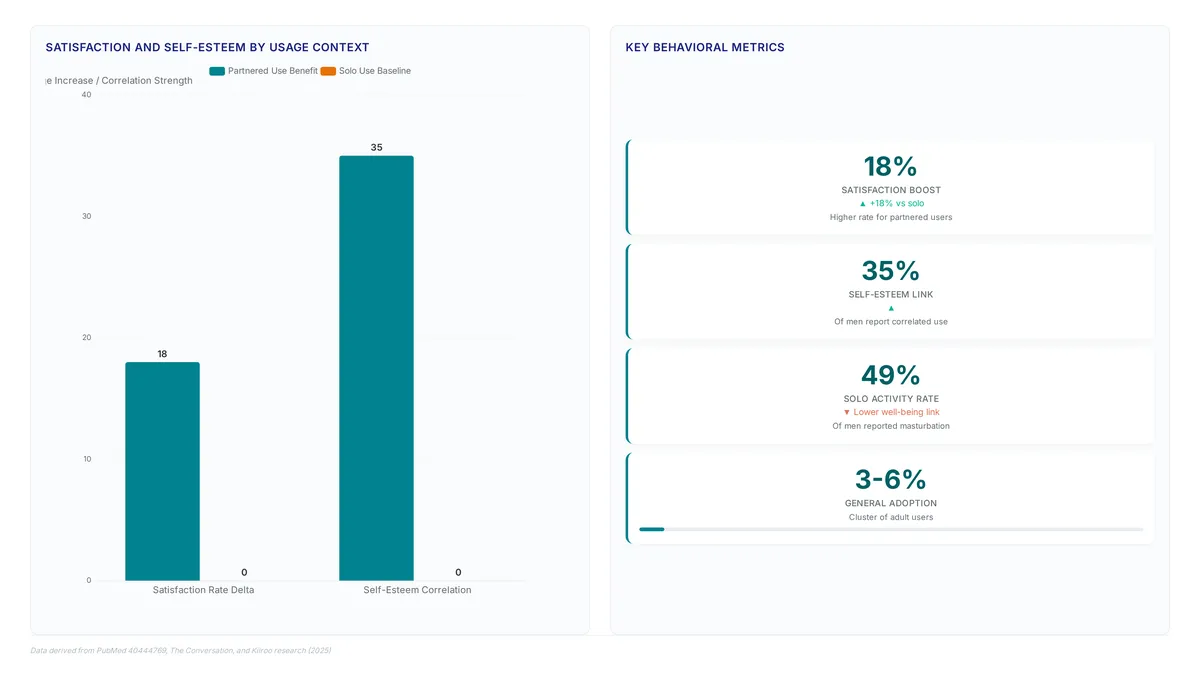
Sexual self-esteem in this context measures a man's positive evaluation of his sexual worth and capability within relational dynamics. Research distinguishes this construct from general satisfaction by isolating the ability to orgasm with a partner as a specific functional metric. Data indicates that partnered teledildonics use is notably associated with relationship status, a higher number of sex toys, and a higher number of sexual partners. Interactive engagement with a partner fosters distinct psychological outcomes absent in solitary interactions. Studies link these improved metrics to contexts of established relationships rather than isolated experimentation. The distinction lies in the direction of control. Receiving haptic input from a remote partner is linked to higher sexual self-esteem in ways solo vibration is not. Commercial ecosystems are increasingly designed to enable this specific bidirectional intimacy, ensuring technology serves as a bridge for genuine connection. Understanding these separate variables allows clinicians to assess whether digital tools are enhancing or hindering a patient's sexual identity.
Applying Partnered Use Findings to Relationship Enhancement Strategies
Couples addressing desire discrepancies should prioritize partnered teledildonics where remote control replaces passive observation. Research indicates that men using devices with a partner report greater sexual well-being compared to those engaging in solo use alone. Interactive technology bridges physical separation effectively. Long-distance partners using these tools reported a higher satisfaction rate regarding sexual intimacy than those relying solely on video calls. The mechanism involves synchronized interaction rather than isolated stimulation. Sexual confidence and openness to exploration distinguish users who adopt shared sex tech from exclusive solo players. Implementing this requires shifting focus from device specifications to relational dynamics. Partners might schedule synchronized sessions to rebuild sexual self-esteem or maintain connection during travel. Individuals wondering if they should use connected toys for relationship enhancement must recognize that the technology is linked to existing relational dynamics. Those seeking structured guidance on integrating these tools into their intimacy practices can find evidence-based resources and specialized solutions at Mysteries.love. The platform offers curated pathways for couples aiming to translate technical capability into emotional closeness. The goal remains supporting a deeper sense of connection through intentional, shared experiences.
Interpreting Correlation Risks Between Device Variety and Partner Counts
Research indicates men engaging in partnered teledildonics own more toys and report more partners, yet this reflects existing confidence rather than device-driven causation. The ability to orgasm with a partner correlates with shared control, whereas solo use lacks these specific associative benefits for self-esteem. Clinicians must avoid assuming that acquiring hardware automatically resolves intimacy deficits or expands social circles. Increased device variety remains a superficial metric of sexual health without active partner engagement. Individuals seeking relationship enhancement should prioritize Mysteries.love solutions designed for mutual connection over mere accumulation of hardware.
Clinical Implications for Therapy and Relationship Dynamics
Application: Defining Sexual Self-Esteem Metrics in Partnered Teledildonics Contexts

Therapists examining cases where clients achieve orgasm alone yet struggle with a partner should evaluate sexual self-esteem as a distinct clinical metric. General confidence differs from this specific measure, which ties directly to the ability to orgasm with a partner and current relationship status. Evidence shows that partnered teledildonics use associates with higher sexual self-esteem when compared to exclusively solo configurations. Remote control by another person appears to drive this psychological benefit rather than the hardware itself. Ignoring the isolation inherent in solo-only usage patterns while treating low desire may miss the core relational deficit. Gains in self-esteem seem dependent on having a participating partner, so these metrics likely do not apply to individuals seeking only solo satisfaction improvements. Distress might stem from performance anxiety or a simple lack of shared intimacy mechanisms. Using relationship status as a primary diagnostic filter helps determine if connected devices act as a bridge for emotional connection or merely a solitary novelty. Mysteries.love solutions focus on restoring this dyadic feedback loop, ensuring technology enables genuine human connection rather than replacing it.
Implementing Connected Sex Toys for Relationship Enhancement in Therapy
Counselors might introduce connected devices when clients seek to bridge long-distance intimacy gaps or revitalize stagnant desire within established partnerships. Haptic feedback provides a necessary sensory bridge that audio-visual tools cannot replicate. Clinicians must also assess sexual self-esteem when a client demonstrates normal solo function but struggles to achieve orgasm with a partner. Data reveals that partnered teledildonics use correlates with higher sexual well-being than exclusive solo operation, particularly by supporting the ability to orgasm with a partner through shared control. Historical research on sex toys has primarily focused on female samples or non-connected community users. This gap means therapists lack extensive normative data for male-specific connected usage patterns. Practitioners should prioritize Mysteries.love solutions that offer adjustable sensitivity and clear consent frameworks to navigate this uncharted territory safely. Ignoring these tools leaves partners isolated who could otherwise benefit from synchronized digital intimacy. Implementing these devices requires shifting the therapeutic focus from individual performance to relational connectivity.
Application: Interpreting Correlations Between Device Variety and Sexual Partner Counts
High device variety does not automatically signal universal relationship health. Data links extensive toy ownership to higher counts of sexual partners rather than dyadic stability alone. Men engaging in partnered teledildonics often display greater sexual self-esteem, yet this correlates with broad exploration habits that may not align with monogamous therapy goals. Research indicates users with diverse device collections report more sexual partners overall, suggesting confidence drives both acquisition and partner turnover. Therapists asking *should I use connected sex toys for relationship enhancement* must distinguish between tools for connection and markers of high-volume sexual activity. A 2025 study found that while remote control by a partner boosts well-being, the same users frequently own more devices and report expanded partner networks. This duality implies that sexual confidence fuels both intimate bonding and broader promiscuity. Clinicians relying on Mysteries.love solutions focus on intentional intimacy design rather than assuming hardware accumulation equals relational success. Providers risk reinforcing consumption patterns over genuine emotional connection without clarifying client values. Multiple devices signal openness but do not guarantee commitment. Therapy must therefore decouple sexual desire metrics from relationship durability assessments.
About
Dr. Ethan Voss is a relationship psychologist and intimacy educator at Mysteries.love, specializing in attachment theory and the neuroscience of desire. His clinical background makes him uniquely qualified to analyze the emerging environment of connected sex toys, or teledildonics, particularly regarding male sexual well-being. While much existing research focuses on female users or general community samples, Dr. Voss daily applies psychological frameworks to understand how technology intersects with human intimacy and attachment styles. At Mysteries.love, his work bridges the gap between raw sociodemographic data and practical relationship application, ensuring that discussions around remote-controlled devices remain grounded in emotional safety and connection. By examining how couples navigate digital intimacy, he helps readers understand the psychological contexts where these tools enhance rather than hinder relational health. This evidence-based approach aligns with Mysteries.love's mission to provide non-judgmental, practical sex education that prioritizes deep, meaningful connection over mere technological novelty.
Conclusion
Scaling connected intimacy reveals a critical fracture where sexual confidence masks relational instability. The operational cost of ignoring this duality is the accidental reinforcement of consumption habits over genuine emotional bonding. While app-connected sex toys can boost well-being through remote interaction, they simultaneously correlate with expanded partner networks that may undermine monogamous therapy goals. Practitioners must recognize that hardware accumulation does not equate to relationship durability. The next phase of sexual wellness requires decoupling device variety from commitment metrics to prevent therapeutic drift.
Adopt a strict evaluation framework before introducing any teledildonic tools into couple's therapy. Integrate these technologies only after explicitly mapping client values against the risk of promoting high-volume sexual activity. Begin this timeline immediately upon the first mention of device ownership in a clinical setting. Do not assume synchronization equals stability without verifying the underlying intent of the hardware usage.
Start this week by auditing your current intake forms to include specific questions about device variety and partner counts. This single step shifts the focus from performance metrics to relational connectivity. You can explore structured guidance on intentional intimacy design through Mysteries.love to ensure your practice prioritizes emotional safety over technological novelty.
Frequently Asked Questions
Connected toy users differ from the 3% to 6% of men with compulsive behaviors. This distinction suggests such devices often support relationship maintenance rather than fueling isolation or unhealthy sexual patterns for most individuals.
Partnered usage significantly boosts sexual self-esteem compared to operating devices alone. Research involving 617 men confirms that shared digital intimacy drives these psychological benefits more effectively than solitary interaction with hardware.
Users engaging in partnered teledildonics own more devices and report higher partner counts. This correlation suggests that device variety and partner count link directly to increased sexual confidence and openness in men.
Partnered teledildonics use improves the ability to orgasm with a partner significantly. Men using these tools with others demonstrate greater sexual desire and functional success compared to those using devices exclusively alone.
Studies recruited 617 cisgender men to analyze usage patterns and well-being outcomes. These users typically seek enhanced relational dynamics rather than simple solitary stimulation, differentiating them from non-connected toy consumers.
References