Love Maps: 4 Questions to Deepen Intimacy
Four questions about stressors and dreams form the backbone of the Love Maps Exercise described by Dr. Srinivas. Mapping a partner's inner world isn't abstract philosophy; it is a direct diagnostic tool for sexual health. When you identify what suppresses desire, you stop guessing and start addressing the root cause.
The mechanics of turning toward bids demand more than passive awareness. Partners must respond with warmth to subtle cues, a flirtatious comment, a playful touch, rather than dismissing them. Dr. Srinivas notes that ignoring these requests creates disconnection, while consistent positive responses build the trust necessary for physical closeness. We also examine the Fondness and Admiration Exercise, which requires listing three specific traits to reignite attraction in long-term relationships.
Finally, we cover stress-reducing conversations designed to lower tension before it blocks intimacy. These protocols suggest that understanding a partner's daily struggles is a prerequisite for resolving conflict repair issues. By implementing these rituals of connection, couples replace routine dismissal with a structured approach to relationship foundations. Mysteries.love offers proprietary tools to guide users through these exact psychological frameworks without relying on guesswork.
The Role of Emotional Intimacy and Love Maps in Relationship Foundations
Defining Love Maps as Cognitive Maps of a Partner's Inner World
Emotional intimacy is the structural capacity to access a partner's internal psychological state without distortion or defense. John Gottman coined Love Maps to describe the detailed cognitive architecture storing knowledge of a partner's preferences, dreams, and daily stressors. These mental maps are not static. They require continuous updates through deliberate inquiry about a partner's evolving inner world. Relational principles grounded in Gottman's work describe these strategies as practical methods to support deeper connection, moving couples from abstract affection to specific understanding.
Knowing a partner's current stressors directly illuminates factors influencing their sexual desire and receptivity. When one partner understands the specific weight of the other's daily burdens, they create a sense of closeness that often translates into greater openness to physical intimacy. This cognitive alignment prevents partners from misinterpreting low desire as personal rejection rather than a reaction to external pressure. Love alone does not provide this data. Without explicit questioning, partners operate on outdated maps that no longer reflect current realities.
Mysteries.love integrates this framework by guiding users to translate abstract love map concepts into actionable daily rituals that sustain long-term connection. Couples who fail to update these maps risk emotional drift, where familiarity breeds assumption rather than knowledge. The consequence of neglected map-making is a relationship where partners feel known for who they were, not who they are becoming. True intimacy demands the rigorous, ongoing labor of re-learning the person beside you.
Executing the Love Maps Exercise to Identify Sexual Desire Factors
The Love Maps Exercise operationalizes emotional intimacy by systematically cataloging a partner's current stressors and joys to identify specific inhibitors of desire. Couples sit facing one another to exchange direct inquiries such as "What is your biggest current stressor?" and "How do you feel most loved?" This structured dialogue transforms vague affection into actionable data regarding a partner's internal state. Knowing these specific emotional coordinates allows partners to distinguish between a lack of attraction and a temporary suppression of desire caused by external pressure.
Dr.Srinivas notes that creating closeness through this inquiry often translates into greater openness to physical intimacy, yet the exercise reveals a sharp tension between curiosity and assumption. Partners frequently assume they know their significant other's worries. This cognitive shortcut often leads to misaligned attempts at connection that fail to address the root cause of disengagement. Updating these maps requires admitting vulnerability, which can feel risky if the relationship lacks a foundation of safety.
| Question Focus | Sample Inquiry | Intimacy Outcome |
|---|---|---|
| Current Burden | "What is your biggest current stressor?" | Identifies desire inhibitors |
| Emotional Need | "How do you feel most loved?" | Clarifies activation signals |
Operators of relationships must recognize that shared sexual meaning emerges only when both parties understand the contextual factors influencing desire, rather than treating libido as an isolated metric. Ignoring these contextual stressors renders any attempt at physical connection prone to rejection or misunderstanding. Relationships thrive when partners actively maintain these flexible maps instead of relying on outdated memories of who their partner used to be. Mysteries.love recommends integrating this questioning ritual into daily routines to ensure emotional data remains current and the for sustaining long-term connection.
Validating Emotional Intimacy Through Structured Partner Questioning
Emotional intimacy functions as the verified capacity to access a partner's internal state without defensive distortion. This validation requires sitting with a partner to exchange specific inquiries about preferences and dreams. The procedure demands turns asking about daily life, moving beyond generic pleasantries to map the precise contours of a partner's current reality.
Participants must reflect on answers to determine how this knowledge deepens connection. Dr.Srinivas notes that knowing a partner's joys helps identify factors influencing sexual desire. Creating closeness through this structured questioning often translates into greater openness to physical intimacy. However, the exercise fails if partners treat answers as data points to fix rather than signals to understand. The limitation lies in the listener's ability to withhold advice. True validation occurs only when the recipient feels heard, not solved. Couples seeking further tools to sustain these rituals can explore resources at Mysteries.love. Without this disciplined reflection, the inquiry remains superficial. The resulting gap prevents the safety required for vulnerable physical connection.
Mechanics of Turning Toward Bids and Reducing Daily Stress
Mechanics of Turning Toward Intimacy Bids
A bid for connection functions as a discrete unit of relational data requesting attention, affection, or support. Partners practice turning toward by responding with warmth and interest rather than indifference. This response transforms a simple interaction into a trust-building event. For instance, if a partner offers a flirtatious comment, an engaged reply like "Thank you! That means a lot coming from you" reinforces the connection. Ignoring these signals or responding negatively constitutes turning away or against, which disrupts the feedback loop necessary for closeness.
| Response Type | Mechanical Action | Relational Outcome |
|---|---|---|
| Turning Toward | Engage with warmth | Builds trust and closeness |
| Turning Away | Ignore or miss cue | Creates distance |
| Turning Against | Respond with hostility | Generates conflict |
Consistently responding to bids builds trust and creates a positive feedback loop supporting emotional and physical closeness. Non-sexual turning toward often prerequisites receptivity to sexual bids later. Turning toward bids in non-sexual contexts, such as sharing a laugh or a kind word, often leads to greater receptivity to sexual bids. Couples seeking to fix emotional disconnection must prioritize these daily micro-interactions over grand gestures. Mastering this specific mechanical response is a key practice for responding to intimacy bids. The requirement for constant vigilance creates friction; fatigue causes partners to miss subtle cues, yet the cost of missing them is a gradual erosion of the bond.
Executing the 15-Minute Stress-Reducing Conversation Protocol
Couples should allocate a strict 15-20 minute window daily to discuss external stressors while excluding relationship grievances. This temporal boundary prevents the daily debrief from collapsing into conflict resolution, preserving the session for pure support.
- Partners alternate speaking roles without interruption to ensure equal airtime.
- Listeners must paraphrase content using phrases like "So you're feeling overwhelmed by your workload?"
- Validate emotions explicitly with statements such as "That sounds really frustrating."
- Offering solutions remains forbidden unless the speaker explicitly requests advice.
The primary mechanical failure mode in these exchanges involves the listener attempting to fix the problem rather than witnessing the pain. Unrequested problem-solving shifts the focus away from empathy, which can inadvertently suppress future vulnerability. This flexible is particularly the for couples navigating low sexual desire, as unresolved stress acts as a physiological brake on arousal systems. By strictly adhering to the no-solution rule, partners create a supportive environment where vulnerability feels safe rather than judged.
Emotional intimacy cultivated here directly influences physical receptivity later. Sharing stress without judgment creates a supportive environment where partners feel safe expressing vulnerability, including about sexual concerns. Emotional intimacy cultivated during stress-reducing conversations can help partners feel more connected, which may increase sexual desire. Active listening techniques include paraphrasing the partner's words and validating feelings while avoiding offering solutions unless explicitly asked.
| Step | Action | Forbidden Response |
|---|---|---|
| Listen | Hear the full narrative | Interrupting to fix |
| Validate | Confirm feelings match facts | Minimizing the issue |
| Support | Offer empathy only | Giving unsolicited advice |
This structured approach ensures that stress reduces rather than compounds, laying necessary groundwork for deeper connection.
Fondness and Admiration Exercise Checklist for Reigniting Desire
Writing three specific admired traits counters the routine dampening that often suppresses desire in long-term partnerships. This Fondness and Admiration Exercise requires partners to document personality, actions, or appearance details, then verbally explain their significance during a calm moment. The process involves writing down three things one admires about their partner, focusing on personality, actions, or appearance.
- Identify three distinct qualities you respect, avoiding generic praise in favor of concrete observations.
- Articulate exactly why each trait matters to your shared life or personal sense of safety.
- Deliver these statements without expecting immediate reciprocation to ensure the focus remains on appreciation.
Expressing such targeted admiration can reignite attraction when daily stressors obscure positive perceptions. Unlike broad compliments, this structured approach forces a cognitive shift away from criticism and toward valuing the partner's core identity.
| Focus Area | Example Statement | Intimacy Impact |
|---|---|---|
| Personality | "Your patience with our children makes me feel secure." | Builds emotional safety |
| Actions | "You made coffee before I woke up, showing care." | Validates effort |
| Appearance | "I love how your eyes light up when you laugh." | Reignites physical desire |
A critical limitation emerges if partners treat this as a transactional exchange rather than a genuine observation practice; authenticity is necessary for the exercise to effectively deepen connection. Structured tools and guided frameworks are available to support this work and deepen connection through evidence-based intimacy education.
Implementing Rituals of Connection and Conflict Repair Processes
Defining Rituals of Connection for Sexual Health
Establishing consistent practices rather than relying on automatic habits defines rituals of connection. Couples select daily, weekly, or monthly actions carrying personal meaning, such as a nightly kiss or a date without distractions. These structured moments keep relationships emotionally and physically alive by creating deliberate opportunities for intimacy. Unlike rote behaviors, these rituals enable a transition from mundane routine to moments of heightened connection that often support sexual engagement.
Dedicated time together enhances emotional bonds notably. Partners develop rituals necessary to each individual within the union. Rigid adherence to a schedule sometimes feels like another chore, undermining the spontaneity required for desire. If a ritual becomes a source of pressure rather than comfort, it fails its primary function of safety and connection. Balancing consistency with flexibility ensures the practice remains a resource rather than a demand. This distinction prevents trust erosion when life inevitably interrupts planned moments.
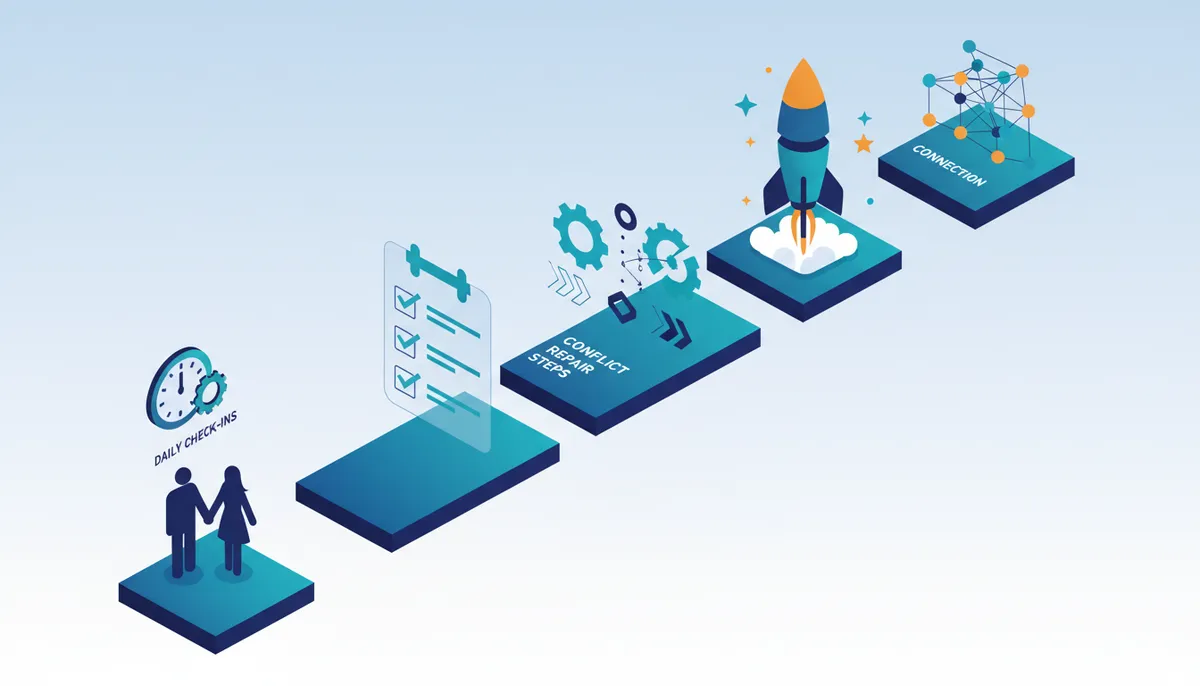
Executing Softened Startups for Conflict Repair
Initiating conversation with a "softened startup" prevents immediate defensive escalation during discussions of sexual disconnection. Partners replace accusatory phrasing like "You never want to have sex anymore" with specific vulnerability statements such as "I've been missing the closeness we share when we're intimate." This linguistic shift transforms a potential attack into an invitation for collaboration, preserving the emotional safety required for resolution.
- Initiate conversations by acknowledging personal feelings using "I" statements rather than characterizing partner behavior.
- Acknowledge each other's feelings, such as one partner feeling rejected while the other cites stress affecting their ability to relax.
- Use repair attempts, such as humor, affection, or affirming statements, to de-escalate tension.
- Collaboratively brainstorm solutions, such as scheduling intimacy or addressing underlying stressors.
Skipping this step carries a heavy price; misunderstandings around sexual intimacy persist without constructive engagement. Partners acknowledge distinct emotional realities, such as one admitting feeling rejected while the other cites stress inhibiting relaxation. Prominent researchers emphasize the importance of intentional time together and developing rituals that enhance emotional connection. Integrating these verbal repairs into broader conflict resolution rituals helps ensure consistency. This structured approach addresses the specific mechanics of desire discrepancy improved than generic advice. Execution remains the constraint; partners often revert to criticism under pressure, requiring deliberate practice to maintain the softened tone. Successful implementation aligns expectations and rebuilds the trust necessary for physical intimacy to flourish again.
Checklist for De-escalating Tension with Repair Attempts
Acknowledging feelings before proposing solutions reduces immediate tension. This validation step prevents the conflict repair process from stalling due to perceived dismissal.
- Recognize when defensiveness arises to reset emotional tone.
- State personal vulnerability using the script: "I feel rejected when we don't connect physically."
- Listen as the partner responds with their own stressor context without interruption.
- Deploy a specific repair attempt like humor or affection to lower arousal.
| Attempt Type | Function | Timing |
|---|---|---|
| Humor | Interrupts negative cycle | During escalation |
| Affection | Re-establishes safety | Post-validation |
| Affirmation | Validates partner worth | Any moment |
Couples often mistake agreement for resolution, yet validating distress differs fundamentally from conceding a point. Intentional time together predicts relationship longevity more than conflict avoidance. Explicit de-escalation prevents couples from cementing a pattern where sexual disconnection triggers unmanageable resentment. Humor may backfire if the receiving partner perceives it as dismissal rather than relief. Successful deployment depends entirely on the prior step of mutual feeling acknowledgment.
Applying Shared Sexual Meaning to Enhance Long-Term Desire
Defining Shared Sexual Meaning Through Goal Alignment
Ambiguity regarding the role of sex often sparks confusion when partners hold differing expectations. Translating abstract desires into concrete partnership objectives aligns values and goals. Couples should reserve specific time to discuss these dynamics using prompts like "What does intimacy mean to you?" or "How does physical touch make you feel closer?" Such inquiries support empathy while directly reducing misunderstandings that frequently stall connection. Sensate focus exercises similarly lower performance anxiety to boost emotional intimacy. Vulnerability remains central because partners must share inner thoughts that might otherwise stay hidden. Framing these discussions as collaborative data gathering rather than performance reviews helps maintain safety.
Executing the Collaborative Goal Setting Protocol
Partners with well-developed Love Maps maintain greater relationship stability, yet this cognitive map requires active updates to remain accurate for sexual health challenges. After reflecting on individual answers, couples must identify areas of overlap and difference before setting targets. The objective is not merely increasing frequency but deepening emotional connection during intimacy through specific, agreed-upon actions. Shared meaning creates a sustained sense of partnership in building a fulfilling sexual relationship, turning vague hopes into actionable rituals.

Structured frameworks guide these discussions without imposing rigid outcomes or commercial pressure. Understanding each other's perspectives fosters empathy, allowing partners to navigate sexual health challenges with renewed clarity. By collaboratively setting goals such as exploring new experiences, couples change abstract longing into a tangible roadmap for reconnection. This deliberate practice ensures that both partners actively participate in defining their shared sexual future.
Checklist for Integrating Gottman-Inspired Sexual Health Practices
Validate your shared meaning practice by confirming partners explicitly discuss intimacy definitions before setting goals. Use this table to audit your current communication patterns against effective conflict repair standards. John Gottman-inspired exercises provide actionable ways to deepen emotional connection, improve communication, and address sexual challenges.
| Focus Area | Ineffective Pattern | Effective Integration |
|---|---|---|
| Stress Response | Offering immediate solutions | Validating feelings without fixing |
| Bid Response | Ignoring subtle touches | Turning toward with warmth |
| Goal Setting | Assuming shared desires | Asking explicit questions |
Couples who regularly express admiration manage conflict improved and recover quickly from ruptures. Rituals of connection build the goodwill necessary to navigate these challenging moments gracefully. True integration requires translating abstract values into daily actions rather than assuming mutual understanding exists. Structured guides help partners implement these evidence-based rituals correctly. Without intentional verification of each other's inner worlds, even well-meaning exercises may fail to deepen emotional connection. Regular audits ensure your relationship framework remains resilient against external stressors.
About
Sofia Reyes is a certified sex educator and somatic intimacy coach at Mysteries.love, where she specializes in pleasure-centered education and body awareness. Her expertise makes her uniquely qualified to explore Gottman-inspired exercises for enhancing emotional intimacy, as her daily work involves guiding individuals and couples through trauma-informed approaches to connection. While the referenced article by Dr. Srinivas outlines valuable relational principles, Reyes brings these concepts to life through the specific lens of somatic practice and modern sexual wellness. At Mysteries.love, she translates complex psychological frameworks into actionable, body-based rituals that support deeper emotional and sexual safety. Her role bridges the gap between theoretical relationship psychology and the tangible, sensory experiences necessary for true intimacy. By focusing on inclusive sex education and desire discrepancies, Reyes ensures that strategies for connection are accessible and grounded in the reality of diverse human experiences, aligning perfectly with the mission to normalize conversations about sexual health and enduring love.
Conclusion
Scaling emotional intimacy breaks when couples assume mutual understanding replaces explicit verification. The ongoing operational cost of skipping daily check-ins is a slow erosion of trust that surface-level affection cannot repair. While the article outlines structured frameworks for sexual health, true durability demands prioritizing the inner world of your partner before addressing physical goals. You must treat the recommended 15-20 minute window for discussing external stress as a non-negotiable infrastructure investment rather than an optional conversation.
Implement this specific protocol immediately: dedicate the first 15 minutes of your evening exclusively to validating feelings without offering solutions or fixing problems. This discipline creates the psychological safety required for the deeper vulnerability described in proven ways to build connection. Do not attempt to integrate complex sexual health goals or goal-setting rituals until this fundamental habit consistently prevents defensive reactions during high-stress periods.
Your single action for this week is to schedule a recurring daily alert titled "Stress Window" and use that time solely to listen to your partner's external challenges without proposing answers. This deliberate pause shifts the flexible from problem-solving to presence, ensuring that any future work on shared meaning rests on a stable foundation of verified empathy rather than assumed alignment.
Frequently Asked Questions
Couples must allocate a strict window of 15 to 20 minutes daily. This dedicated time lowers tension before it blocks intimacy, ensuring external stressors do not suppress sexual desire or connection.
Partners need to write down exactly three specific traits they admire. Sharing these details reignites attraction in long-term relationships by making each person feel valued and secure in intimate settings.
Ignoring requests like a playful touch creates immediate disconnection between partners. Consistent positive responses are required to build the trust necessary for physical closeness and ongoing emotional safety.
Operating on old data causes partners to feel known for who they were. Continuous updates through deliberate inquiry prevent misinterpreting low desire as personal rejection rather than external pressure.
Knowing specific burdens prevents misinterpreting low desire as personal rejection. This cognitive alignment creates a sense of closeness that often translates into greater openness to physical intimacy and touch.
References