Friends with benefits: 38 studies on real risks
Sixty percent of individuals have experienced a friends with benefits relationship, distinguishing these ongoing encounters from one-time hookups. This SpringerLink meta-analysis argues that while such partnerships drive higher sexual activity and health risks, they simultaneously correlate with lower violence compared to other non-committed structures.
The study synthesizes 38 distinct studies to resolve decades of mixed results regarding casual sexual relationships. Unlike fleeting booty calls, these arrangements involve sex within an existing friendship without commitment expectations. Data indicates that participants in these dynamics report greater sexual features yet face increased sexual health risks. Notably, the analysis reveals that being in this specific relationship type associates with reduced aggression, challenging assumptions that casual intimacy inherently breeds conflict.
Readers will examine how gender dynamics shape outcomes, specifically where cisgender men report higher sexual engagement than women. The article further dissects the weak but present links to clinical mental health and non-clinical well-being. By mapping these five conceptual clusters, the research provides a necessary convergence for future relationship education, moving beyond anecdotal evidence to define the actual safety and psychological profile of modern uncommitted intimacy.
Defining Friends with Benefits Relationships Within the Spectrum of Casual Sexual Interactions
FWBRs Set as Sex Within Existing Friendship Without Commitment
Friends with benefits relationships (FWBRs) are not hookups; they are friendships that added sex. The definition hinges on a pre-existing platonic bond where romantic commitment expectations remain absent. This friends-first initiation creates a unique intersection of intimacy and nonexclusivity, separating the flexible from stranger-based encounters. Approximately 60% of individuals surveyed have experience with this arrangement, confirming its prevalence across adult demographics. The arrangement explicitly lacks an obligation to build a shared romantic life, distinguishing it from committed romantic relationships where partners frequently negotiate exclusivity. Only 43% of romantic couples explicitly discuss sexual boundaries. FWBR participants often avoid the topic entirely to preserve the underlying platonic bond.
Researchers apply Multiple Linear Regression analysis to isolate expectation fulfillment as a primary predictor for relationship continuity. Statistical approaches confirm that successful FWBRs depend on aligned definitions of the lack of commitment between partners. A typology containing seven distinct types further illustrates variance in nonsexual interaction levels among these dyads. Asymmetric expectations introduce operational risk; one party often desires romantic escalation while the other seeks maintained friendship. Longitudinal outcomes show that only 15% of those desiring romance achieve it, whereas 59% successfully revert to friendship. The remaining 31% dissolve completely into no relationship, highlighting the fragility of the arrangement when definitions diverge. Operators in social dynamics must recognize that the sexual activity component introduces aggression risks absent in pure friendships. Clear boundary maintenance prevents interpersonal violence.
Distinguishing FWBRs From One-Time Hookups and Stranger-Based Casual Sex
Friends with benefits relationships require pre-existing platonic bonds, separating them from stranger-based casual sex initiated through immediate attraction. Initiation patterns reveal a structural divide. Two-thirds of crowdsourced adults reported initiating romance through friendship. Casual hookups often function as one-time events with strangers lacking this relational foundation. This friends-first model creates a distinct trajectory where participants maintain social connectivity even after sexual intimacy ceases. Unlike transient encounters, the majority of FWBRs continue as friendships after sexual activity ends, preserving the underlying social network. Stranger-based interactions rarely sustain such post-coital social connectedness, frequently dissolving into non-relationships immediately.
| Feature | FWBRs | One-Time Hookups |
|---|---|---|
| Initiation Source | Existing Friend Circle | Strangers / New Acquaintances |
| Encounter Frequency | Ongoing / Repeated | Single Event |
| Post-Sex Outcome | Sustained Friendship | Social Dissolution |
| Emotional Baseline | Established Trust | Minimal Connection |
Operational definitions matter because risk profiles diverge sharply. A study of Canadian college students on spring break observed real-time behavior, finding that among those planning casual sex, 61% of men engaged in intercourse within 24 hours of meeting a partner. This rapid escalation characterizes stranger-based encounters but contradicts the slow-burn nature of FWBRs. Grouping FWBRs with hookups obscures the protective effect of prior friendship on violence reduction. Researchers must isolate the friendship variable to accurately assess mental health outcomes. Conflating these distinct relationship types yields noisy, unreliable data regarding sexual safety and emotional well-being.
Longitudinal tracking reveals that the friendship retention rate vastly outpaces romantic conversion, challenging the assumption that sexual intimacy inevitably drives commitment. This divergence highlights an operational reality: participants aiming for romance face steep odds, yet those prioritizing the underlying connection achieve their goal more often. Data indicates that post-relationship outcomes favor continued association over total estrangement or romantic escalation. Unlike stranger-based encounters, FWBRs use pre-existing social capital to sustain interaction after sex ceases. Hookups with casual acquaintances rarely result in sustained friendship, creating a sharp contrast in long-term social utility. The structural difference lies in the foundation. FWBRs begin with established trust, allowing the relationship to absorb the removal of sexual activity without collapsing. Expecting a shift toward committed romantic relationships ignores the statistical likelihood of failure. Recognizing the high probability of friendship survival offers a more stable framework for managing expectations and maintaining mental well-being.
Sexual Features and Gender Dynamics Driving Outcomes in Non-Committed Partnerships
Greater Sexual Features and Reduced Violence in FWBR Mechanics
Friends with benefits relationships (FWBRs) generate higher sexual feature density while suppressing aggression compared to other relationship types. This flexible operates through a specific structural constraint: participants maintain existing friendship bonds that pre-date sexual activity, creating a buffer against the volatility seen in stranger-based encounters. The mechanism relies on established trust protocols that reduce the likelihood of physical conflict, even as sexual frequency increases. Data confirms that being in such an arrangement correlates with lower levels of violence and aggression across studied cohorts.
The limitation is elevated exposure to sexual health risks, a direct consequence of reduced barrier usage within trusted circles. Romantic couples often negotiate exclusivity, yet FWBR participants frequently avoid these discussions, leading to ambiguous safety boundaries. This avoidance creates a vulnerability where sexual health risks accumulate despite the low aggression environment. Approximately 50% of participants report feeling closer t o their partner after intimacy ceases, reinforcing the post-relationship outcome of sustained friendship rather than estrangement. Operators of these social dynamics must recognize that low violence does not equate to low risk. The mechanical success of maintaining friendship often comes at the cost of explicit risk mitigation dialogues.
Cisgender men report greater sexual features in FWBRs than cisgender women, creating a measurable expectation gap. This disparity manifests through divergent escalation timelines and satisfaction metrics. Men frequently prioritize rapid physical intimacy, whereas women often emphasize the maintenance of the underlying friendship bond. Research indicates that among individuals planning casual encounters, 67% of men engage in intercourse within 24 hours, contrasting sharply with the 33% of women who follow similar rapid trajectories. This misalignment generates friction when sexual pacing expectations diverge. The meta-analysis published in Archives of Sexual Behavior 1007/s10508-026-03426-0) confirms that men consistently rate these arrangements higher on sexual frequency scales.
Operationalizing these differences requires distinct study methodologies to capture accurate data. Researchers must separate partner types rather than grouping all casual sex under a single umbrella, as recommended by PMC studies. Aggregating data obscures the specific mental health impacts tied to gendered expectations. The structural consequence involves a hidden risk profile for female participants. Higher sexual activity without matched emotional investment correlates with increased aggression risks in some cohorts. Men may perceive the arrangement as purely transactional, while women anticipate relational stability. This tension remains unresolved in standard relationship education. Ignoring these divergent profiles leads to ineffective counseling interventions. Practitioners must address the expectation mismatch directly to mitigate potential harm. Failure to distinguish these experiences perpetuates ambiguous norms that disadvantage both parties.
Mental Health Impacts and Aggression Risks Associated with Casual Relationship Structures
Weak Association Between FWBRs and Clinical Mental Health Outcomes
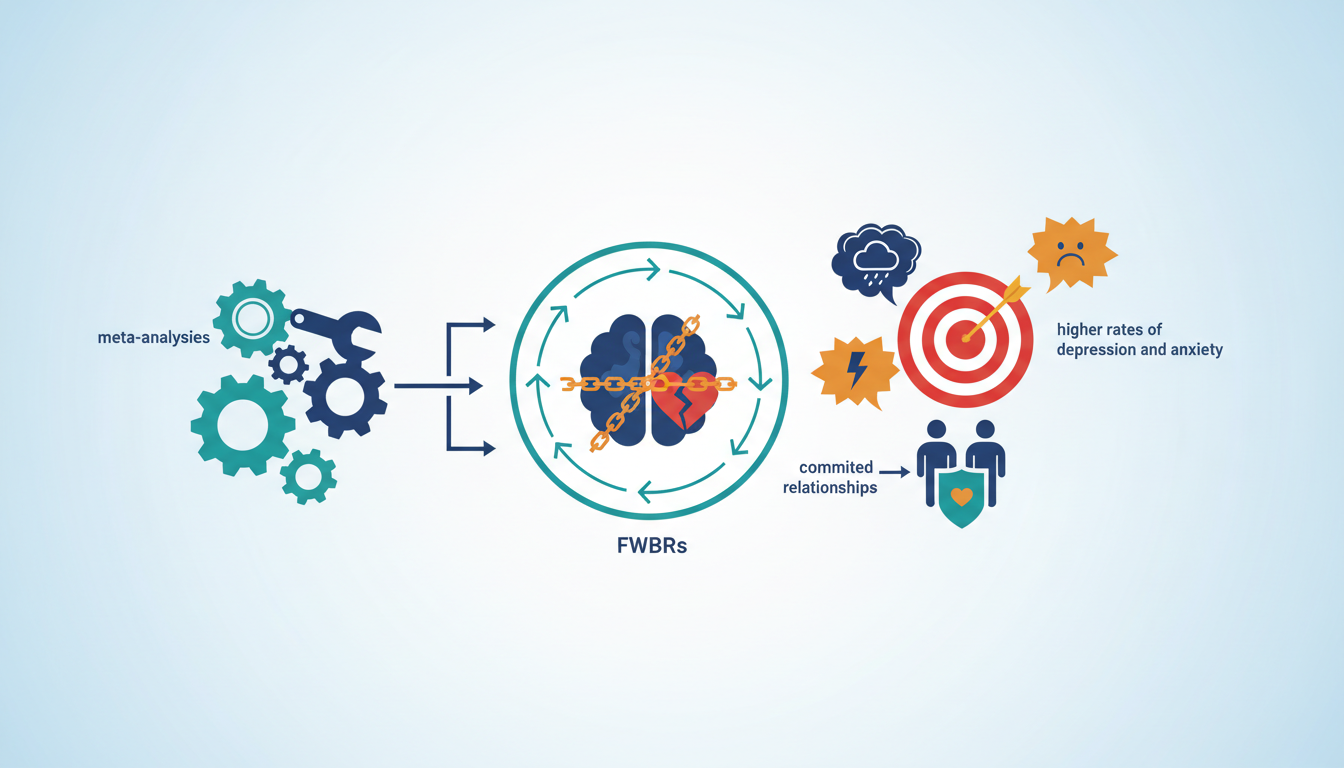
Meta-analysis data confirms a weak correlation between FWBR participation and clinical mental health indicators rather than severe pathology. This distinction separates transient emotional fluctuations from diagnosable disorders, clarifying that sexual intimacy within friendship does not inherently degrade psychological stability. Research moves away from grouping all casual sex under a single hookup umbrella to improved isolate these specific mental health impacts. The findings indicate that while non-clinical mental health metrics show variance, they rarely cross thresholds requiring medical intervention. Operators in relationship education must recognize that the primary risk profile involves sexual health rather than psychiatric collapse. Broader social science suggests strong platonic bonds predict longevity in older men, implying the friendship component may buffer potential stressors. Editorial Mission recommends focusing intervention resources on communication protocols instead of psychological screening. The trade-off is accepting higher sexual activity volumes while monitoring for aggression spikes, which remain lower than in other casual structures.
Applying Meta-Analysis Data to Assess Violence and Aggression Risks
Risk assessment frameworks must prioritize the lower levels of violence 1007/s10508-026-03426-0) observed in friends with benefits arrangements compared to other casual structures. Practitioners evaluating safety profiles should note that aggression risks diminish when sexual activity occurs within pre-existing friendships rather than stranger encounters. Data indicates that only 34% of women engage in rapid intercourse timelines, contrasting with male patterns that often accelerate physical intimacy. This divergence creates a pacing mismatch that requires explicit communication to prevent conflict escalation. Operators must distinguish these dynamics from one-time hookups where trust protocols are absent.
| Risk Factor | FWBR Profile | Stranger Hookup Profile |
|---|---|---|
| Physical Aggression | Low | Moderate to High |
| Emotional Continuity | High | None |
| Trust Baseline | Established | Absent |
The limitation lies in the lack of sexual exclusivity discussions, as fewer than half of such pairs define boundaries explicitly. Safety evaluations must account for this ambiguity, which can obscure consent violations despite lower physical violence rates. Participants often retain closeness after sexual cessation, suggesting that social buffers mitigate retaliation risks common in dissolved romantic pairings. However, the weak association with clinical mental health outcomes means practitioners cannot assume psychological safety solely based on reduced aggression. Editorial Mission recommends integrating these meta-analysis findings into relationship education curricula to refine risk stratification models for non-committed structures.
Elevated Sexual Health Risks Despite Reduced Interpersonal Aggression
Meta-analysis confirms increased sexual health risks in FWBRs despite lower violence rates compared to other relationship types. Participants face higher exposure to sexually transmitted infections because only a minority explicitly negotiate exclusivity protocols before intimacy begins.
| Risk Factor | FWBR Profile | Romantic Couple Profile |
|---|---|---|
| Physical Aggression | Low | Moderate |
| STI Exposure | High | Variable |
| Exclusivity Talks | Rare | Frequent |
| Emotional Safety | Moderate | High |
Research distinguishing partner types in casual sexual relationship experiences reveals that grouping all casual encounters obscures this specific danger signal. Operators in sexual education must address the false security provided by emotional familiarity, which often suppresses necessary risk mitigation dialogues. The Archives of Sexual Behavior 1007/s10508-026-03426-0) publication highlights this divergence as a critical gap in current counseling frameworks. Editorial Mission recommends implementing mandatory pre-intimacy checklists for individuals entering these arrangements to counteract complacency.
Methodological Frameworks for Synthesizing Inconsistent Data on Casual Relationships
Defining the Omnibus Meta-Analysis Scope for FWBR Research
Execute an omnibus meta-analysis by aggregating 38 systematically identified studies to resolve conflicting data on friends with benefits relationships. This methodological approach filters two decades of mixed results into five conceptual clusters, creating a unified dataset for comparative analysis. Scholars must apply Multiple Linear Regression techniques to isolate statistically significant parameters regarding expectation fulfillment and re-engagement willingness (quantitative study) The framework validates a seven-type typology
- Screen literature for explicit FWBR definitions excluding one-time stranger encounters.
- Code variables across sexual health, violence, and mental health domains.
- Normalize effect sizes to enable cross-disciplinary comparison.
The limitation is that conceptual clustering requires discarding studies lacking standardized measurement tools, potentially reducing sample depth. Operators using this scope gain a baseline for distinguishing FWBRs from casual hookups, ensuring analytical consistency. Future research must adhere to these strict inclusion criteria to prevent data contamination from undefined casual arrangements.
Executing Systematic Study Selection Using Asterisk Markers
Mark references with an asterisk to designate the 38 studies qualifying for the omnibus meta-analysis dataset. This visual indicator separates included literature from excluded works, ensuring reproducibility during the verification phase. The process requires filtering papers that examine sexual activity within existing friendships without commitment expectations.
- Identify candidate papers mentioning cross-sex friendship dynamics and sexual behaviors.
- Verify the absence of romantic commitment clauses in the study methodology.
- Append an asterisk to the citation in the final reference list upon confirmation.
Specific entries like Akbulut, V. & Weger, H. Jr. (2016) receive this marker after confirming their focus on escalation bids rather than romantic transitions.
Execute this validation protocol to segregate true friends with benefits dynamics from stranger-based hookups before meta-analysis aggregation.
- Verify the emotional connection persists beyond single encounters, distinguishing the sample from transient casual acquaintance interactions.
- Confirm participants lack expectations for a shared romantic future, as commitment absence defines the structural boundary of these arrangements.
- Assess whether the pair maintains social ties after intimacy ceases, since most such relationships revert to sustained friendship rather than dissolving completely.
Researchers must differentiate these ongoing encounters from one-time events to prevent data contamination. The analysis reveals that FWBRs involve less commitment level than romantic couples, creating a unique risk profile often misclassified in broader studies. Ignoring this distinction inflates aggression metrics by conflating friend-based safety with stranger-based volatility.
| Criterion | FWBR Requirement | Hookup Profile |
|---|---|---|
| Pre-existing Bond | Mandatory | Absent |
| Post-Sex Contact | Frequent | Rare |
| Exclusivity Talk | Infrequent | Variable |
Editorial Mission recommends applying this filter to resolve the mixed results plaguing current literature Synthesizing inconsistent data demands strict adherence to these definitional constraints.
About
Dr. Ethan Voss serves as a Relationship Psychologist and Intimacy Educator at mysteries. Love, where he specializes in attachment theory and the neuroscience of desire. His extensive background as a former researcher at the University of Amsterdam's Department of Social and Behavioral Sciences uniquely qualifies him to analyze complex data on friends with benefits relationships (FWBRs). This meta-analysis directly aligns with his daily work dissecting how casual sexual dynamics impact mental health and relational aggression. By bridging rigorous academic findings with practical intimacy education, Dr. Voss helps readers navigate the detailed emotional landscapes of modern connections. His role at mysteries. Love, operated by the Center for the Development of Intimate Relationships, ensures that this evidence-based review transcends theoretical discussion to offer actionable insights for adults seeking clarity in non-committal partnerships. This synthesis of clinical expertise and contemporary research provides a trusted foundation for understanding FWBR outcomes.
Conclusion
Scaling these arrangements reveals a critical break point: the emotional latency between casual intimacy and romantic expectation often exceeds the durability of the underlying friendship. While many assume nonexclusivity simplifies dynamics, the operational cost is actually higher due to the constant, unspoken negotiation of boundaries that romantic couples explicitly formalize. The data suggests that attempting to force a romantic outcome from this framework is statistically inefficient, whereas preserving the platonic foundation offers a far more stable long-term asset. You should abandon the strategy of using casual intimacy as a probationary period for romance if no explicit definition occurs within three months. Instead, treat the arrangement as a distinct category requiring its own maintenance protocol, separate from both dating and standard friendship. Start by auditing your current undefined relationships this week to determine if a written or verbal boundary agreement exists; if one does not, initiate that conversation within 48 hours or deliberately dissolve the intimacy component to save the social tie. This immediate clarification prevents the slow erosion of trust that occurs when assumptions replace clear communication.
Frequently Asked Questions
Only a small minority of participants successfully transition these arrangements into committed romance. Longitudinal outcomes show that only 15% of those desiring romance achieve it, while most others revert to friendship or end the connection entirely.
The majority of these dynamics successfully revert to a non-sexual friendship after intimacy ends. Data indicates that 59% of participants successfully revert to friendship, preserving the social bond despite the cessation of sexual activity.
A significant portion of these arrangements dissolve entirely when expectations regarding commitment diverge between partners. The remaining 31% dissolve completely into no relationship, highlighting the fragility of the arrangement when definitions do not align.
These arrangements are highly common across various adult demographics and social circles. Approximately 60% of individuals surveyed have experience with this arrangement, confirming its status as a widespread form of casual sexual interaction.
Romantic partners are more likely to explicitly negotiate sexual boundaries than those in casual arrangements. Only 43% of romantic couples explicitly discuss sexual boundaries, whereas FWBR participants often avoid the topic to preserve the platonic bond.