Arousal anchors: Use scent to trigger desire fast
You can trigger desire quicker by pairing a specific scent with climax, a method backed by neurological conditioning.
Arousal anchors cut the wait for spontaneous libido. They are deliberate sensory shortcuts. This approach solves the responsive desire problem: needing an external signal to start the engine rather than waiting for it to turn over on its own. The brain's limbic system and hypothalamus wire these associations hard. A scented candle stops being background noise and becomes a switch for erotic focus.
Here is the mechanics of that wiring. Consistent pairing of stimuli builds lasting pathways for pleasure. This matters most when stress kills the mood; anchored cues create the conditions for arousal instead of hoping for luck. We will walk through constructing personalized cues that remain effective tools for consistent intimacy without becoming chores. It is a practical fix for modern constraints, using psychological principles to make connection efficient.
The Neurological Foundation of Arousal Anchors and Responsive Desire
Arousal Anchors as Limbic System Shortcuts
An arousal anchor is a engineered sensory cue designed to elicit desire instantly. Angie Rowntree defines this as a trigger working at the drop of a dime. The mechanism sidesteps the need for spontaneous hormonal surges by hijacking established neural pathways. The limbic system handles emotion and memory. The hypothalamus regulates hormones like oxytocin and dopamine. Both regions react sharply to specific sensory inputs. When you consistently pair a distinct stimulus with sexual pleasure, the brain wires these elements together. The result is a reliable shortcut.
Scent Pairing to Trigger Dyadic Arousal
Inhale a specific fragrance while on the brink of climax. Later, that scent alone evokes erotic focus. This scent pairing technique creates an arousal anchor by conditioning the brain to link a neutral smell with peak physical pleasure. Partners initiate dyadic arousal when they share this cue. One person's physiological readiness directly influences the other's emotional and sexual response.
Research using image sets confirms the power of this association. Positive valence stimuli yield a mean arousal rating of 5.53, while neutral images yield a rating of 4.09. Couples change a simple odor into a potent neurological trigger by linking a candle's scent to these high-arousal moments. This bypasses the latency of spontaneous desire. However, the efficacy depends entirely on consistency. Irregular use dilutes the association. Caution is required here: individuals with a history of sexual trauma may find forced sensory conditioning distressing. Build these shared rituals with care and consent.
Spontaneous vs Responsive Desire Mechanisms
Responsive desire needs external cues to start. It does not emerge spontaneously from internal hormonal drives. Waiting for unprompted libido often fails under stress. Anchored stimuli reliably activate the nervous system's readiness pathways instead. The limbic system connects specific sensory inputs with pleasure, creating a neurological shortcut that bypasses the need for high-energy hormonal surges.
| Feature | Spontaneous Desire | Responsive Desire |
|---|---|---|
| Trigger Source | Internal hormonal fluctuation | External sensory cue |
| Onset Speed | Immediate and unprompted | Requires warm-up period |
| Reliability | Variable during stress | High with conditioning |
| Energy Cost | Low biological barrier | Lowered by anchors |
Relying solely on biological spontaneity leads to inconsistent access to intimacy when life demands increase. Engineered arousal states replace this uncertainty with predictable physiological responses. You stop hoping for desire and start constructing the conditions where it flourishes. Finding an effective anchor takes time and experimentation, especially for those diagnosed with hypoactive sexual desire disorder. But the strategic advantage is clear: desire often follows action rather than preceding it. Partners mitigate the friction of mismatched libidos and reduce the emotional labor of initiation by deploying these cognitive-behavioral tools. This mechanism proves vital when hormone-driven spontaneous desire remains inaccessible due to exhaustion or lifecycle changes.
Mechanisms of Sensory Association in Activating Sexual Readiness
Limbic Processing and Autonomic Arousal Pathways
Smell and sound trigger the limbic system to process emotion and memory. The hypothalamus manages hormones like oxytocin and dopamine. These brain regions react sharply to sensory input, forging a path where a specific scent evokes arousal, anticipation, or erotic focus. Biology challenges the idea that desire must be spontaneous. Consistent pairing of sensory input with pleasure allows the brain to connect them, creating a shortcut to physical readiness.
Recent studies have identified Galanin-expressing spinal neurons that independently drive ejaculation and regulate arousal, challenging the traditional brain-centric view of sexual response. The brain manages complex emotional context, yet established anchors offer a direct route for physical response when desire feels inaccessible. Establishing these pathways requires consistent pairing. The result is a strong mechanism functioning even when the hormonal environment is quiet or during times of stress. Effective intimacy practices must target these sensory-neural links rather than waiting for mental readiness to descend from the brain.
Hormonal surges vary wildly compared to the steadiness of neural associations. Unlike broad environmental changes, this targeted approach isolates variables to create reliable neural shortcuts. Stimulus intensity clashes with consistency; establishing an anchor requires repetition of the experience, with the number of repetitions needed depending on the level of intensity of the initial association. The technique relies on psychological conditioning, yet there are no direct monetary costs associated with the method itself, as it uses existing sensory inputs rather than purchased products.
Individual variability in sensory processing means a cue effective for one person may remain neutral for another. Successful deployment requires iterating through different modalities to find the specific anchor that reliably triggers the desired cognitive labeling of arousal. Physiological arousal is technically set by measurable increases in heart rate, blood pressure, and respiration rate, alongside specific genital sensations.
> [!NOTE] > This content provides educational information on intimacy techniques and does not constitute professional therapy or medical advice. Consult a qualified healthcare provider for personal health concerns.
Applying Persuasion Index VAD Scales to Sensory Cues
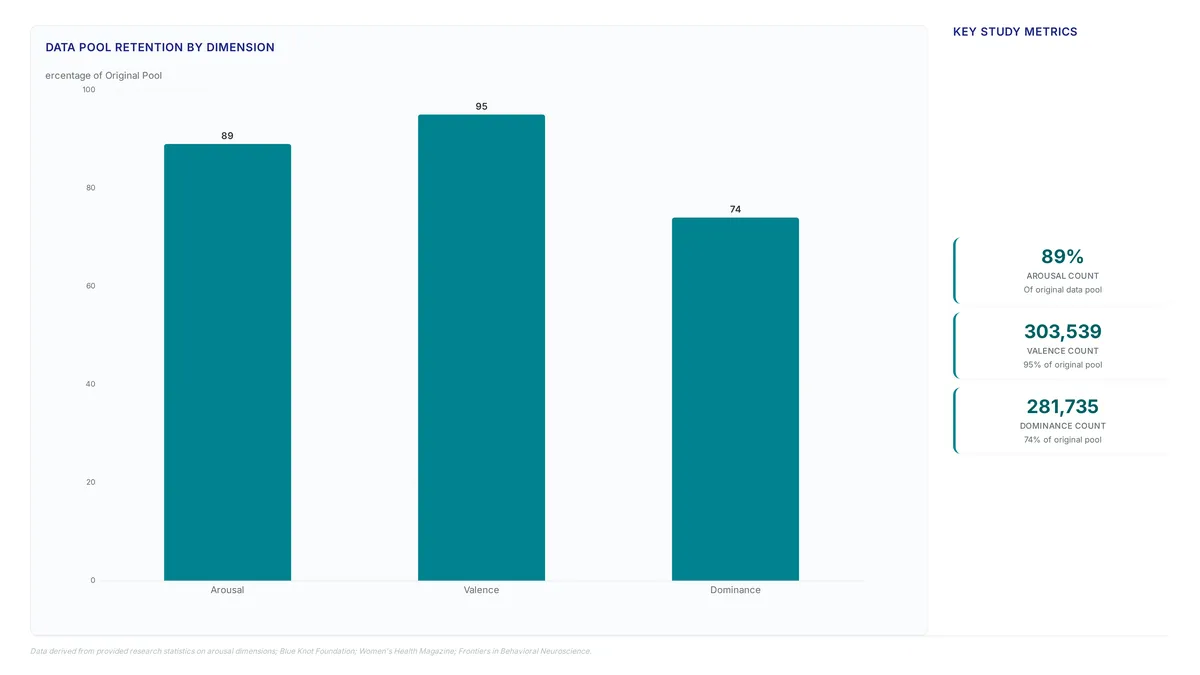
Mapping sensory inputs to the Persuasion Index framework quantifies how specific scents and sounds shift cognitive processing states. This system evaluates stimuli across valence, arousal, and dominance scales to predict their impact on sexual readiness. Researchers apply this framework alongside discrete emotions like joy or fear to analyze how external cues influence internal physiological states. The final data set for normative arousal ratings consisted of 339,323 observations specifically for the dimension of arousal, representing a significant majority of the original data pool collected for linguistic analysis. Individuals can apply these metrics by selecting cues that naturally elicit a positive emotional response to maximize engagement.
Positive Valence Images vs Neutral Stimuli Arousal Ratings
Controlled studies using image sets confirm that positive valence images yield a mean arousal rating of 5.53 (± 0.56), while neutral images produce a notably lower baseline of 4.09. This quantitative gap demonstrates that positive valence sensory inputs effectively bridge the gap for responsive desire by providing the specific energy required to activate readiness. Neutral stimuli lack the same immediate emotional charge, often requiring more time, effort, and experimentation to find what works or to build a strong association.
Personal history drives the elevation found in individual anchors. High-intensity cues yield quicker results, but the investment of time is a significant non-monetary cost, as establishing an anchor requires repetition of the experience. Individuals addressing low libido should prioritize high-valence cues initially to establish the neural pathway before introducing neutral elements. Effective protocols may involve experimenting with different cues to maintain the physiological response threshold above the neutral baseline.
Constructing Personalized Sensory Cues for Consistent Intimacy
Selecting Unique Sensory Cues Beyond Common Triggers

Effective anchors require specificity drawn from personal history rather than generic stimuli found in daily life. Dr. Oreck explains that desire activation depends on individual associations, meaning a cue must lack common external links to function as a reliable trigger. Generic scents or sounds often fail because they carry conflicting neurological data from non-intimate contexts. Operators should audit their sensory environment to identify inputs exclusive to erotic moments.
- Evaluate which of the five senses holds the strongest memory connection for you.
- Select a stimulus absent from your routine work or leisure activities.
- Ensure the chosen cue is distinct enough to avoid accidental activation.
This approach differentiates targeted libido tools from general relaxation techniques designed to lower stress. Unlike broad calming methods, a unique anchor triggers a high-arousal state specifically associated with intimacy. There are no direct monetary costs for this psychological method, as it uses existing sensory inputs like a specific gesture or word. The limitation lies in the discipline required to maintain exclusivity; using the cue outside intimate settings dilutes its potency. Partners must agree to keep the trigger contextually pure to preserve its neurological impact. This intentional selection process transforms abstract intention into tangible readiness without relying on spontaneous hormonal surges. By avoiding common triggers, individuals create a dedicated pathway for responsive desire that bypasses the noise of everyday stressors. The result is a consistent, low-effort entry point into sexual connection.
Constructing a Sex Playlist and Scent Pairing Routine
Build a sensory protocol by selecting five to ten slow-paced songs with minimal lyrics to serve as an auditory gate. This specific curation limits cognitive load while establishing a consistent rhythmic baseline for responsive desire. Smell functions as a potent neurological trigger because the olfactory bulb connects deeply to the limbic system, bypassing the processing layers other senses navigate. Partners might choose a floral perfume resembling an anniversary bouquet to explicitly link the fragrance to a romantic memory.
- Compile an audio queue of instrumentals or frequency sound baths devoid of distracting vocals.
- Identify a scent exclusive to intimacy that avoids contamination from daily household products.
- Apply the fragrance and initiate the playlist only when transitioning toward physical connection.
This routine uses existing sensory inputs rather than requiring purchased technology to create effective sexual meetups. Unlike general relaxation methods aiming to lower stress, these targeted cues trigger a specific high-arousal state associated with libido. A critical limitation emerges if the chosen scent is worn to work or social events, causing accidental activation that dilutes the erotic association. Consistency in pairing is the only mechanism that converts a neutral stimulus into a reliable shortcut for arousal.
Validating Cue Specificity Against Limbic Processing Paths
Verify candidate cues by ensuring they bypass standard cognitive filtering to directly engage the limbic system. Since the olfactory bulb connects deeply to emotional centers, selecting a unique scent often bypasses the processing layers other senses navigate.
- Audit your daily environment to eliminate stimuli shared with work or non-intimate leisure.
- Choose a specific perfume or candle that holds no prior association outside erotic contexts.
- Confirm the cue triggers anticipation before physical contact begins, acting as a neurological shortcut.
Generic inputs frequently fail because they carry conflicting data from routine activities, diluting their potency as arousal anchors. The Persuasion Index framework maps these affective scales to analyze how discrete emotions like joy influence cognitive processing states.
| Validation Step | Goal | Failure Mode |
|---|---|---|
| Exclusivity Check | Ensure zero non-sexual usage | Accidental activation during dinner |
| Intensity Test | Measure immediate physiological shift | Requires prolonged exposure to work |
| Consistency Audit | Verify repeatable pairing | Variable results based on mood |
A critical limitation arises when partners share cues that one individual encounters daily, causing the brain to reject the signal as noise rather than a trigger. Practitioners must prioritize distinctiveness over convenience to maintain reliable pathway activation.
Strategic Application of Arousal Anchors for Libido Challenges and Trauma Recovery
Responsive Desire and the Arousal Anchor Shortcut
External signals initiate the physiological shift from neutral to ready for individuals with responsive desire styles. Dr. Sarah Oreck notes that many people express a wish to want intimacy yet struggle to reach that state without a catalyst. An arousal anchor functions as a deliberate neurological shortcut for these individuals. This mechanism bypasses the need for spontaneous hormonal surges that stress often suppresses. Consistently pairing a specific sensory input with moments of pleasure wires a direct pathway in the brain toward physiological readiness. The process activates emotional and physical circuits associated with pleasure. It effectively creates the conditions desire needs to emerge rather than waiting for desire to lead the way.
Purely hormone-driven spontaneity demands high energy levels that daily life frequently depletes. This cognitive-behavioral approach transforms abstract intention into tangible somatic response through repeated association. Specific sensory cues might inadvertently trigger distress or dissociation instead of safety for survivors of sexual trauma. Individuals diagnosed with hypoactive sexual desire disorder may also find standard conditioning insufficient without professional guidance.
Operators must recognize that anchors accelerate access to desire only when they maintain strict exclusivity to avoid neurological dilution. A scent used daily for work cannot effectively signal erotic safety. Select stimuli entirely absent from non-intimate contexts to maintain the integrity of the neural association.
Trauma-Informed Anchor Deployment for Safety Signaling
Consistent sensory cues signal safety to the limbic system before sexual activity begins. This prevents the nervous system from flipping its lid. Dr. Sarah Oreck explains that survivors often struggle to access desire because their bodies prioritize threat detection over pleasure. Establishing a Window of Tolerance allows an individual to endure feelings without dissociating or becoming overwhelmed. Specific sensory anchors trigger a targeted state of safety associated with intimacy unlike general relaxation techniques designed to lower arousal.
Introducing erotic stimuli too quickly can reinforce avoidance pathways rather than creating new connections. Individuals diagnosed with hypoactive sexual desire disorder or complex PTSD may find self-guided anchoring insufficient without professional support. Working with a specialist helps navigate the tension between seeking pleasure and managing trauma responses in these cases. Personal history shapes what activates desire. This reality requires a customized protocol rather than a universal solution. That input becomes a reliable shortcut to physiological readiness when the brain successfully links a specific cue to a state of calm. This deliberate signaling allows the hypothalamus to regulate hormones like oxytocin without interference from stress responses. Partners should view this process as building a shared language of safety rather than rushing toward intercourse. Stopping immediately preserves the integrity of the safety signal if distress arises during deployment. Professional guidance remains necessary when past trauma complicates the ability to distinguish between safety and danger signals.
Validating Anchor Efficacy for Libido Challenges
Measure anchor success by determining whether a specific sensory cue lowers the energy required to kickstart desire without professional intervention. A functional arousal anchor makes the body more responsive to touch. It becomes easier to tap into desire. This effectively bridges the gap for responsive desire styles. The strategy may require adjustment if repeated pairing of a cue with pleasure fails to create a neurological shortcut after significant effort. Self-directed anchoring might cause distress rather than relief for individuals diagnosed with hypoactive sexual desire disorder or those navigating sexual trauma. Working with a professional who specializes in sexual dysfunction provides necessary safety and tailored experimentation in these scenarios.
| Indicator | Self-Management Viable | Professional Support Recommended |
|---|---|---|
| Response to Cue | Cue triggers anticipation or erotic focus | Cue induces anxiety, numbness, or no change |
| Desire Style | Responsive desire needing warm-up | Hypoactive sexual desire disorder diagnosis |
| Trauma History | No active trauma triggers present | History of sexual trauma causing distress |
| Outcome Goal | Enhanced intimacy and synchronization | Safety stabilization and trauma processing |
Persistence conflicts with pathologizing normal variation. Anchors activate nervous system pathways even when hormones are not driving spontaneity. Forcing a cue that triggers a trauma response reinforces avoidance rather than building pleasure. Users should seek specialized guidance if the attempt to create conditions for desire consistently results in emotional withdrawal.
About
Sofia Reyes, a certified sex educator and somatic intimacy coach at mysteries.love, brings specialized expertise to the discussion of arousal anchors. Her daily practice centers on somatic approaches and body awareness, making her uniquely qualified to explain how sensory cues can bypass mental barriers to desire. As a relationship writer focused on pleasure-centered education, Reyes routinely helps individuals navigate desire discrepancies by grounding intimacy techniques in physical reality rather than abstract theory. This article directly reflects her professional work guiding adults through trauma-informed methods to reclaim their sexual agency. At mysteries.love, a platform dedicated to evidence-based intimacy education, Reyes connects modern sexual wellness research with practical tools for couples. Her background ensures that the concept of arousal anchors is presented not just as a quick fix, but as a psychologically sound strategy for maintaining connection in long-term relationships, aligning perfectly with the blog's mission to normalize conversations about sexual health and desire.
Conclusion
Neurological conditioning fails when users treat anchors as universal triggers rather than personalized signals. Ignoring this distinction reinforces avoidance behaviors, particularly when a chosen cue inadvertently activates distress instead of desire. While Metro News highlights this method for overcoming exhaustion, success depends entirely on the user's ability to distinguish between safety and danger signals without professional oversight. Stop applying generic sensory inputs if your body responds with numbness or anxiety rather than anticipation.
Implement a strict evaluation period of two weeks to test your chosen stimulus. If the cue does not lower the energy required to initiate desire within this timeframe, discontinue the practice immediately and consult a specialist in sexual dysfunction. This timeline prevents the cementing of negative associations that can worsen libido challenges over time.
Start by documenting your physiological response to a specific scent or sound before attempting to use it during intimacy this week. Record whether the sensation creates erotic focus or emotional withdrawal to determine if self-management is viable for your specific history. This data point dictates whether you proceed alone or seek tailored guidance to ensure safety.
Frequently Asked Questions
No single scent is universally best for everyone. You must choose a fragrance you do not wear daily to ensure the cue remains distinct and effective for triggering your personal desire.
Individuals with sexual trauma may find forced conditioning distressing rather than helpful. Professional guidance is often required to navigate these triggers safely without causing emotional harm or re-traumatization during the process.
The article does not specify a exact timeline for wiring pathways. Consistency is the critical factor, as irregular use dilutes the association and prevents the brain from forming a reliable shortcut.
Occasional use will likely fail to create a lasting neurological connection. You must consistently pair the stimulus with pleasure to solidify the neural pathway and bypass the need for spontaneous hormonal surges.
Partners may not share identical sensory associations or responsive desire styles. Each individual should construct their own personalized cues to ensure the anchor effectively triggers their specific physiological readiness for intimacy.
References